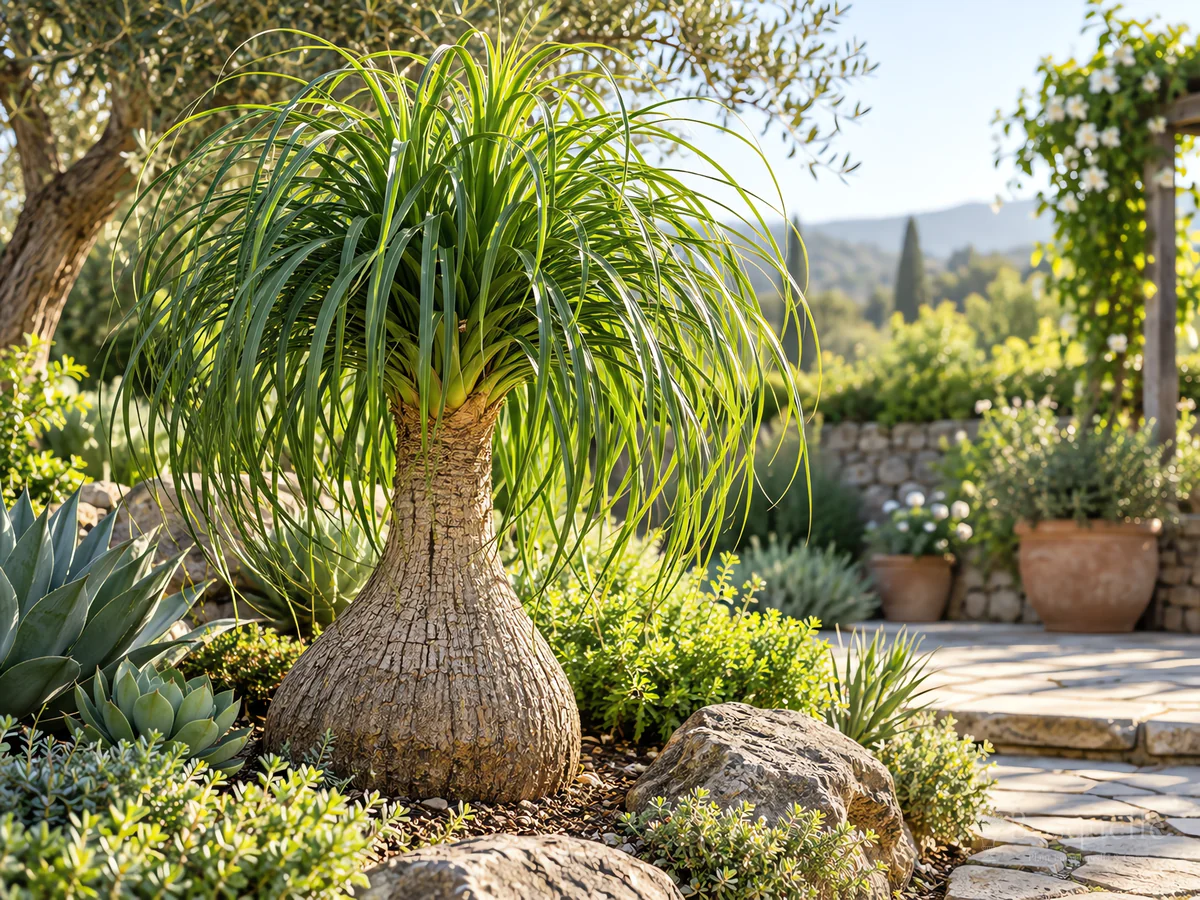
Grow ponytail palm in a bright window, in cactus mix, and water only when it is dry. Ponytail palm here is Beaucarnea recurvata, also sold as elephant's foot and sometimes labeled Nolina recurvata — not a true palm, and not yucca.
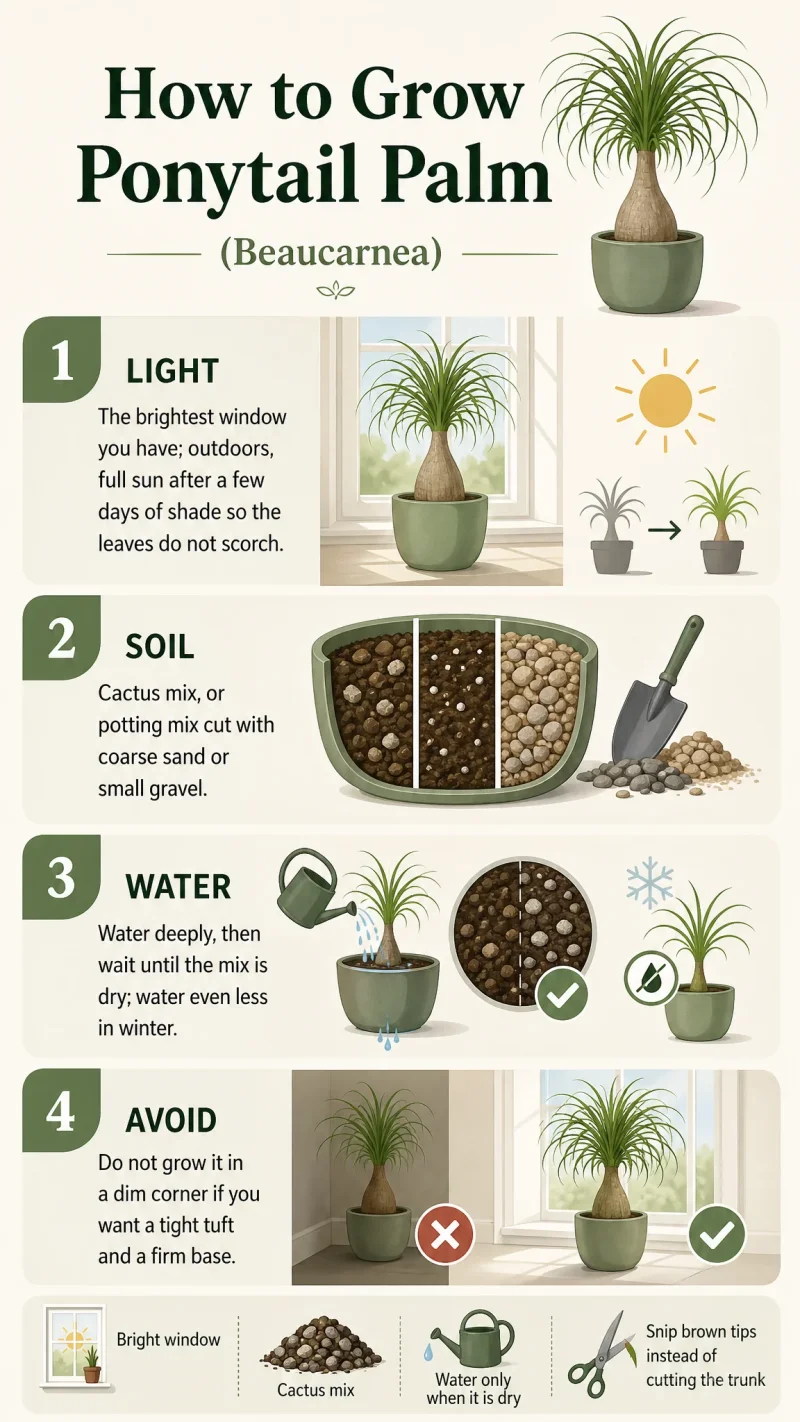
Give it a bright window and cactus mix, and water only when it is dry
| Factor | Recommended | Avoid |
|---|---|---|
| Light | The brightest window you have; outdoors, full sun after a few days of shade so the leaves do not scorch | Do not grow it in a dim corner if you want a tight tuft and a firm base |
| Water | Water deeply, then wait until the mix is dry; water even less in winter | Do not keep the mix wet, and do not leave a saucer of water under the pot |
| Soil | Cactus mix, or potting mix cut with coarse sand or small gravel | Do not plant in heavy, wet soil |
| Drought | Skip extra water once the swollen base is storing moisture | Do not water on a calendar while the mix is still wet |
| Winter | Keep it above about 50°F, and hold back water | Do not leave it against freezing glass, and do not leave it out for a frost |
Give ponytail palm the brightest seat in the room and mix that dries between waterings. Soggy mix around the roots is the primary cause of root rot, because the swollen base already stores water. [1] A south window is the usual indoor home. Move a pot outdoors for the summer only after nights stay warm, and give it a few days of shade first so the leaves do not scorch. [2]
- Set it in a bright window, or in full sun outdoors once nights stay warm.
- Water deeply, then wait until the mix is dry before you water again. In winter, wait longer between waterings.
- Bring a patio pot in before nights drop near 50°F, and keep it off cold glass.
How much light does ponytail palm need?
The brightest window you have. Outdoors, full sun after a few days of shade. A dim corner stretches the leaves and slows the base.
How often should I water ponytail palm?
Water deeply, then wait until the mix is dry. In winter, wait even longer. Do not water while the mix is still wet.
Is ponytail palm an indoor plant?
Yes, in most of the United States. It is a houseplant you can set on a patio in summer and bring in before a frost.
What are the common problems with ponytail palms?
Wet mix is the main one. The base turns soft and the leaves yellow when roots sit wet. Brown tips come from wet mix, a long dry spell, extra fertilizer, or salts in the water.
Plant it in cactus mix, in a pot with a hole
Knock the plant from its nursery pot and set the swollen base no deeper than it was already growing. Fill around it with cactus mix, or with potting mix cut with coarse sand or small gravel. A pot with a hole is required, because water that sits around the base starts root rot.
- Choose a pot with a hole. Unglazed clay helps the mix dry after you water. [3]
- Fill with cactus mix, or with potting mix cut with coarse sand or small gravel. Do not pack heavy, wet soil around the roots.
- Set the swollen base at the same depth as the nursery pot. Leave about an inch between the trunk and the rim if you are sizing up.
- Water once to settle the mix, then wait until it is dry before you water again. Empty the saucer.
How do I pot it?
Use a pot with a hole and cactus mix. Set the swollen base no deeper than it was already growing, water once to settle, then wait until the mix is dry.
When do I move it to a larger pot?
It can stay in a snug pot for years. A larger pot gives the base and the trunk more room to thicken. Stay one size up when you do move it.
Snip brown tips, and leave the trunk alone
Brown tips are common on a houseplant. They come from wet mix, a long dry spell, extra fertilizer, or salts in the water. Snip only the brown part so the tuft looks clean. Do not cut the trunk to shorten a plant that has reached the ceiling — that opens wet wood and is a common way the stem rots.
- Use clean scissors and cut only the brown part of a leaf tip.
- Pull or cut yellow, dry older leaves at the base of the tuft.
- Do not cut the trunk to shorten a houseplant.
- If a small bump appears on the swollen base and you want a single trunk, cut it flush. Left in place, it grows as an extra head, not as a separate plant.
Should I cut the brown tips?
Yes. Snip only the brown part. If a whole leaf is dry, take that leaf at the base. Do not cut the trunk to shorten the plant.
Sow seed in spring if you want a new plant
Shop plants almost never flower indoors, so seed is not a common packet. If you have fresh seed, sow it in spring in cactus mix and keep the room warm.
- Sow in spring, in cactus mix, in a pot with a hole.
- Keep the room at about 68°F. The seed sprouts without soaking or nicking.
- Keep the mix barely moist until the seedling shows, then wait until it is dry between waterings, the same as a started plant.
- Buy a started plant if you want one this year. A houseplant rarely flowers or sets fruit.
Can I grow it from seed?
Yes, in spring, in a warm room, in cactus mix. Seed is not a common shop item. Buy a started plant if you want one this year.
Not a true palm — and not yucca or ponytail grass
A true palm is in the palm family. It has feather or fan leaves and no swollen water-storing base. Date palm, parlor palm, and Christmas palm are those plants — see How to Grow Date Palm, How to Grow Parlor Palm, and How to Grow Christmas Palm if that is the tag you bought. [4] Ponytail palm is Beaucarnea, with a bulbous base and a tuft of strap leaves at the top.
Yucca is a related desert plant with stiffer leaves and, on most kinds, no elephant-foot base. See How to Grow Yucca if the leaves are rigid and the trunk is not swollen at the soil.
Ponytail grass is Mexican feather grass, a fine bunch grass for a dry bed — see How to Grow Feather Grass. It is not this houseplant.
Is this a true palm?
No. A true palm has feather or fan leaves and no swollen water-storing base. Ponytail palm is Beaucarnea, with a bulbous base and a tuft of strap leaves.
Is this yucca?
No. Yucca has stiffer leaves and, on most kinds, no elephant-foot base. Ponytail palm stores water in the swollen base.
Is this ponytail grass?
No. Ponytail grass is Mexican feather grass, a fine bunch grass. Ponytail palm is the houseplant with the swollen base.
Set the next pot in a bright window, in cactus mix, water only when it is dry, and snip brown tips instead of cutting the trunk.
FAQ
Can I leave it outdoors all winter?
Only where frost never reaches the pot. Everywhere else, grow it in a pot you can bring in before nights drop near 50°F.
Can I root a pup from the base?
A bump on the swollen base usually grows as an extra head. Cut it flush if you want a single trunk. Those offsets do not root as new plants.
Can I grow it from a cutting?
A leaf or a snip of trunk does not make a new plant.
Are the leaves toxic to pets?
Ponytail palm is listed as non-toxic to cats, dogs, and horses. The leaf edges are finely toothed, so they can still irritate a mouth. Keep pets from chewing houseplants.
Will it bloom indoors?
A creamy panicle is rare on a houseplant. Large outdoor plants flower more often. Grow it for the swollen base and the leaf tuft.
Do I need to feed it?
A light cactus feed once or twice in spring and summer is enough. Skip fertilizer in winter, and do not feed a plant sitting in wet mix.
Is this desert rose?
No. Desert rose is Adenium, a fat-based shrub with showy flowers. Elephant's foot on this tag is ponytail palm. See How to Grow Desert Rose if the plant has thick leaves and trumpets.
Is bottle palm a different plant?
Bottle palm is a shop name for this Beaucarnea. A true bottle palm is a different tropical palm with a swollen trunk and feather leaves. Confirm the Latin if the leaves are feathered.
Do you hold Guatemalan ponytail palm?
The plant here is Beaucarnea recurvata. A Guatemalan kind is sold for redder new leaves. It still wants bright light, cactus mix, and dry mix between waterings.
How long can it live indoors?
It is slow and long-lived in a pot. Keep it in a snug pot if you want to manage the size, because a larger pot lets the base and the trunk thicken.
Recommended plants

References
- [1] University of Wisconsin Horticulture -
https://hort.extension.wisc.edu/articles/ponytail-palm-beaucarnea-recurvata/ - [2] University of Florida IFAS -
https://ask.ifas.ufl.edu/publication/ST093 - [3] Old Farmer's Almanac -
https://www.almanac.com/plant/ponytail-palms - [4] NC State Extension -
https://plants.ces.ncsu.edu/plants/beaucarnea-recurvata/
More first-season notes by plant are gathered in How to Grow Guides.
Updated: Reviewed by Bosquelle Editors