
Propagate Texas sacahuista by taking a rooted offshoot in winter.

Take a rooted offshoot in winter
| Factor | Recommended | Avoid |
|---|---|---|
| When | Winter, from a mature clump | Do not rip a leafless scrap with no roots |
| Piece | A young rosette that already has its own roots | Do not treat a 4-inch leaf section as a cutting |
| Aftercare | Keep the soil barely moist for several weeks | Do not let the new plant sit in a bog, and do not let it go bone-dry the first month |
Texas sacahuista makes new rosettes around the parent. Lift one of those young plants in winter, with roots attached, and reset it at the same depth. [1] If you cannot keep the bed barely moist for a few weeks, pot the offshoot in a six-inch pot with a hole until it starts to grow, then plant it out. [2]
- Find a young rosette at the edge of a mature clump. It should already have roots of its own.
- Cut or tease it free with a sharp knife. Keep the roots. Discard a piece that is only leaf with no crown. [3]
- Replant at the same depth in soil that drains, or pot it in a six-inch pot with gritty mix. Water once to settle.
- Keep the soil barely moist for several weeks while the roots take. Then skip extra water, the same as a settled clump.
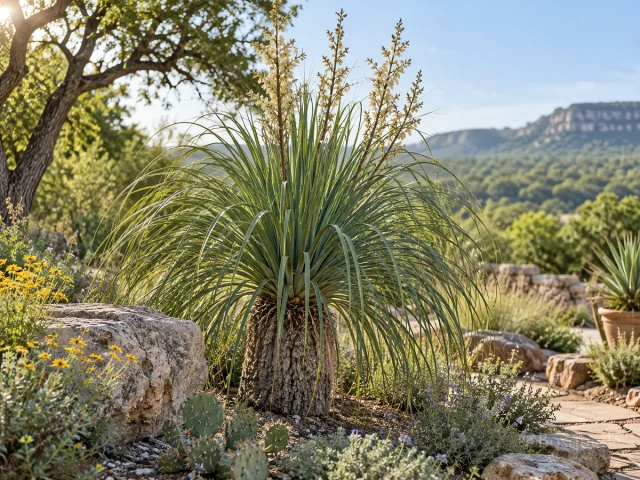
A mature plant is a slow mound about two to three feet tall and three to four feet wide, so take a rooted section rather than a handful of leaves. [4]
When do I take an offshoot?
In winter, from a mature clump. Take a young rosette that already has roots.
Can I root a leaf cutting instead?
No. A leaf section without a crown and roots does not make a new clump. Take a rooted offshoot.
What fails an offshoot?
A piece with no roots, a wet hole, or a bed you cannot keep barely moist for a few weeks. Pot it first if the site will dry out.
Sow seed in a cold frame in late January
Collect capsules when they start to dry. Spread the seed in a thin layer at room temperature, then store it sealed in the refrigerator for up to a year. Sow in a cold frame or a cool greenhouse in late January. Move seedlings into four- to six-inch pots and give them light shade for the first season.
- Pick capsules as they dry, before they spill. Dry the seed in a thin layer at room temperature.
- Store the dry seed sealed in the refrigerator until late January.
- Sow in a cold frame or a cool greenhouse. Use mix that drains. Do not bury the seed deep.
- When seedlings can handle a four- to six-inch pot, move them on and give light shade for the first season. Then grow them in sun on soil that drains — see How to Grow Texas Sacahuista.
When do I sow the seed?
Late January, in a cold frame or a cool greenhouse. Seedlings want light shade their first season.
Take the next rooted offshoot in winter, keep the soil barely moist until it holds, then skip extra water.
FAQ
Will an offshoot bloom the first year?
Often not. The new rosette spends the first season making roots. Flowers sit down in a settled clump.
Can I divide the whole clump in spring instead?
You can thin a crowded clump by taking rooted sections. Winter is the usual window. Each piece needs a crown and roots.
Do I need rooting hormone?
No. Take a rosette that already has roots. Hormone on a leafless scrap will not replace a missing crown.
Related guides
Recommended plants
References
- [1] Lady Bird Johnson Wildflower Center -
https://www.wildflower.org/plants/result.php?id_plant=NOTE - [2] Lady Bird Johnson Wildflower Center / Mr. Smarty Plants -
https://www.wildflower.org/expert/show.php?id=7379 - [3] Native Plant Society of Texas -
https://www.npsot.org/posts/native-plant/nolina-texana/ - [4] Mountain States Wholesale Nursery -
https://mswn.com/wp-content/uploads/info-sheets/Nolina-texana.pdf
This note is part of Nolina Guides.
More notes on making another plant live in Propagating Guides.
Updated: Reviewed by Bosquelle Editors