
Grow sweet fern in acidic sandy soil, in sun to part sun, and skip extra water once the roots are in. Sweet fern is Comptonia peregrina, a bayberry-family shrub, not a true fern.
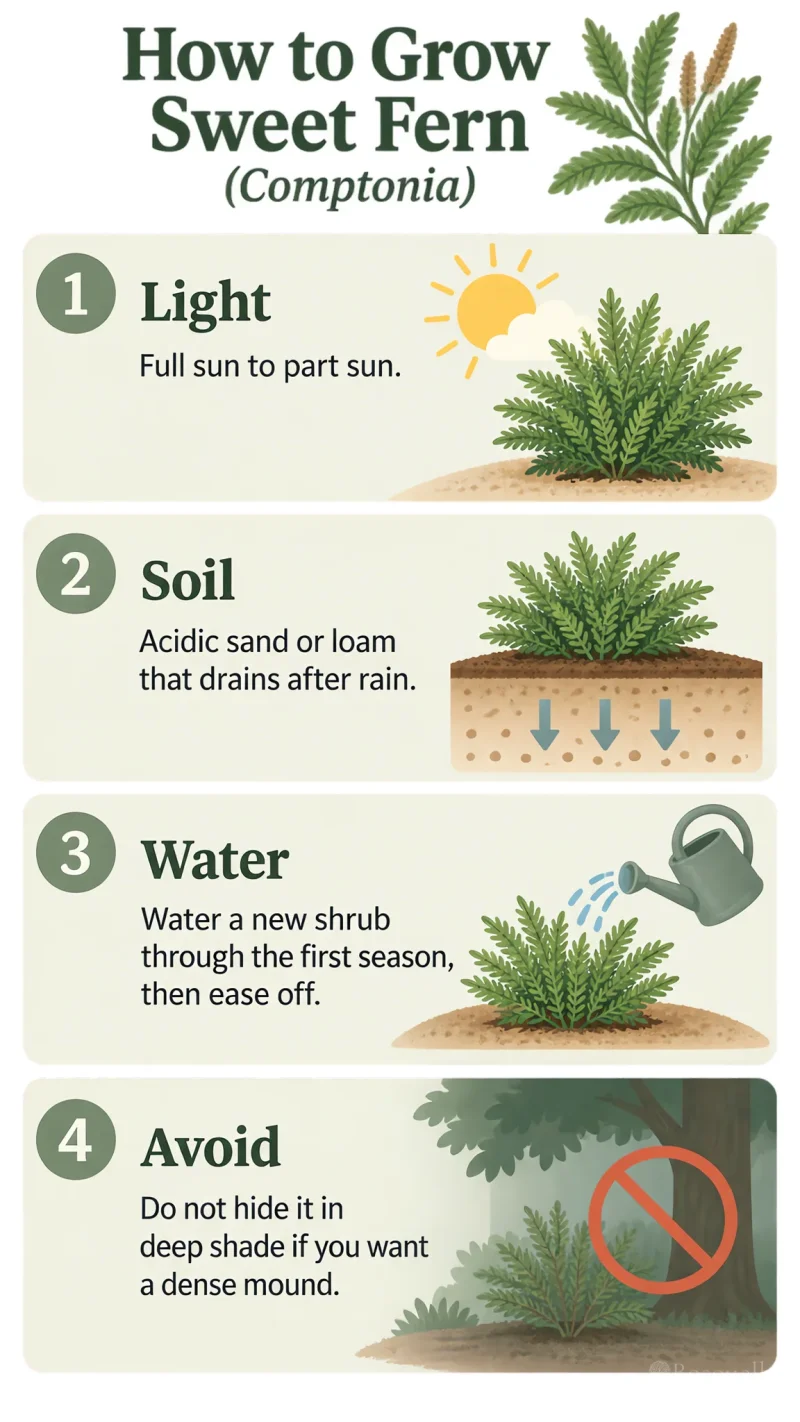
Give it acidic sandy soil, sun to part sun, and room to spread 4 to 8 feet
| Factor | Recommended | Avoid |
|---|---|---|
| Light | Full sun to part sun | Do not hide it in deep shade if you want a dense mound |
| Water | Water a new shrub through the first season, then ease off | Do not keep the soil soggy after it is set |
| Soil | Acidic sand or loam that drains after rain | Do not plant it in alkaline clay |
| Size | 2 to 5 feet tall and 4 to 8 feet wide | Do not crowd the colony |
Sweet fern wants acidic sand that drains, and a site in full sun to part sun. [1] Sweet Fern is a 2 to 5 foot eastern shrub with fragrant, fern-like leaves and a spread of about 4 to 8 feet as the rhizomes fill in. Water a new shrub through the first dry season, then ease off; an established plant takes missed water better than soggy soil. [2] It fixes its own nitrogen, so skip fertilizer and skip rich compost that stays wet. This is a poor-sand shrub for a bank, a pine opening, or a sheltered seashore site, not a border plant for moist alkaline loam.
How much sun does sweet fern need?
Give it full sun to part sun. Deep shade makes a loose mound.
How often do I water sweet fern?
Water a new shrub through the first season. Then ease off. Soggy soil around the roots is the primary cause of rot.
How big does sweet fern grow?
A mature shrub is about 2 to 5 feet tall and about 4 to 8 feet wide. Leave that room so the colony can fill in.
Can I plant sweet fern under pines?
Yes, under open pines with afternoon sun and soil that drains. Do not set it in heavy shade or wet clay under a tight canopy.
Plant a container shrub; do not count on a dug-up wild plant
Buy a nursery plant in a pot. Sweet fern does not transplant well from the wild, and a ball-and-burlap shrub often fails. [3] Plant in spring or fall on acidic sand. Slide the root ball out and set it even with the surrounding soil. Disturb the roots as little as you can.
- Choose a container shrub. Do not dig a wild plant and expect it to take.
- Plant in spring or fall on acidic sand or loam that drains. Set the root ball even with the surrounding soil.
- Leave about 3 to 4 feet between plants if you want a mass; a single shrub still needs room to colonize 4 to 8 feet.
- Water it in, then water until new growth shows. Skip fertilizer. Ease off once it is set.
How do I plant sweet fern?
Plant a container shrub in spring or fall. Set the root ball even with the surrounding soil, and water until new growth shows.
Does sweet fern transplant well?
No. A dug-up wild plant often fails. Buy a container shrub, or lift a sod piece from a colony you already own.
Start more plants from rhizome pieces, not stem cuttings
Stem cuttings from mature wood do not root. The reliable start is a short piece of rhizome, laid on its side just under the mix. [4]
- In fall, lift a rhizome piece about 2 inches long from the edge of a colony you own, or buy another container plant instead.
- Lay the piece on its side, just under the surface, in vermiculite or an acidic mix that drains.
- Keep it cool and barely moist through winter, above freezing. Do not let the mix dry out, and do not freeze the tray.
- In spring, shoots push. Keep watering until you can set the young plant out on acidic sand.
Seed is rarely useful
Seed is hard to germinate, so do not wait on a packet. Buy a container shrub or start a rhizome piece if you want more plants.
How do I start more sweet fern plants?
Lay a 2-inch rhizome piece on its side in mix that drains, and keep it cool and barely moist through winter. Stem cuttings from mature wood fail.
Can I grow sweet fern from seed?
Seed is rarely useful. Germination is difficult. Buy a container shrub or start a rhizome piece instead.
Not a fern — and not bayberry or wax myrtle
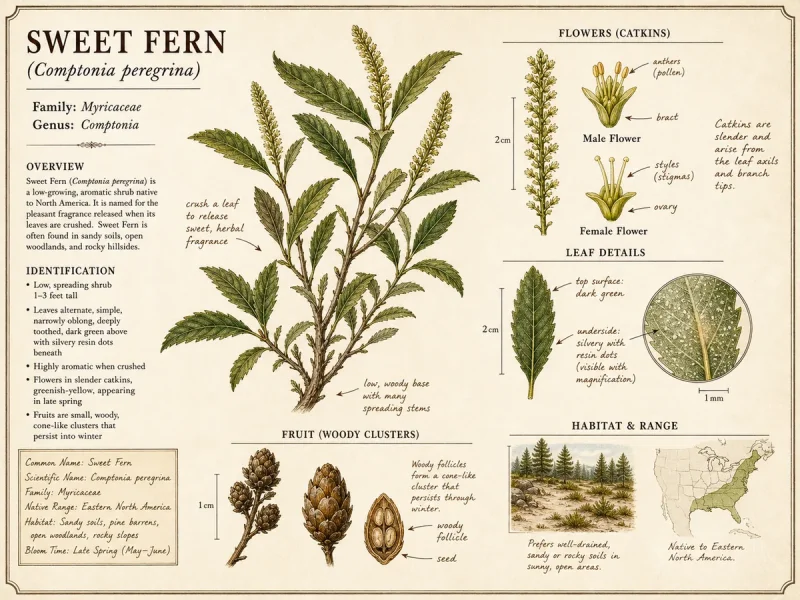
Sweet fern is a woody shrub in the bayberry family. The leaves look fern-like, but it has woody stems, spring catkins, and a strong scent when you crush a leaf. If the tag says asparagus fern, read How to Grow Asparagus Fern. Wood fern is How to Grow Wood Fern. Cinnamon fern is How to Grow Cinnamon Fern. Maidenhair fern is How to Grow Maidenhair Fern.
Wax myrtle is Morella, an evergreen native screen with waxy fruit; read How to Grow Wax Myrtle. Northern bayberry is Myrica, a related shrub, not this plant. Older tags may say Myrica aspleniifolia or Comptonia peregrina var. aspleniifolia; those names still point to this one shrub. If the tag says Comptonia peregrina, you have sweet fern.
Is sweet fern a fern?
No. It is a bayberry-family shrub with fern-like leaves. A fern, including asparagus fern or wood fern, is a different plant.
Is sweet fern the same as bayberry or wax myrtle?
No. Wax myrtle is Morella, an evergreen screen. Northern bayberry is Myrica. Sweet fern is Comptonia peregrina, a deciduous eastern shrub.
If the shrub sits in alkaline clay or a wet hole, set a container plant on acidic sand that drains, and water it only until the roots take.
FAQ
Can I grow sweet fern in a pot?
A nursery pot is how the shrub is sold, not a houseplant. Keep it outdoors in sun to part sun, in acidic mix that drains, until you can set it in the ground.
Is there more than one kind of sweet fern?
Comptonia peregrina is the plant here. Older names such as sweetfern and Myrica aspleniifolia are the same shrub, not a second type.
Will sweet fern stay green in winter?
No. The leaves drop in winter. New shoots return in spring. Do not wrap the shrub.
Can sweet fern grow with other plants?
Yes, with other acid-sand natives that also want soil that drains. Do not pack a wet lawn plant against the crown.
Can I make tea from sweet fern?
Grow it as an ornamental shrub. Do not treat the leaves as a medicinal tea.
Do I need to prune sweet fern?
Rarely. The shrub holds a low mound without regular cutting. Remove a dead stem if you see one.
Recommended plants
References
- [1] North Carolina Extension Gardener Plant Toolbox -
https://plants.ces.ncsu.edu/plants/comptonia-peregrina/ - [2] University of Connecticut Plant Database -
https://plantdatabase.uconn.edu/detail.php?pid=118 - [3] University of Connecticut SARE Native Plant Nursery Manual -
https://projects.sare.org/media/pdf/N/a/t/Native-Manual-13.pdf - [4] Lady Bird Johnson Wildflower Center -
https://www.wildflower.org/plants/result.php?id_plant=cope80
More first-season notes by plant are gathered in How to Grow Guides.
Updated: Reviewed by Bosquelle Editors