
Grow wax myrtle in sun to part shade, in soil that stays moist at first and then drains. Pacific wax myrtle is the West Coast screen in the same genus.

Give it sun to part shade, moist soil that drains, and room to screen
| Factor | Recommended | Avoid |
|---|---|---|
| Light | Full sun to part shade | Do not count on deep shade for a dense hedge |
| Soil | Acid to neutral soil that stays moist but still drains; sand, loam, or clay is fine | Do not plant in high-pH ground that yellows the leaves |
| Water | Keep a new plant moist. After the roots take, water less | Do not let a new plant dry out, and do not leave the roots in a hole that never drains |
| Kind | Southern wax myrtle for an East or Gulf screen; Pacific wax myrtle for the West Coast | Do not treat northern bayberry as this evergreen |
| Salt and deer | Salt spray is fine once the plant is set; deer usually leave the leaves alone | Do not plant it on an open dune with no shelter from hard spray |
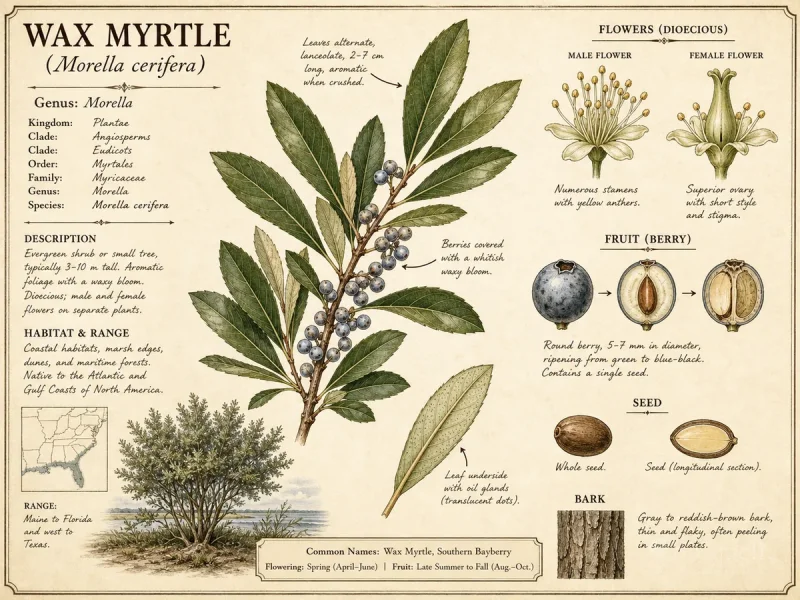
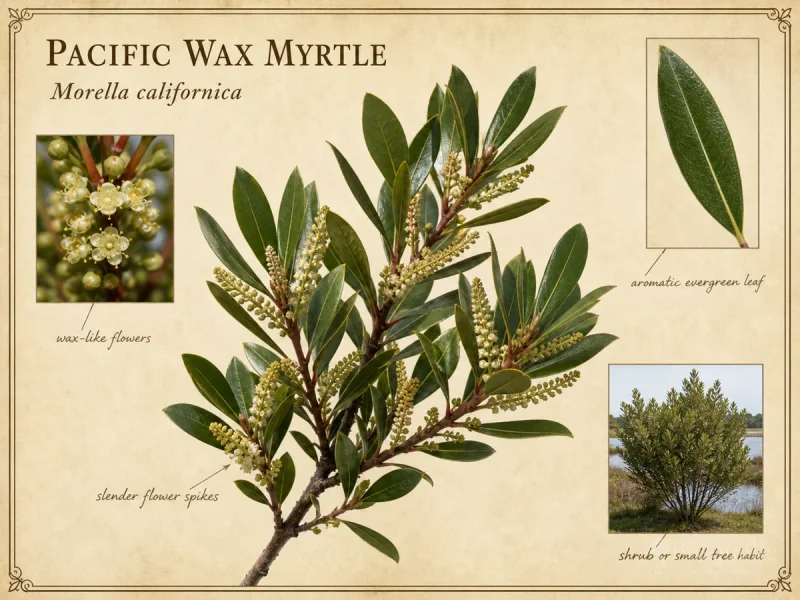
Wax myrtle wants sun or part shade and soil that stays moist while the roots take, then it handles wet ground or a dry spell. Give it room to become a screen. wax myrtle is the eastern evergreen, Morella cerifera. Pacific wax myrtle is Morella californica, the same job on the Pacific coast. [1] Once the shrub is set, Pacific wax myrtle takes a dry summer with little extra water. Southern wax myrtle still wants a soak in a long dry spell. [2]
- Choose full sun or part shade. A dense hedge fills in better in sun than in a dark corner.
- Set it in acid to neutral soil that drains after a rain. Sand, loam, or clay is fine if water does not stand around the stem.
- Water a new plant so the root ball stays moist. After the first season, water less. Pacific wax myrtle takes dry summers; southern wax myrtle still wants water in a long drought.
- Leave room for a 10 to 20 foot screen. Pacific wax myrtle can grow taller on the West Coast.
How much sun does wax myrtle need?
Full sun to part shade. Deep shade makes a thin screen.
How often should I water a new wax myrtle?
Keep a new plant moist through the first season. After the roots take, water less. Pacific wax myrtle takes a dry summer; southern wax myrtle still wants a soak in a long drought.
Should I buy southern or Pacific wax myrtle?
Buy southern wax myrtle for an East or Gulf screen. Buy Pacific wax myrtle for the West Coast. Both want sun to part shade and soil that drains.
Plant at the same depth as the pot, and leave room for a screen
Knock the shrub from its pot and set the root ball at the same depth it was already growing. Leave 6 to 12 feet between plants if you want a screen that can sucker. Water after you plant, and keep the first dry weeks from baking the new roots. [3]
- Plant when the soil is workable, in sun or part shade that drains.
- Set the root ball even with the surrounding soil. Do not bury the stem deeper than it grew in the pot.
- Space plants 6 to 12 feet apart for a screen. Closer spacing knits faster; wider spacing leaves room for suckers.
- Water to settle the soil. Keep the first season moist, then ease off. Pull unwanted suckers if you want one shrub instead of a thicket.
How far apart do I plant a wax myrtle screen?
Leave 6 to 12 feet between plants. Set the root ball at the same depth as the nursery pot, and water after you plant.
Shear a hedge, or limb it into a small tree
Wax myrtle takes shearing as an evergreen hedge. You can also limb up the lower branches and keep a small tree with pale gray bark. Next year's berries sit on last year's wood, so do not strip every old stem if fruit is the goal.
- Shear a hedge in late winter or early spring, before the new flush. Light cuts through the growing season are fine if you stop well before frost.
- To make a small tree, cut lower limbs back to the trunks and keep a few strong stems.
- Take out a dead or broken stem any time. Do not cut more than about a third of the canopy in one pass.
- If you want berries, leave last year's wood. Fruit clusters sit on that older growth.
When should I prune wax myrtle?
Shear a hedge in late winter or early spring. Limb it into a small tree at the same time. Leave last year's wood if you want berries.
Take stem cuttings in summer
Take a 5 to 6 inch tip cutting of new wood in summer. Strip the lower leaves, dip the base in rooting hormone, and stick it in a mix that drains. Keep the cutting humid and out of hot sun. Roots usually show in about four weeks. [4]
- Cut a healthy tip in summer, about 5 to 6 inches long, with several nodes.
- Strip the lower leaves so those nodes will sit in the mix. Dip the base in rooting hormone.
- Stick the cutting in a moist mix that drains. Cover it or mist it so the leaves do not crisp, and keep it in bright light without hot midday sun.
- Tug gently after a month. If it resists, pot it on, then plant it out the next cool season.
Can I grow wax myrtle from a cutting?
Yes. Take a summer tip cutting, use rooting hormone, and keep it moist and humid until roots form in about four weeks.
Grow it from a berry if you want seedlings
If you have ripe berries and you want seedlings, wash off the wax in warm soapy water, rinse, then keep the seed cold and moist for 40 to 90 days before you sow. Named dwarf kinds will not come true from seed.
- Collect ripe berries in fall. Wash off the waxy coat in warm soapy water and rinse well.
- Keep the seed cold and moist for 40 to 90 days, or sow outdoors in fall and let winter do that work.
- Sow in a mix that drains, barely cover, and keep the seed moist until it sprouts.
Not a crape myrtle — and not true myrtle or northern bayberry
Wax myrtle is Morella, an evergreen native screen with tiny spring catkins and waxy berries. Crape myrtle is Lagerstroemia, a deciduous shrub or tree grown for showy summer flowers — see How to Grow Crape Myrtle. If the tag says crepe or crape myrtle and the plant drops its leaves and blooms in big clusters, you have the wrong plant.
True myrtle is Myrtus communis, a Mediterranean evergreen with different flowers. Northern bayberry is Myrica pensylvanica, a colder, often deciduous shrub whose berries are the old candle fruit. Pacific wax myrtle berries have little of that scented wax. Sweet gale is a small deciduous bog shrub, not this screen. If the tag says Morella cerifera or Morella californica, you still have wax myrtle.
Is wax myrtle a crape myrtle?
No. Crape myrtle is Lagerstroemia, grown for showy summer flowers. Wax myrtle is an evergreen native screen with tiny catkins.
Set wax myrtle in sun to part shade, keep a new plant moist, then let it screen.
FAQ
Can I grow wax myrtle in a pot?
Only as a young plant. Use a pot with a drainage hole and a mix that drains. Keep it outdoors in sun, water when the mix is dry on top, and empty the saucer. A screen this size is happier in the ground.
Do I need a male and a female for berries?
Yes, if you want fruit. Male and female flowers usually sit on separate plants. Birds eat the waxy fruit. Do not boil the berries for candles or medicine.
What about dwarf wax myrtle?
Dwarf selections stay shorter than a full screen. Southern wax myrtle and Pacific wax myrtle are the two kinds. Read the tag for height if you need a low hedge.
Will a cold snap kill wax myrtle?
Leaves may brown or drop after a hard freeze. The stems usually live and leaf out again. Wait until spring to cut the dead tips.
Can I plant it against the house?
Give it room. The leaves and stems are resinous and can carry fire. Keep the screen away from the house wall.
What is the leaf blight on Pacific wax myrtle?
Pacific wax myrtle can get a leaf blight in cool, shady, wet weather. Grow it in more sun, prune in spring, and pick up fallen leaves. That is cleanup, not a spray schedule.
Recommended plants
References
- [1] NC State Extension Gardener Plant Toolbox -
https://plants.ces.ncsu.edu/plants/myrica-cerifera/ - [2] Oregon State University Landscape Plants -
https://landscapeplants.oregonstate.edu/plants/morella-californica - [3] Clemson Cooperative Extension HGIC -
https://hgic.clemson.edu/factsheet/waxmyrtle/ - [4] University of Florida IFAS Extension -
https://ask.ifas.ufl.edu/publication/SG176
More first-season notes by plant are gathered in How to Grow Guides.
Updated: Reviewed by Bosquelle Editors