
Grow striped squill in sun or part shade, in soil that drains, and water it while the leaves are up. Striped squill is Puschkinia scilloides, also sold as Lebanon squill — not Siberian squill.
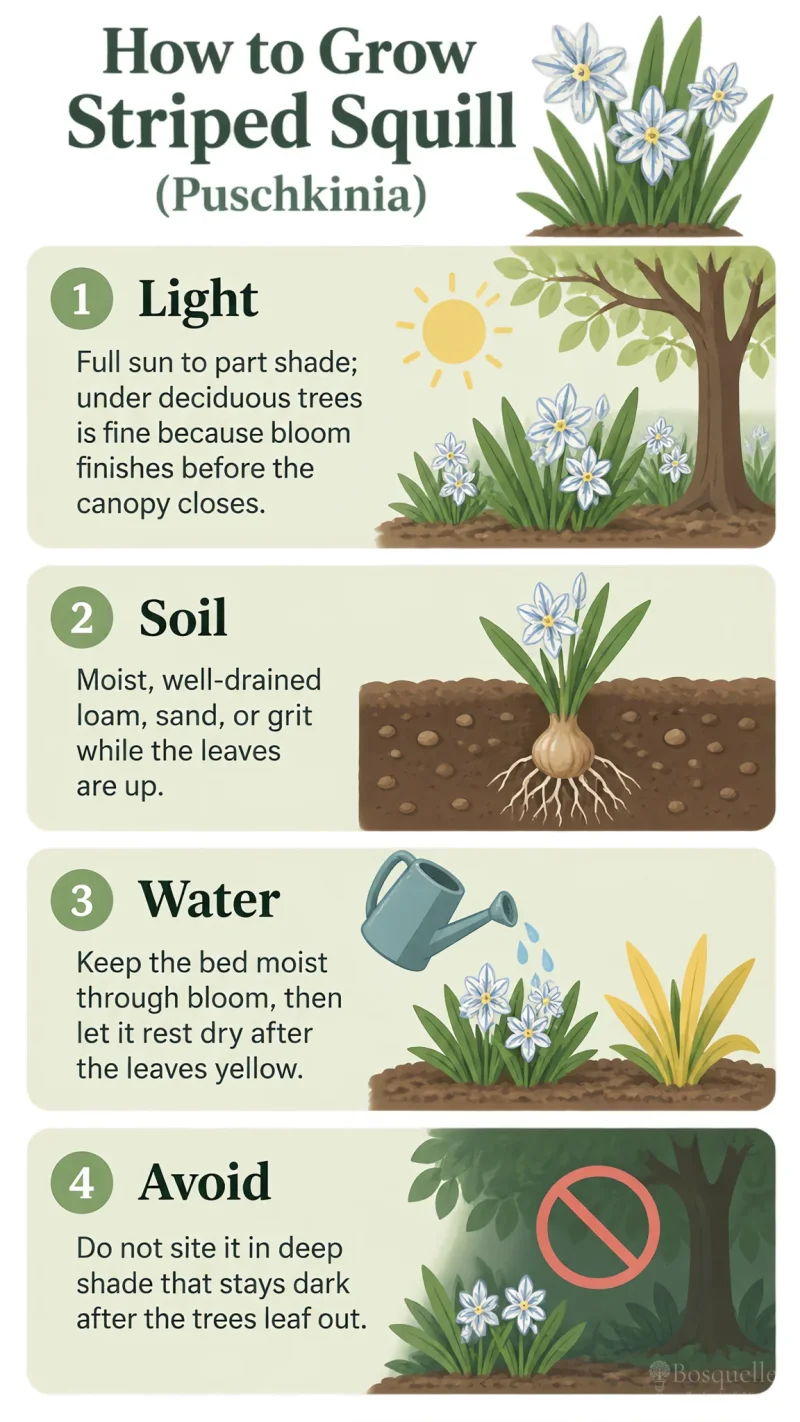
Give it sun or part shade, soil that drains, and water while the leaves are up
| Factor | Recommended | Avoid |
|---|---|---|
| Light | Full sun to part shade; under deciduous trees is fine because bloom finishes before the canopy closes | Do not site it in deep shade that stays dark after the trees leaf out |
| Soil | Moist, well-drained loam, sand, or grit while the leaves are up | Do not plant it in a low clay hole that stays soggy |
| Water | Keep the bed moist through bloom, then let it rest dry after the leaves yellow | Do not keep watering a dormant bulb all summer |
| Size | Leave a 4 to 6 inch clump of two strap leaves and a short flower scape | Do not expect a tall hyacinth spike |
| Wildlife | Deer and rabbits usually leave the planting | Do not treat that as a promise if voles already dig every bulb in the bed |
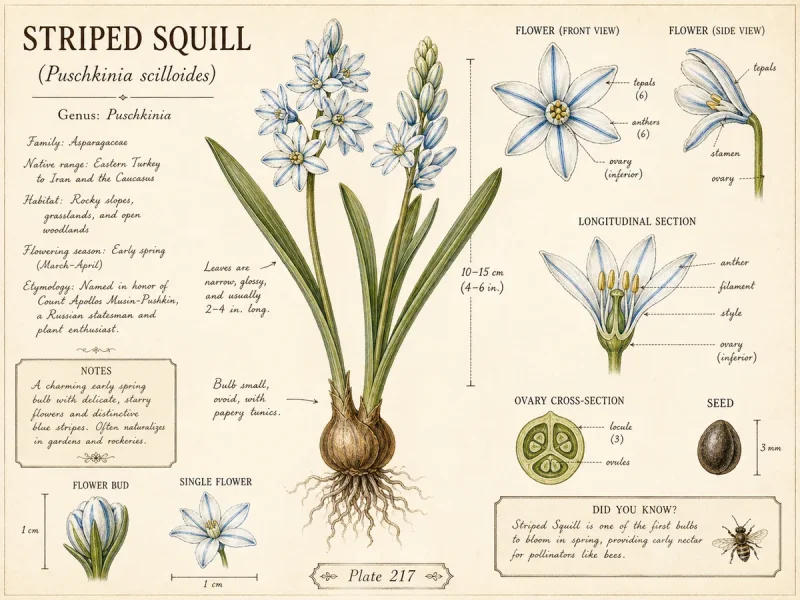
Striped squill is Puschkinia scilloides, a small western-Asian bulb with pale blue stars and a darker stripe down the middle of each tepal. Give it spring sun or the light under leafless trees, and soil that can wet in March and then dry once the foliage dies. [1] [2]
Water while the leaves are up so the bulb can charge for next year. After the leaves yellow, the plant is dormant, and extra summer water rots it. Pair it with other early small bulbs that share drain and spring sun. To plant the bag, read Planting Striped Squill.
Where is the best place to plant puschkinias?
Sun or part shade on ground that drains. A walkway, a rock garden, a lawn you can mow high, or the ground under deciduous trees all work. A clay puddle does not.
How tall do Puschkinia grow?
About 4 to 6 inches. The show is a low haze, not a tall spike.
Do Puschkinia come back every year?
Yes, if the hole drains and you leave the leaves until they yellow. The bulbs rest through summer and bloom again in early spring.
Is striped squill deer resistant?
Yes, deer usually leave it, and rabbits usually do too. Cage a new planting if browse in your yard is heavy anyway.
Pair it with other early bulbs
Plant it with other early small bulbs that want the same sun and drain, such as crocus, grape hyacinth, and small daffodils, so the bed still has bloom after this one fades. Glory of the snow likes the same kind of ground; that job is How to Grow Glory of the Snow.
Use a pot that drains
A patio pot works as a short spring show if the mix drains and the pot has a hole. Set the bulbs about three times as deep as they are wide, water while they are in leaf, and move a cold-climate pot against the house or into an unheated garage for winter so the compost does not freeze solid around the bulbs. [3] Open ground is still the better home if you want a drift that returns.
- Choose a pot with a drainage hole and a gritty mix, not wet compost with no way out.
- Set the bulbs pointy end up, about three times their width deep, and close enough that the haze reads.
- Water after planting, then keep the mix barely moist while leaves are up.
- After the leaves yellow, store a cold-zone pot where it stays cold but the mix does not stay soaked.
Can I grow striped squill in a pot?
Yes, in a draining pot as a spring hold. It is not a houseplant. Plant the rest of the bag in the ground if you want a returning drift.
Leave the leaves until they yellow
The strap leaves feed next year’s flowers. Cut them only after they yellow and collapse. In a lawn, raise the first mows so you do not scalp green leaves, or skip that patch until the foliage fades.
- After bloom, leave the two strap leaves in place. Do not braid, bundle, or cut them green.
- Wait until the leaves turn yellow and wither, then rake them off if you want a tidy bed.
- If the bulbs sit in turf, set the mower high for the first cuts, or leave that patch until the leaves fade.
Is striped squill invasive?
It thickens by offsets and seed in a spot that drains. That is not the same plant as Siberian squill, which some Midwest states treat as invasive. If the tag says Scilla siberica, that job is How to Grow Squill.
Not Siberian squill — and not pale striped Scilla
Siberian squill is Scilla siberica, a nodding true-blue bell, often one or two flowers to a stem. If the tag says Siberian squill or Scilla siberica, that job is How to Grow Squill. Pale striped squill in the squill catalog is Scilla mischtschenkoana, another icy star with a midstripe. You tell them apart in the flower: this plant has flattened filaments fused into a small cup; the Scilla has separate filaments. [4]
Glory of the snow faces more upward and usually shows a white eye — that job is How to Grow Glory of the Snow. A starch-hyacinth tag is still this bulb, not a true hyacinth; a true hyacinth job is How to Grow Hyacinths. Snowdrop is How to Grow Snowdrops. Grape hyacinth is How to Grow Grape Hyacinth. Spanish bluebells are How to Grow Spanish Bluebells. Silver squill is a houseplant Ledebouria, not this hardy spring bulb.
Is striped squill the same as Siberian squill?
No. Striped squill is Puschkinia, a pale star with a blue midstripe. Siberian squill is Scilla siberica, a nodding true-blue bell.
Is Puschkinia the same as Scilla?
No. Bags sometimes say Scilla by mistake. Pale striped Scilla mischtschenkoana looks close, but the filaments are separate. This plant’s filaments are fused into a small cup.
If the clump thins, the hole stayed wet in summer, or the leaves were cut green. Next year keep the spring moisture, then let the bed rest once the foliage yellows.
FAQ
Is there more than one kind of striped squill?
This catalog holds one species, Puschkinia scilloides. Lebanon squill and Puschkinia libanotica are names for the same plant. A white Alba form shows up in shops, but it is not a separate card here. All of them still want sun or part shade and soil that drains.
Is striped squill toxic?
It is not a food plant. Do not eat the bulbs, and keep pets from chewing them. Grow it for the spring haze, not for the kitchen.
Related guides

Recommended plants
References
- [1] NC State Extension Gardener -
https://plants.ces.ncsu.edu/plants/puschkinia-scilloides/ - [2] Missouri Botanical Garden -
https://www.missouribotanicalgarden.org/PlantFinder/PlantFinderDetails.aspx?taxonid=281802 - [3] Van Zyverden -
https://www.vanzyverden.com/garden-guides/fall-planting/bulbs/puschkinia/ - [4] Wave Hill -
https://www.wavehill.org/discover/garden-journal/puschkinia-scilloides-var-libanotica-puschkinisa-variety
This note is part of Puschkinia Guides.
More first-season notes by plant are gathered in How to Grow Guides.
Updated: Reviewed by Bosquelle Editors