
Grow glory of the snow in sun to high shade on free-draining ground, with a dry rest once the leaves yellow. The tag may also say Chionodoxa. Wet clay and an early lawn cut fail a planting faster than cold.

Give it sun to high shade, sharp drain, and a dry summer rest
| Factor | Recommended | Avoid |
|---|---|---|
| Light | Full sun to high shade. Under deciduous trees is fine — bloom finishes before the canopy closes | Heavy shade that fades the planting after a few years |
| Soil | Well-drained ground that stays moist while leaves are up | Heavy clay or a low spot that stays soggy |
| Summer | Let the bed dry once foliage dies. The bulbs rest until fall | Keeping the spot wet all summer as if it were a moisture lover |
| Wildlife | Deer and black walnut sites often work | Expecting a pest-proof plant if nematodes are already in the soil |
Glory of the snow wants bright spring light and soil that does not sit wet. Under oaks or other deciduous trees it blooms before the leaves close. Once the foliage dies, a dry summer rest is normal. [1] [2]
Is Glory of the Snow easy to grow?
Yes, in sun to high shade with drainage and a dry summer rest. Wet clay and early mowing fail it.
Is Glory of the Snow invasive?
It naturalizes by offsets and seed. NC State does not treat it as invasive. That is not a reason to plant Siberian squill by mistake.
Does Chionodoxa spread quickly?
Offsets and seed thicken a well-sited drift. Ants may move seed a short way. A soggy or deeply shaded spot thins instead.
Pair it with other early bulbs
Pair it with other early small bulbs that share drain and spring sun — crocus, grape hyacinth, and small daffodils — so the bed still has bloom after this one fades. Do not copy a snowdrop watering calendar onto this planting.
Leave the leaves until they yellow, and mow high
The leaves feed next year’s flowers. Cut them only after they yellow and wither. In a lawn, raise the first mows so you do not scalp green leaves, or wait until the foliage starts to die back — often five to six weeks. Skip herbicide while those leaves are still active. [3] The leaves usually fade within a few weeks of bloom. [4]
- After bloom, leave the strap leaves in place. Do not braid, bundle, or cut them green.
- Wait until the leaves turn yellow and collapse, then rake them off if you want a tidy bed.
- If the bulbs sit in turf, set the mower high for the first cuts, or skip that patch until the leaves fade.
- Do not spray lawn weedkiller on that patch while glory of the snow leaves are still green.
Do Chionodoxa bulbs multiply?
Yes. Daughter bulbs form beside the original, and seed can fill nearby gaps. Leave the leaves until they yellow so the clump can store food.
Will glory of the snow naturalize in a lawn?
Yes, if you mow high at first or wait until the leaves start to die. Early low cuts starve the bulbs.
Lift overcrowded clumps after bloom
A crowded patch can be lifted shortly after flowering. Tease the offsets apart and replant at once in drainable ground. Do not store the bulbs dry for weeks in a hot shed.
Skip a patio pot except as a winter hold
This is an open-ground naturalizer, not a patio specimen. A pot is only a winter hold: drainage holes, a mix that drains, and a cool dark rest in warm climates. Move the bulbs into the bed in fall. Do not force them as the only culture.
Can Chionodoxa be grown in pots?
A pot can hold bulbs through winter if it drains and stays cool. The lasting planting is in free-draining ground.
Not Siberian squill, snowdrop, or morning glory
Bags often say Scilla luciliae or Scilla forbesii — that is this plant under a renamed genus, not a second crop. Siberian squill is Scilla siberica: a different, often more aggressive lawn bulb. Snowdrop is Galanthus. Morning glory is an Ipomoea vine planted after frost. Confirm glory of the snow / Chionodoxa on the tag before you copy those plants’ care.
Are Scilla and Chionodoxa the same?
Many bags now list Scilla luciliae for glory of the snow. That is this plant. Siberian squill (Scilla siberica) is a different species.
Is Siberian squill the same as glory of the snow?
No. Siberian squill is Scilla siberica. Glory of the snow is Chionodoxa, often sold as Scilla luciliae.
Do snowdrop bulbs come back every year?
Snowdrops are Galanthus, a different plant. Glory of the snow also returns, but it is not a snowdrop.
Blue Giant, Pink Giant, Violet Beauty, or Alba
Culture is the same sun, drain, dry rest, and leaf-until-yellow rule. Flower color is the choice. Shop lists of Gigantea and extra mix names are not extra plants we hold.
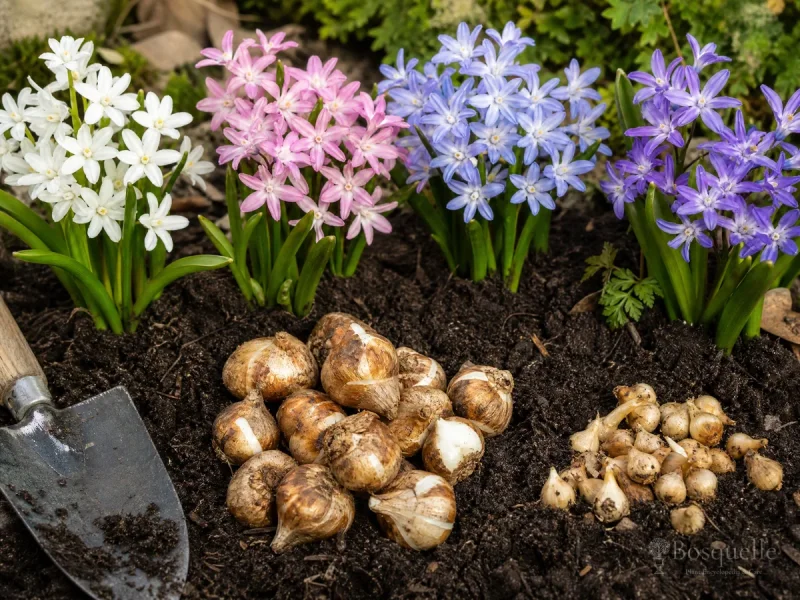
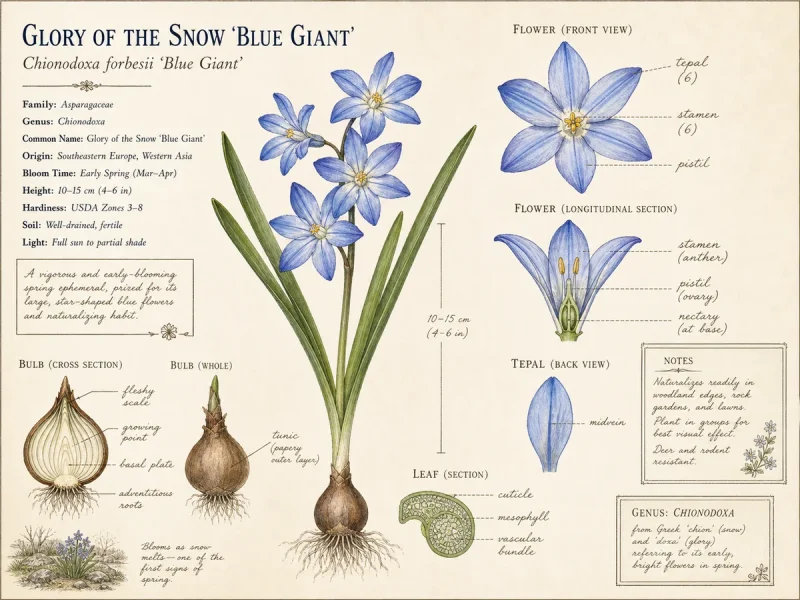
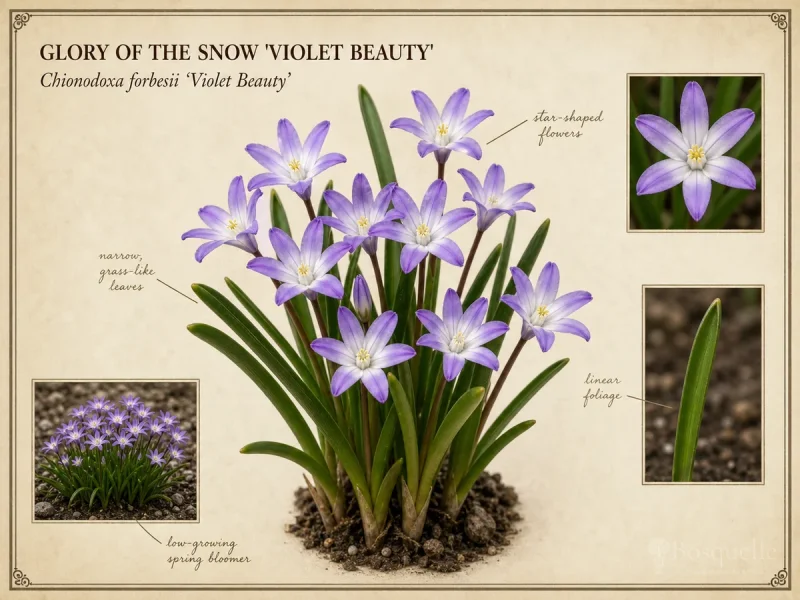
C. forbesii ‘Blue Giant’ is the large blue forbesii form for a mass. C. forbesii ‘Pink Giant’ is pink on the same clock. C. forbesii ‘Violet Beauty’ is the violet-toned form. C. luciliae ‘Alba’ is white luciliae for a lighter edge. Do not treat a bag labeled Gigantea as a fifth catalog kind.
What is the common name for Chionodoxa?
Glory of the snow. Bags may also say Scilla luciliae or Scilla forbesii.
Keep the bed drained, leave the leaves until they yellow, mow high at first, and confirm the tag is not Siberian squill.
FAQ
What is Chionodoxa?
The Latin genus for glory of the snow. Bags may also say Scilla luciliae or Scilla forbesii.
Is Gigantea a plant we hold?
No extra Gigantea card. White luciliae Alba may carry a Gigantea-group alias; culture is still the same four kinds.
Related guides
Recommended plants


References
- [1] University of Wisconsin–Madison Division of Extension -
https://hort.extension.wisc.edu/articles/glory-of-the-snow-chionodoxa/ - [2] NC State Extension -
https://plants.ces.ncsu.edu/plants/scilla-luciliae/ - [3] University of Arkansas Division of Agriculture -
https://www.uaex.uada.edu/yard-garden/resource-library/plant-week/glory-snow-2-21-13.aspx - [4] Longfield Gardens -
https://www.longfield-gardens.com/blogs/all-about-fall-planted-bulbs/all-about-chionodoxa
This note is part of Chionodoxa Guides.
More first-season notes by plant are gathered in How to Grow Guides.
Updated: Reviewed by Bosquelle Editors