
Grow stock flower in full sun, on cool, moist soil that drains. Shops also call it stock or Matthiola.

Give it full sun, cool weather, and soil that drains
| Factor | Recommended | Avoid |
|---|---|---|
| Light | Full sun, with a little afternoon shade if the bed bakes | Do not hide it on a dark north wall |
| Soil | Moist soil that drains, and is not acid | Do not plant it in a sour, soggy hole |
| Water | Keep the soil evenly moist while it is in bloom | Do not let the root zone bake, and do not leave it in standing water |
| Kind | Garden stock for clove-scented spikes you can cut; night-scented stock for perfume after dusk | Do not buy night-scented stock if you want a showy daytime spike |
| Heat | Cool spring or fall weather | Do not expect garden stock to hold in days that stay above about 80 F |
| Deer | Garden stock is often left by deer | Do not call night-scented stock deer-resistant from this catalog |
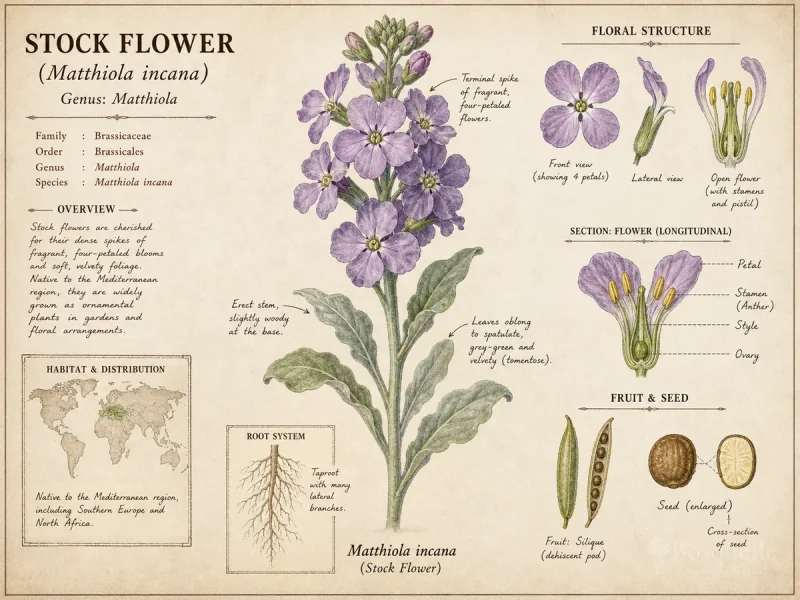
Stock flower wants full sun, cool weather, and moist soil that drains. Acid ground and a hole that stays wet after rain are the usual reasons the roots rot. Garden stock also declines when days stay hot, especially when nights stay warm. [1] garden stock is the upright kind, 1 to 3 feet tall, with gray-green leaves and dense spikes. night-scented stock wants the same cool, draining bed, with small flowers that open in the evening.
How much sun does stock flower need?
Full sun is the usual site. A little afternoon shade helps if the bed bakes. A dark wall gives you leaves and few spikes.
Why did my stock stop blooming in heat?
Garden stock is a cool-season plant. When days stay above about 80 F, the spikes stall. Sow again for fall if your nights cool off.
Sow garden stock in a tray, and sow night-scented stock in place
Start garden stock in a tray about six to eight weeks before you set it out, then transplant once the seedlings have a few true leaves. Barely cover the seed and keep the mix evenly moist at 65 to 75 F. Seedlings usually show in one to two weeks. Set plants out in cool weather, at the same depth they grew in the cell. [2]
- Fill cells with a mix that drains. Sow one or two seeds per cell and barely cover them.
- Keep the surface moist until seedlings show. Thin to one seedling per cell.
- Harden the plants off, then set them in full sun on moist soil that drains. Do not bury the stem deeper than it grew in the cell.
- Sow another tray two weeks later if you want a longer bloom. Direct sow after frost only if you can keep the surface from drying.
Sow night-scented stock where it will bloom
Night-scented stock does not like a move, so sow it on the bed or in the pot where it will bloom. Scatter the seed on cool, draining ground, press it so it is barely covered, and keep the surface moist until seedlings show. Thin to about 8 inches. Sow again in three weeks if you want perfume later in the season. [3]
When should I sow stock flower?
Start garden stock in a tray six to eight weeks before you transplant. Sow night-scented stock in place a few weeks before last frost, and again later for a second flush.
Do I start night-scented stock indoors?
No. Sow it where it will bloom. A tray and a later move often fail because the plants do not like to be transplanted.
Not Virginia stock — and not a gillyflower pink
Virginia stock is Malcolmia, a small daytime annual with a different tag, not this Matthiola. A shop gillyflower is often a pink — see How to Grow Dianthus. Wallflower is Erysimum, a different mustard-family plant — see How to Grow Wallflower. If the tag says stock flower or Matthiola, you still have this cool-season plant with four-petal spikes or evening sprays.
A search for stock flower also pulls photo libraries. Garden stock is the upright clove-scented spike. Night-scented stock is the evening perfume plant you sow in place.
Is this Virginia stock?
No. Virginia stock is Malcolmia, a small daytime annual. Stock flower is Matthiola.
Is gillyflower the same as Dianthus?
Shops often use gillyflower for Dianthus. Garden stock is Matthiola. Pinks are Dianthus.
Cut stems when a third of the florets are open
Cut garden-stock spikes in the cool morning when about a third to half of the florets on the stem are open and the rest still show color. Put the stems in water at once. Strip the leaves that would sit in the vase. Once you cut the main spike, that plant is finished as a cut stem. [4]
- Cut in the cool morning, when a third to half of the florets are open.
- Take as long a stem as the plant can spare, and put it in clean water at once so it does not wilt.
- Strip the lower leaves so none sit in the vase water. Recut the thick white base if water cannot move up the stem.
- Change the water and recut the ends every couple of days. Night-scented stock is for perfume in the bed, not a florist spike.
Do not pinch a column stem
Leave a column garden-stock stem alone so it can make one tall spike. Pinching delays bloom into heat, and the stem stays short. If you want more branches on a bedding plant, take the tip only before a bud shows.
When do I cut stock stems?
Cut when a third to half of the florets are open. Put the stems in water at once, and strip leaves below the water line.
Do I pinch stock?
Do not pinch a column stem grown for a tall spike. Once you cut that spike, the plant is finished as a cut stem.
Sow the next tray while nights stay cool, and cut stems when a third of the florets are open.
FAQ
Can I grow stock flower in a pot?
A pot that drains can hold dwarf garden stock or a sowing of night-scented stock by a seat. Empty the saucer. It is not a houseplant.
Can I overwinter Brompton stock?
In most U.S. beds, garden stock is grown as a cool-season annual. A biennial Brompton sowing is a summer start for the next cool spring, not a houseplant to bring indoors.
Do you list Iron or Cinderella stock?
No. This catalog holds garden stock and night-scented stock. Named series still want cool sun and soil that drains.
What about flea beetles?
Stock flower is a mustard-family plant, so flea beetles can pit the leaves. Cover new transplants with a light row cover until they are growing hard.
Recommended plants

References
- [1] NC State Extension Gardener -
https://plants.ces.ncsu.edu/plants/matthiola-incana/ - [2] Johnny's Selected Seeds -
https://www.johnnyseeds.com/growers-library/flowers/stock/stock-key-growing-information.html - [3] Select Seeds -
https://www.selectseeds.com/products/evening-scented-stock-seeds - [4] Mississippi State University Extension -
https://extension.msstate.edu/publications/stock-matthiola-incana-for-the-farmer-florist
More first-season notes by plant are gathered in How to Grow Guides.
Updated: Reviewed by Bosquelle Editors