
Grow stapelia in bright light, in a mix that drains, and water when the mix is dry. It is Stapelia grandiflora, a leafless succulent about a foot tall, sold as giant toad plant, not a true cactus.
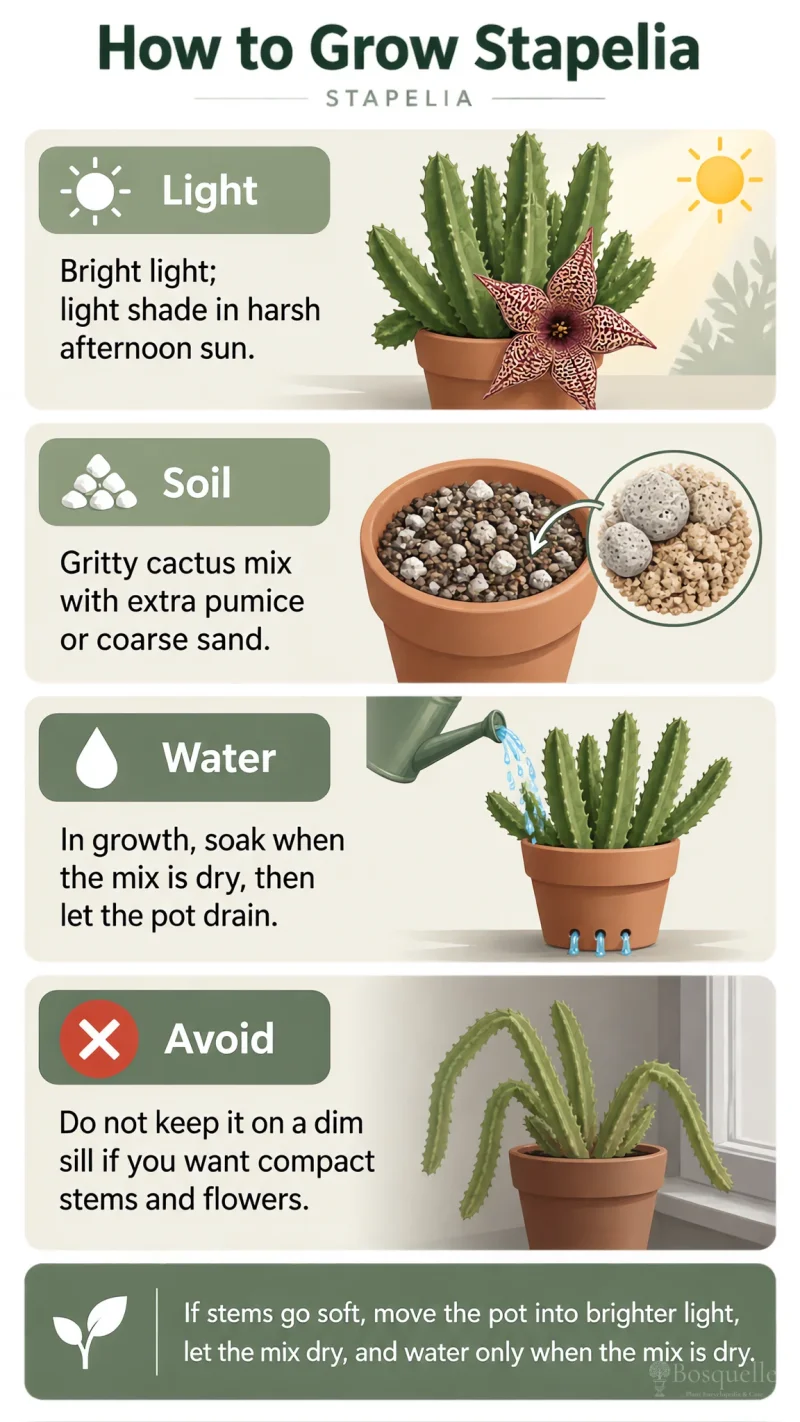
Give it bright light, a mix that drains, and water when the mix is dry
| Factor | Recommended | Avoid |
|---|---|---|
| Light | Bright light; light shade in harsh afternoon sun | Do not keep it on a dim sill if you want compact stems and flowers |
| Water | In growth, soak when the mix is dry, then let the pot drain | Do not keep the mix wet between waterings |
| Soil | Gritty cactus mix with extra pumice or coarse sand | Do not use packed potting soil that stays wet |
| Warmth | Keep it frost-free; prefer a room above about 50°F | Do not leave it wet in a cold room or outdoors in frost |
stapelia is Stapelia grandiflora, a clumping succulent from South Africa. The stems are four-angled, velvety, and about a foot tall as they form a compact cluster. They can flush red in strong sun. The star-shaped flower is six to eight inches across, reddish-brown to purple, and hairy. It can smell like rotting meat because flies pollinate it. [1] Give it bright light with some shade from harsh afternoon sun, and a cactus mix that sheds water. While it is growing, water when the mix is dry, then empty the saucer. Keep the pot almost dry in winter, and add only a spare watering if the stems wrinkle hard. [2] Soft, collapsing stems are usually rot from a wet mix, not a missed watering. Take cuttings on How to Propagate Stapelia.
How do I care for stapelia?
Give it bright light, a gritty mix with a drainage hole, and water only when the mix is dry. Keep it frost-free, and do not leave the mix wet.
How often should I water stapelia?
In summer growth, soak the mix when it is dry, then let the pot drain. In winter, keep it almost dry and water only if the stems wrinkle hard.
Does stapelia smell?
The flowers can smell like rotting meat. That scent draws flies, which pollinate it. Grow it for the hairy star bloom, not as a cut flower for a vase.
Bring it in before frost, and keep it almost dry in winter
This is a tender plant. Bring the pot indoors before nights turn to frost. Keep it bright, and water much less. A cool, wet mix in winter is the usual collapse. A windowsill rest that stays dry and above about 50°F is safer than a wet porch. [3]
Can stapelia stay outdoors in winter?
Only where nights stay frost-free. In a cold garden, bring the pot in before frost, keep it bright, and water less until spring.
Grow it in a snug, shallow pot that drains
The usual home is a pot, a bright sill, or a table, not a wet garden bed. Roots stay shallow, so a snug, shallow pot with a hole dries faster than a deep tub. Unglazed clay dries faster than plastic. Empty the saucer. Wait to size up until the stems crowd the rim. [4]
- Choose a snug, shallow pot with a drainage hole. Empty the saucer after you water.
- Fill it with cactus mix cut with pumice, coarse sand, or grit. Do not use packed houseplant soil.
- Set the plant no deeper than it grew in the nursery pot. Firm the mix around the stems without burying them in wet compost.
- Water once to settle the mix, then wait until the mix is dry before you water again.
- Wait to move it into a larger pot until the stems crowd the rim. A jump into a deep, wet tub is the usual rot.
Can I grow stapelia in a pot?
Yes. Use a snug, shallow pot with a hole, a gritty mix, and bright light. Empty the saucer. It is not a dim indoor foliage plant.
Can I plant it in the ground?
Only in a frost-free, very well-drained rock garden. For most U.S. gardens, a pot you can bring inside is the safer start.
Not starfish cactus — and not a toad lily or a pitcher plant
A shop tag that says starfish cactus is often Orbea variegata: shorter stems and a spotted yellow star. This plant is Stapelia grandiflora, with larger, often fuzzy, reddish-brown flowers. Lifesaver cactus is Huernia, with a glossy raised ring in the flower.
Earth star is Cryptanthus, a bromeliad with striped leaves, not this succulent — see How to Grow Earth Star. Persian carpet flower is Edithcolea, with harder brown teeth on the stems — see How to Grow Persian Carpet Flower. Toad lily is Tricyrtis, a woodland perennial. A search for toad plant usually lands there — see How to Grow Toad Lily. String of hearts is Ceropegia woodii, a hanging vine with heart-shaped leaves — see How to Grow String of Hearts. Pitcher plant is Sarracenia, a bog plant that also gets called carrion flower — see How to Grow Pitcher Plant. Starfish cactus care for Orbea lives on How to Grow Starfish Cactus. Stapelia is one shop card here. Extra species names on a listicle are not extra kinds we list.
Is stapelia a real cactus?
No. It is Stapelia, a leafless succulent in the dogbane family. It looks cactus-like, but it is not a cactus.
Is this the same as starfish cactus?
Not usually. Spotted yellow stars sold as starfish cactus are often Orbea variegata. Hairy, giant reddish flowers are this plant.
If stems go soft, move the pot into brighter light, let the mix dry, and water only when the mix is dry. Bring it in before frost.
FAQ
Do I prune it?
You do not shape it like a shrub. Cut out a soft, rotting stem so the rest stays dry. New growth comes from the remaining stems.
Can I take cuttings?
Yes. Full steps are on How to Propagate Stapelia.
Do you list other Stapelia species?
No. This shop card is Stapelia grandiflora. Other species names belong to collector lists, not extra cards we list.
Is it safe around pets?
Keep pets from chewing any houseplant, and expect the flowers to smell while they are open.
Is toad plant the same plant?
Giant toad plant is a shop name for this succulent. A search for toad plant usually means toad lily, a woodland perennial.
Related guides
Recommended plants

References
- [1] NC State Extension -
https://plants.ces.ncsu.edu/plants/stapelia-grandiflora/ - [2] Llifle Succulent Encyclopedia -
https://www.llifle.com/Encyclopedia/SUCCULENTS/Family/Asclepiadaceae/17384/Stapelia_grandiflora - [3] succulent-plant.com -
https://succulent-plant.com/families/apocynaceae/asclepiadaceae/stapelia.html - [4] succulent-plant.com -
https://succulent-plant.com/families/apocynaceae/asclepiadaceae/acult.html
This note is part of Stapelia Guides.
More first-season notes by plant are gathered in How to Grow Guides.
Updated: Reviewed by Bosquelle Editors