
Grow pitcher plant in full sun, with rainwater and a peat mix that has no fertilizer. Pitcher plant here is North American Sarracenia — not a tropical hanging pitcher.

Give it full sun, rainwater, and a peat mix with no fertilizer
| Factor | Recommended | Avoid |
|---|---|---|
| Sun | Full sun, about 6 hours of direct light | Do not grow it on a dim windowsill or in a closed terrarium |
| Water | Rainwater, distilled, or reverse-osmosis water; sit the pot in a shallow tray in the growing season | Do not use hard tap water, and do not let the peat dry |
| Mix | Sphagnum peat with sand or perlite, no added fertilizer | Do not use bagged potting soil, compost, or fertilized peat |
| Feed | Let outdoor plants catch insects; skip soil fertilizer | Do not put hamburger, food scraps, or Miracle-Gro in the pot |
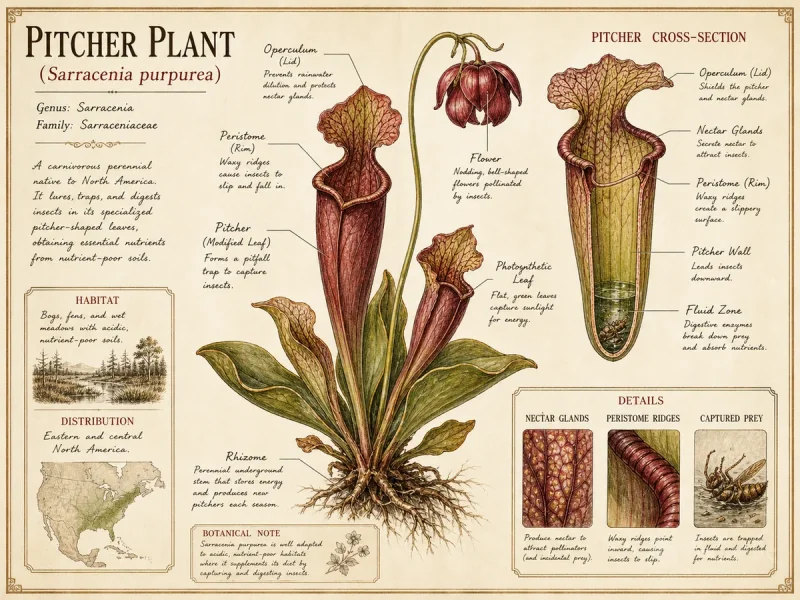
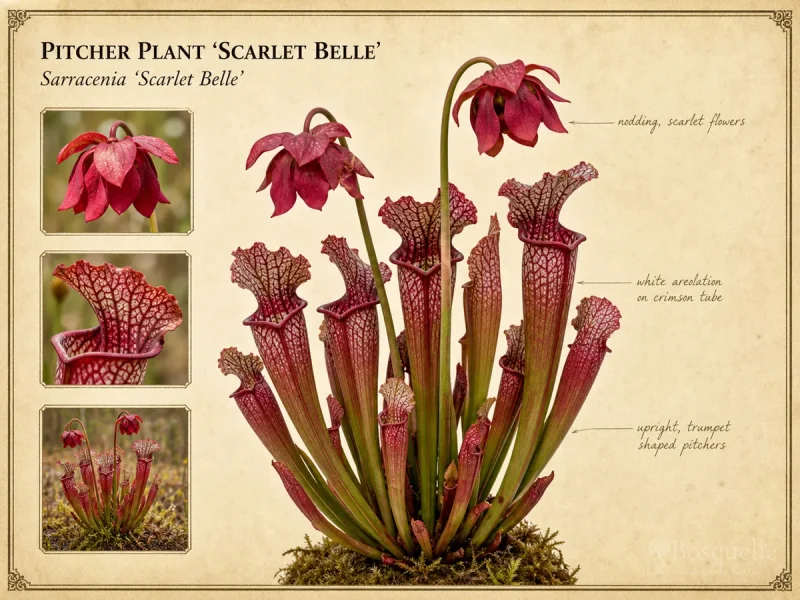
North American pitcher plant wants bright sun and wet, nutrient-poor peat. Minerals in hard tap water and fertilizer in the mix burn the roots. [1] [2] A hardy cup such as purple pitcher plant and a tall trumpet such as yellow pitcher plant share that same sun and rainwater. Match kind on Types of Pitcher Plant.
Stand the pot in a shallow tray of rainwater while it is in growth. Do not dunk the whole crown. If tap water is your only option, use it only when dissolved minerals stay very low. [3]
Does a pitcher plant need full sun?
Yes. Give it about 6 hours of direct sun outdoors. Weak light makes floppy, pale pitchers. A closed terrarium is the wrong home.
What water should I use?
Rainwater, distilled, or reverse-osmosis water. Hard tap water leaves minerals in the peat. Keep a shallow tray under the pot in the growing season, and never let the mix dry.
Do pitcher plants need fertilizer?
No. Skip soil fertilizer. Outdoor plants catch their own insects. Do not put hamburger or food scraps in the pitchers.
Give it a cold winter rest, and cut brown pitchers in spring
These plants are temperate. They need a cold rest of about three to five months. Pitchers browning as days shorten is normal, not a failed plant.
- Leave the plant outdoors through frost if your winters are moderate, or move the pot to an unheated garage, shed, or cold porch that stays cold. [4]
- Keep the peat damp — not sitting in a deep tray of water — through the rest so the rhizome does not dry.
- In late winter or early spring, cut fully brown pitchers down. Leave any pitcher that is still green, especially on purple and parrot kinds, which keep leaves longer.
- When new growth shows, return the pot to full sun and a shallow rainwater tray.
Do pitcher plants go dormant in winter?
Yes. They need a cold rest of about three to five months. Keep the peat damp. A warm indoor room year-round skips that rest and the plant weakens.
When do I cut brown pitchers?
Cut fully brown pitchers in late winter or early spring, before new growth. Leave green tissue. Purple and parrot pitchers often keep leaves into the next year.
Not a tropical hanging pitcher, a sundew, or a Venus flytrap
A hanging vine with pitchers on the leaf tips is Nepenthes — a tropical plant that does not want a winter freeze or a bog tray. Sticky glandular leaves are sundew; see How to Grow Sundew. A snap-trap is a Venus flytrap, not this genus. Cobra lily (Darlingtonia) is another bog plant with different culture. Hardy Sarracenia grows as an upright or low pitcher from the soil, outdoors, with a cold rest.
Is this the same as a tropical pitcher plant?
No. Tropical hanging pitchers are Nepenthes. North American pitcher plant is Sarracenia. It wants full sun, a bog tray, and winter cold.
If pitchers stay pale and floppy, move the pot into full sun and rainwater — do not wait for tap water and fertilizer to finish the clump.
FAQ
Can I grow pitcher plant indoors year-round?
Not as a windowsill houseplant that skips winter. It needs a cold rest. A bright outdoor pot is the usual home.
Can I feed it hamburger?
No. The plant cannot digest fats. Outdoor plants catch insects. Do not put food scraps in the pitchers.
Can I dig a pitcher plant from a bog?
No. Wild plants are protected in many places, and dug clumps often die. Buy nursery-grown stock. Montane pitcher plant is especially scarce.
What pests hit pitcher plant?
Aphids and thrips can twist new pitchers. Wipe them off the new growth as soon as you see them.
Can I plant it with a sundew?
Only if both plants share the same sun, rainwater, and winter rest. Sundew care is on How to Grow Sundew.
Related guides


Recommended plants


References
- [1] NC State Extension Gardener -
https://plants.ces.ncsu.edu/plants/sarracenia/ - [2] Grow Carnivorous Plants -
https://www.growcarnivorousplants.com/sarracenia-care/ - [3] New York Botanical Garden -
https://libguides.nybg.org/c.php?g=654975&p=4597450 - [4] New England Carnivorous Plant Society -
https://www.necps.us/caresheets/american-pitcher-plants
This note is part of Sarracenia Guides.
More first-season notes by plant are gathered in How to Grow Guides.
Updated: Reviewed by Bosquelle Editors