
Grow earth star in bright light, water the mix when the surface is dry, and do not fill a cup. Earth star is Cryptanthus. Shops also say earth star bromeliad or Pink Starlite.

Give it bright light, water the mix not the cup, and keep it evenly moist
| Factor | Recommended | Avoid |
|---|---|---|
| Light | Bright light; a little morning sun is fine | Do not set it in hot midday sun, or on a dim shelf that turns pink leaves green |
| Soil | A loose, humus-rich mix that still drains | Do not use a dense mix that stays soggy, and do not mount it like an air plant |
| Water | Water the mix when the surface is dry, then empty the saucer | Do not pour water into the center of the rosette, and do not let the mix go bone-dry |
| Frost | Grow it as a houseplant, or move the pot out only in frost-free weather | Do not leave it out through a freeze |
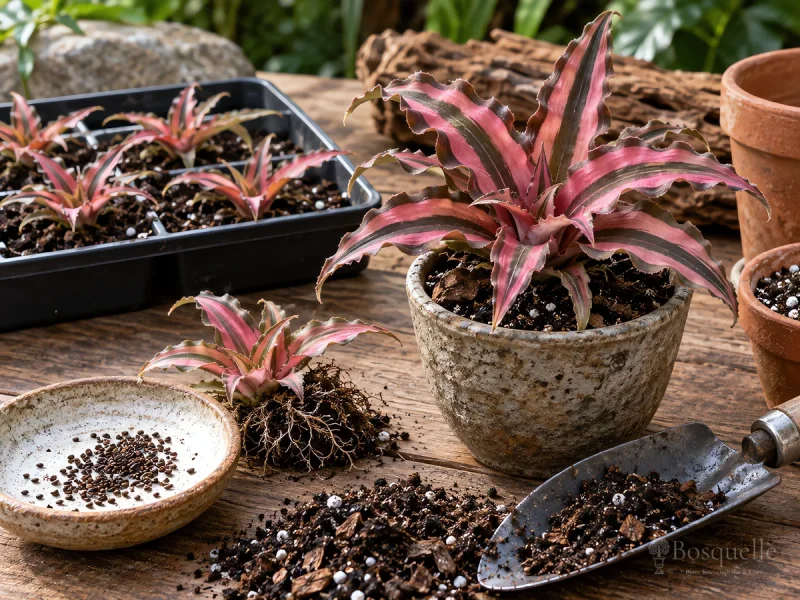
earth star is a terrestrial bromeliad. It sits in mix and takes water at the roots, so a cup of water in the rosette does not help and can rot the crown. [1] It is not a succulent either. Mix that stays evenly moist, then dries at the surface, is the site. Bone-dry mix shrivels the leaves; soggy mix rots the roots. [2] Keep it like an African violet on moisture: not soggy, and not bone-dry. [3] Pink and red stripes hold in bright light. Too little light turns the leaves plain green. Hot midday sun bleaches them.
- Set the plant in bright light. An east window, or a few feet back from a south or west window, is the usual indoor slot. Harden it before any outdoor sun, or the leaves bleach.
- Use a loose, humus-rich mix that still drains. Earth star cannot live mounted on bark the way an air plant can. [4]
- Water the mix when the surface is dry. Empty the saucer. Do not fill the center of the rosette.
- Keep the mix evenly moist in warm weather. In winter, wait longer between waterings, but do not let the roots go bone-dry.
- Keep it off heat vents and air-conditioning drafts. Dry moving air crisps the leaf edges.
How do you care for Earth Star plants?
Give it bright light and a mix that drains, and water the mix when the surface is dry. Do not fill a cup in the rosette.
How do you grow earth stars?
Bright light, evenly moist mix, and a shallow pot. Keep it indoors through frost.
How do you care for Earth Star Bromeliad?
Same job. Water the mix, not the center of the rosette, and keep it in bright light so the pink stripes hold.
Do I water the cup?
No. Earth star has no tank. Water the mix when the surface is dry, then empty the saucer.
Bring it in before frost, and water less in winter
If you move the pot outside for summer, give it bright shade at first, then bring it in before the first frost. In winter, keep it in a warm room and water less. Do not fertilize while growth is slow.
Use a shallow pot and a mix that drains, and wait to repot
The roots spread wide and stay shallow, so a wide, shallow pot with a hole in the bottom fits better than a deep pot of unused mix. Earth star does not need a larger pot often. Wait until the rosette is crowded, then step up only one size. Pups that fill the pot are a separate job on How to Propagate Earth Star.
- Choose a shallow pot with a drainage hole. A wide azalea pot is deep enough for the roots.
- Fill it with a loose, humus-rich mix that still drains. Set the rosette at the same depth as the nursery pot. Do not bury the leaves.
- Water the mix, then empty the saucer. Wait a few days before the next watering if you tore roots.
- Repot only when the clump is crowded, usually after a few years, in spring. Go up one size.
What kind of pot does it need?
A shallow pot with a hole. The roots spread wide, so extra depth of wet mix is wasted.
When should I repot it?
When the rosette is crowded. Stay one size up, and wait until spring if you can.
Not an air plant, not an urn plant, and not an earthstar fungus
Earth star sits in mix. An air plant is a tillandsia with no potting mix; it soaks and then dries on a mount. See How to Grow Air Plants if that is the plant you bought. An urn plant holds about an inch of water in a cup; earth star does not. See How to Grow Urn Plant if the tag is silver vase or urn plant. Pineapple is a different bromeliad grown for fruit. See How to Grow Pineapple if that is the plant you bought.
Earthstar fungus is a star-shaped puffball on the ground, not a houseplant. Starfish plant on this tag is still earth star. A starfish cactus is a different succulent. Zebra banding on a shop Cryptanthus is still this genus. A zebra plant with fat succulent leaves is Haworthia. See How to Grow Haworthia if that is the plant you bought.
Is an earth star the same as an air plant?
No. Air plants are tillandsias with no mix. Earth star sits in mix and is watered at the roots.
Is this the earthstar fungus?
No. Earthstar fungus is a puffball on the ground. This earth star is a small bromeliad in a pot.
Keep the mix evenly moist, and water when the surface is dry. Pups can wait until one is about a third the size of the mother.
FAQ
What about Pink Starlite, Ruby, or a zebra Cryptanthus?
Pink Starlite and Ruby are shop names for this same plant. They still want bright light and mix watered at the roots. A zebra Cryptanthus in a collector list is a cousin we do not hold separately; water it the same way if the tag is Cryptanthus.
Does it flower indoors?
Sometimes, after a few years. The small white flowers sit in the center of the rosette. After it flowers, the mother rosette declines and pups keep the clump going.
Are earth stars toxic to cats?
ASPCA lists earth star as non-toxic to cats and dogs. The leaf edges are toothed, so keep chew-happy pets from working the rosette.
Does it get mealybugs?
It can, mostly indoors. Check where the leaves meet the center. Wipe them off, and let the mix dry at the surface before you water again.
Related guides
Recommended plants

References
- [1] NC State Extension Gardener -
https://plants.ces.ncsu.edu/plants/cryptanthus-bivittatus/ - [2] University of Arkansas Extension -
https://www.uaex.uada.edu/yard-garden/resource-library/plant-week/Cryptanthus-hybrids-Earth-Star-06-07-2019.aspx - [3] Bromeliad Society Houston -
https://bromeliadsocietyhouston.org/common-genera/cryptanthus/ - [4] Clemson Home & Garden Information Center -
https://hgic.clemson.edu/factsheet/bromeliads/
This note is part of Cryptanthus Guides.
More first-season notes by plant are gathered in How to Grow Guides.
Updated: Reviewed by Bosquelle Editors