
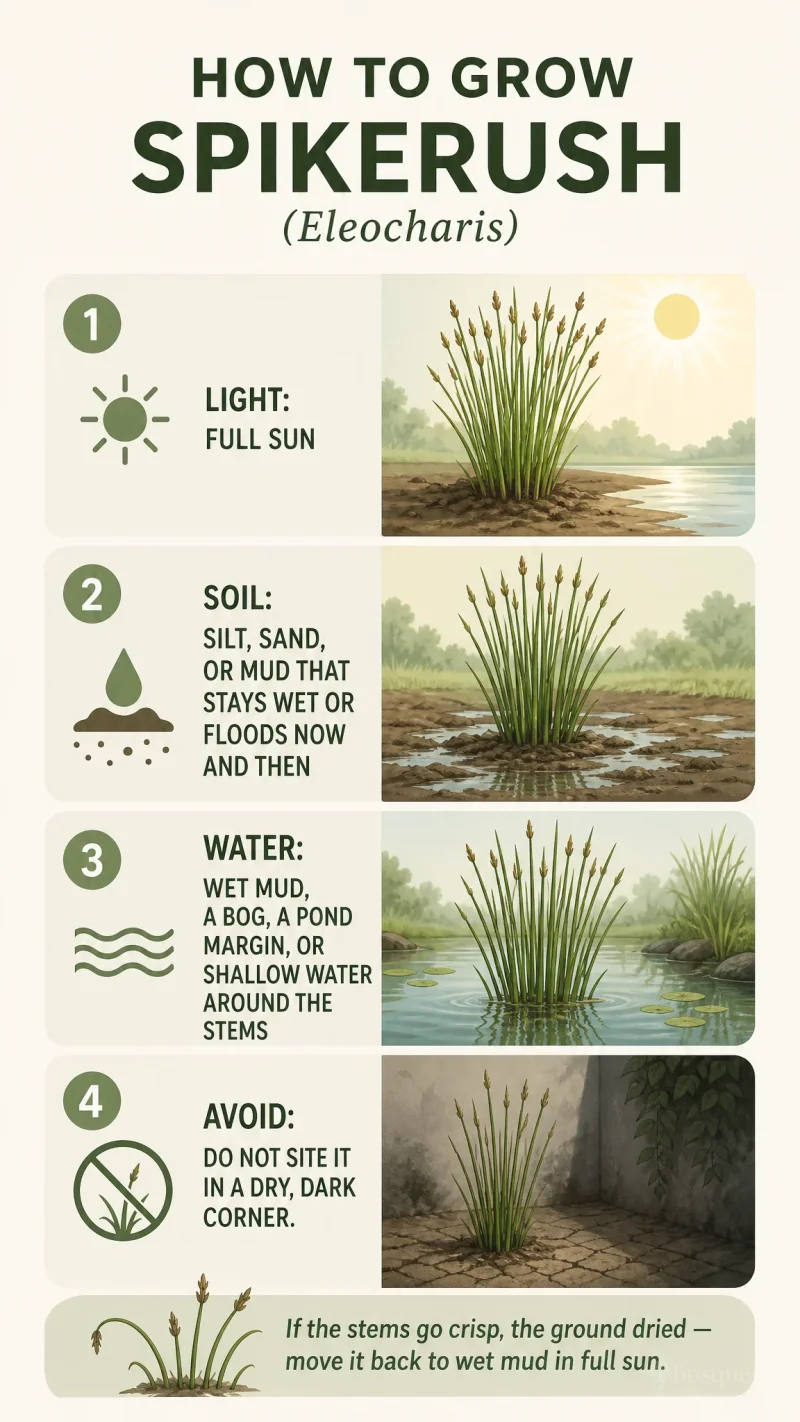
Grow spikerush in wet mud or shallow water, in full sun. Spikerush is Eleocharis, also sold as dwarf hairgrass when the stems are hair-thin.
Keep the ground wet, in full sun
| Factor | Recommended | Avoid |
|---|---|---|
| Light | Full sun, several hours of direct light | Do not site it in a dry, dark corner |
| Water | Wet mud, a bog, a pond margin, or shallow water around the stems | Do not let the ground dry, even once |
| Soil | Silt, sand, or mud that stays wet or floods now and then | Do not plant it in a mix that drains in a day |
| Spread | Let rhizomes form a colony along a wet edge you can contain | Do not toss extras into a lake or storm drain |
| Feed | Little fertilizer once the stems sit in wet mud | Do not dump nitrogen into a small tub and thicken algae |
Spikerush wants wet ground in full sun. Heat is fine; a dry week is not. Give it silt, sand, or mud that stays moist to wet, along a pond, ditch, or bog, and the stems will hold instead of going crisp. [1] needle spikerush uses that same wet site as a few-inch wet lawn. [2] pale spikerush uses the same water and light as a taller pond-edge colony, often one to three feet once the stems keep their heads above the water. [3] Both plants share the same water and light. This is a wetland plant, not a dry meadow grass, so the ground has to stay wet. [4] Set new plugs at the waterline on Planting Spikerush.
Does spikerush need full sun?
Give it full sun. Several hours of direct light keeps the stems dense. A dry, dark corner is the wrong site.
How wet does it need to stay?
Keep the ground wet. Wet mud, a bog, or shallow water around the stems is the home. A dry week kills it.
Not a true rush — and not tufted hairgrass or pink muhly
Garden-center rush in a rain garden is often Juncus, a true rush with pithy stems and real leaf blades — see How to Grow Rush. Lawn sedges with triangular stems and leaf blades are Carex — see How to Grow Sedge. Spikerush is Eleocharis: bladeless sheaths and one scaly spikelet at the tip.
Tufted hairgrass is Deschampsia, a clump grass for moist soil that is not a pond carpet — see How to Grow Tufted Hair Grass. Pink hair grass is pink muhly — see How to Grow Pink Muhly Grass. That dry-sun pink cloud is not a wetland sedge. Wire grass on a pale-spikerush tag is another shop name; Aristida wiregrass grows in dry sand, not wet mud. Aquarium cups labeled parvula or mini are extra dwarf-hairgrass plants, not pale spikerush. Read the Latin on the tag: Eleocharis for this plant.
Is this the same as dwarf hairgrass?
Needle spikerush is the plant sold as dwarf hairgrass. Tufted hairgrass is Deschampsia. Pink hair grass is pink muhly. Read the Latin name.
Is this a true rush?
No. Spikerush is Eleocharis, a sedge. True rush is Juncus. They are not interchangeable plants.
If the stems go crisp, the ground dried — move it back to wet mud in full sun.
FAQ
Can I grow spikerush in an aquarium?
Needle spikerush can sit submerged in a bright indoor tank. Pond and bog culture outdoors is the usual garden job. Pale spikerush is a pond-edge colony, not a tank carpet.
Can I grow spikerush in a pot?
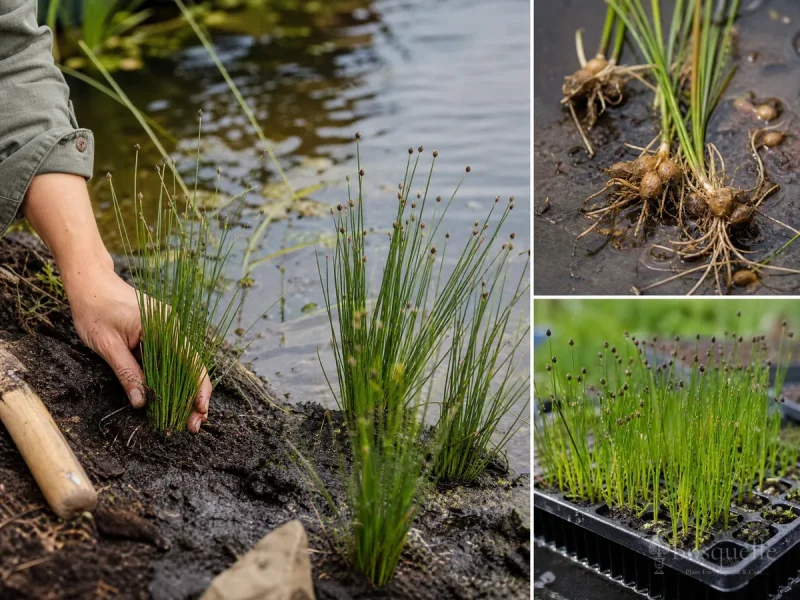
Yes, if the mix stays wet. Stand the pot in a tray of water. A mix that dries in a day kills it. A pond basket on a shelf is on Planting Spikerush.
Will it take over a small pond?
Pale spikerush fills a wet edge by rhizomes. Give it a contained shelf, and do not dump extras into a lake or storm drain. Needle stays a short lawn if the water stays shallow.
Related guides
Recommended plants


References
- [1] Illinois Wildflowers -
https://www.illinoiswildflowers.info/grasses/plants/needle_sprush.html - [2] Prairie Moon Nursery -
https://www.prairiemoon.com/eleocharis-acicularis-spike-rush - [3] Lady Bird Johnson Wildflower Center -
https://www.wildflower.org/plants/result.php?id_plant=ELMA5 - [4] Idaho Plant Materials -
https://plants.usda.gov/DocumentLibrary/plantguide/pdf/pg_elpa3.pdf
This note is part of Eleocharis Guides.
More first-season notes by plant are gathered in How to Grow Guides.
Updated: Reviewed by Bosquelle Editors