
Grow spatterdock in sun to part shade, in still or slow pond water about 1 to 3 feet deep. Spatterdock is Nuphar lutea subsp. advena, also sold as yellow pond lily or cow lily — not a true water lily and not a calla lily.
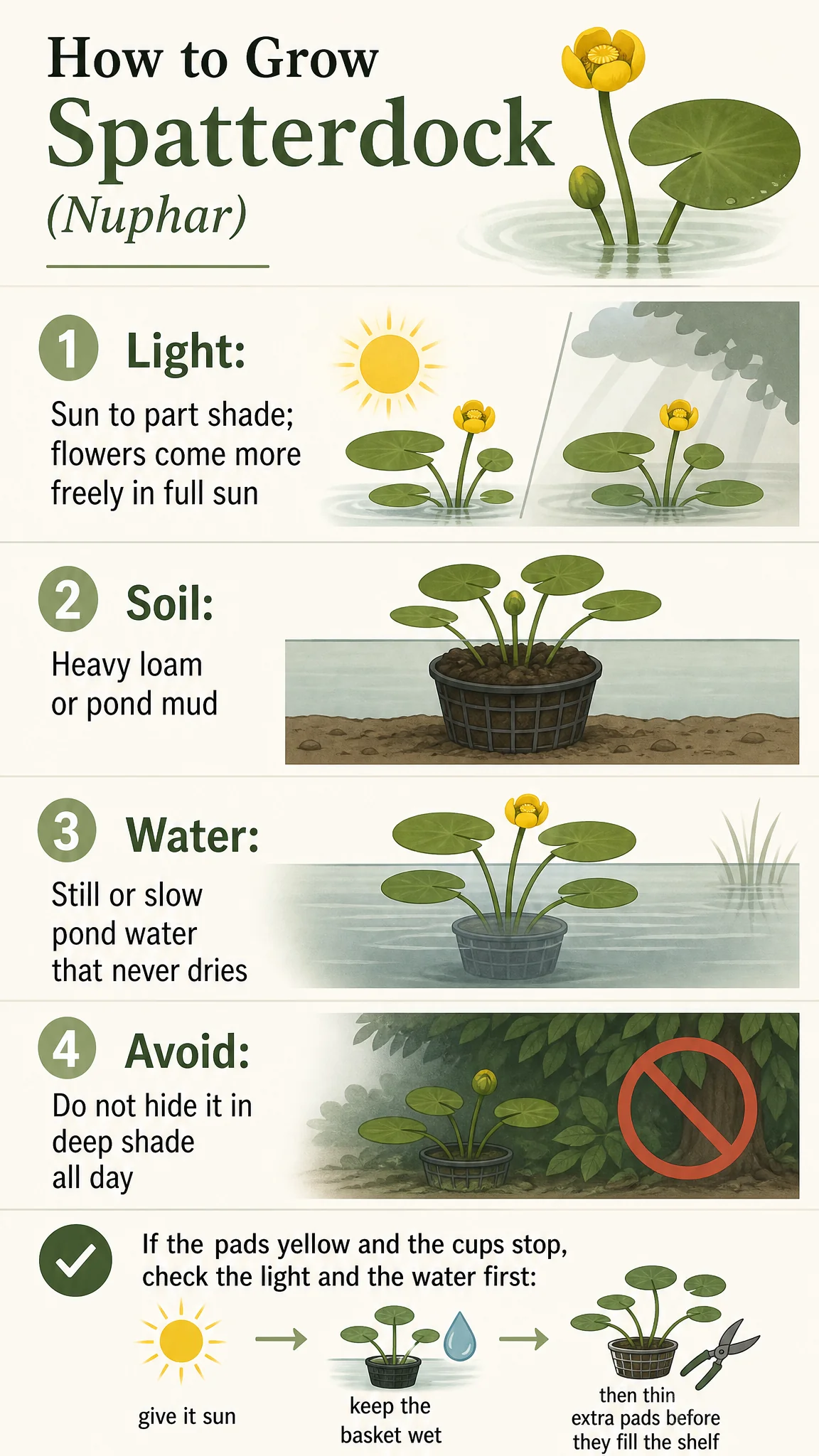
Give it sun to part shade and still pond water
| Factor | Recommended | Avoid |
|---|---|---|
| Light | Sun to part shade; flowers come more freely in full sun | Do not hide it in deep shade all day |
| Water | Still or slow pond water that never dries | Do not grow it in a dry pot, and do not set it in a fast current |
| Soil | Heavy loam or pond mud | Do not use lightweight potting mix, which floats and clouds the water |
| Depth | About 1 to 3 feet of water is the usual start; established plants tolerate deeper water than a true water lily | Do not drop a new plant off a deep shelf where the first leaves cannot reach the air |
| Winter | Leave the rhizomes in the mud | Do not lift them into a dry pot |
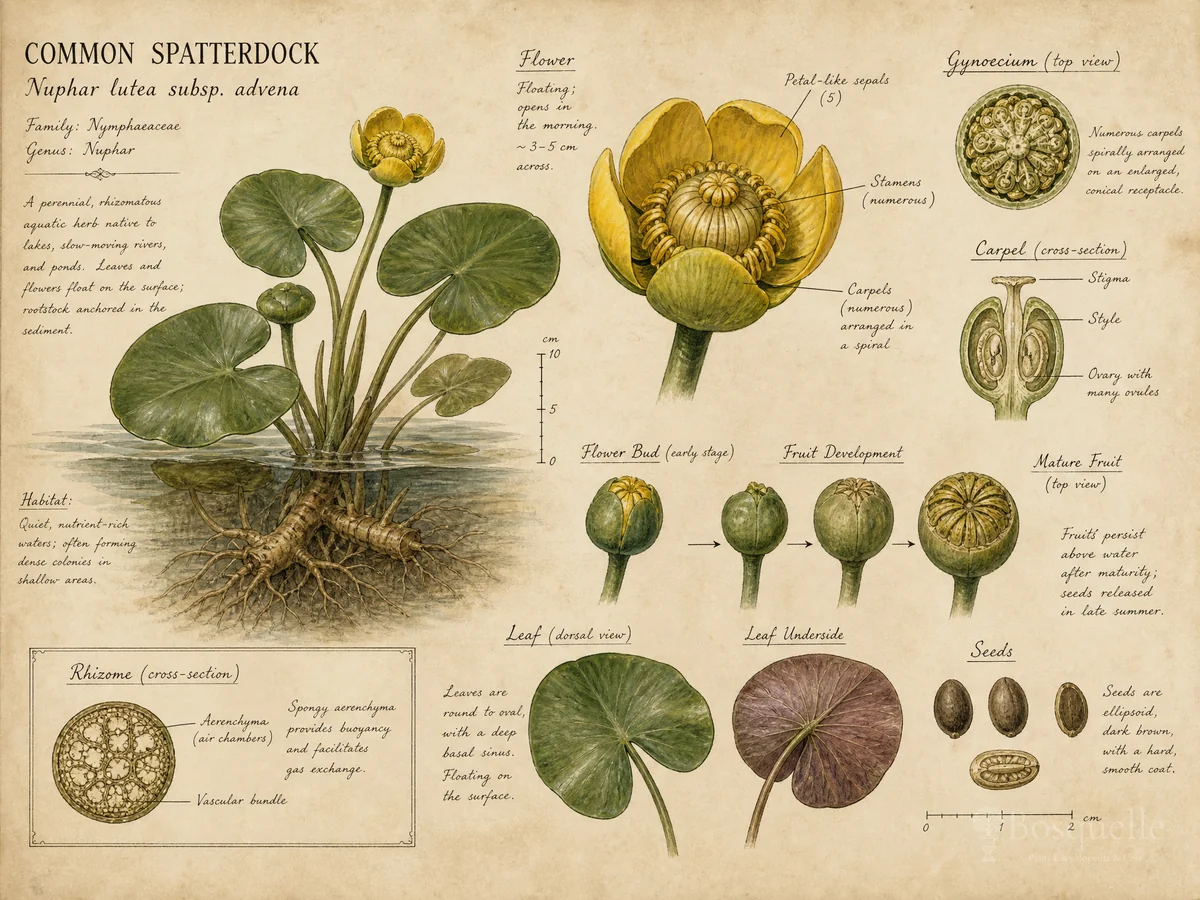
Spatterdock is Nuphar lutea subsp. advena, a native pond plant with heart-shaped leaves and yellow cups that only partly open. It wants sun overhead and water that stays put, with the thick rhizomes in mud. [1] Give it still or slow water about 1 to 3 feet deep to start. It takes part shade and deeper water better than a true water lily, so a pond with some tree cover can still work, but the cups thin out if the leaves sit in shade all day. [2] The flowers are fragrant and last a few days each, from late spring into fall, then the next cup takes its place. Leave the rhizomes in the mud when the pads die back. The basket recipe and the growing-tip angle sit on Planting Spatterdock.
How much sun does spatterdock need?
Sun to part shade. Flowers come more freely in full sun. Deep shade all day gives thin pads and few cups.
How deep should I set it?
Start a new plant in about 1 to 3 feet of water so the first leaves can reach the air. Established plants can sit deeper.
Thin extra pads so it does not fill the pond
The rhizomes creep through mud, so one plant can cover several feet of water in a few seasons. Keep the clump in a large pond basket and pull yellow pads when they crowd the shelf, the pump, or a neighbor plant. [3] Bag what you pull. Do not toss extras into a lake, a ditch, or a storm drain, because a broken rhizome roots again in still water.
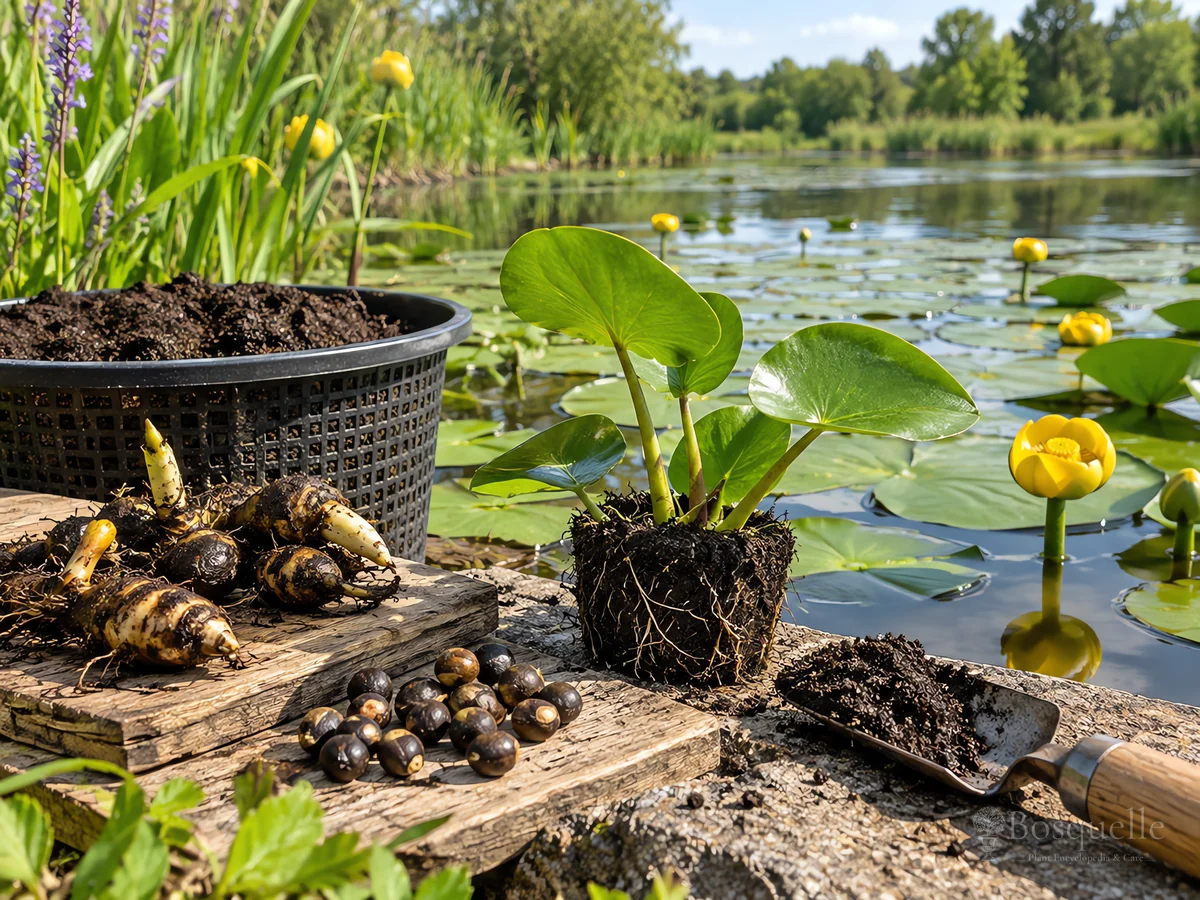
- Keep the plant in a large mesh pond basket, not loose in a small liner if you need to contain the run.
- Pull yellow or torn pads down near the basket so the stalks do not rot in the water.
- If pads crowd the open water, lift extra rhizomes in spring and replant only what you want to keep.
- Bag extras. Do not dump them into wild water.
How do I keep it from filling the pond?
Keep it in a large pond basket and pull yellow pads as they build up. Bag extras instead of tossing them into a lake.
Not a water lily — and not a lotus or a calla lily
A tag that says water lily is often a round pad with a slit and a showy many-petaled flower. Spatterdock has heart-shaped leaves with a wide notch and yellow cups that only partly open — see How to Grow Water Lily. [4] Lotus leaves stand above the water with no notch — see How to Grow Lotus. Watershield has smaller oval leaves with no slit and a jelly coating — see How to Grow Watershield. Floating heart has smaller pads and fringed yellow flowers — see How to Grow Floating Heart. People looking up cow lily often find a calla, a dry-bed bulb with a spathe — see How to Grow Calla Lily.
Is this a water lily?
No. A water lily has round pads with a slit and a showy many-petaled flower. Spatterdock has heart-shaped leaves and yellow cups that only partly open.
Is cow lily a calla?
Not this plant. Cow lily is a shop name for spatterdock. A calla is a dry-bed bulb with a spathe, not a pond rhizome.
If the pads yellow and the cups stop, check the light and the water first: give it sun and keep the basket wet, then thin extra pads before they fill the shelf.
FAQ
Are there other kinds of spatterdock?
The plant sold as spatterdock is Nuphar lutea subsp. advena. Extra shop names are usually the same pond rhizome, not a second type.
Can I grow it in a dry pot?
No. A mix that dries in a day dries the rhizome out. A pond basket works when the soil stays under water. It is not a patio houseplant.
Is this the Japanese aquarium plant?
No. Japanese spatterdock is a different species sold for tanks. This shop card is a native pond plant with large heart-shaped pads.
Will deer eat it?
Deer may graze the pads. Do not count on it as a deer-proof pond plant.
Does it come back after ice?
Leave the rhizomes in the mud. New leaves return when the pond warms. If the pond freezes to the bottom, move the basket to a wet, frost-free tub.
Is it toxic to pets or fish?
It is not treated as a poisonous pond plant. Keep pets from chewing the pads, and never dump extras into wild water.
Related guides
Recommended plants
References
- [1] USDA NRCS National Plant Data Center -
https://plants.sc.egov.usda.gov/DocumentLibrary/plantguide/pdf/pg_nulu.pdf - [2] Pond Informer -
https://pondinformer.com/common-spatterdock-nuphar-advena/ - [3] Rutgers Cooperative Extension -
https://njaes.rutgers.edu/fs1255/ - [4] Mississippi State University Extension -
https://extension.msstate.edu/publications/spatterdock-nuphar-advena
This note is part of Nuphar Guides.
More first-season notes by plant are gathered in How to Grow Guides.
Updated: Reviewed by Bosquelle Editors