
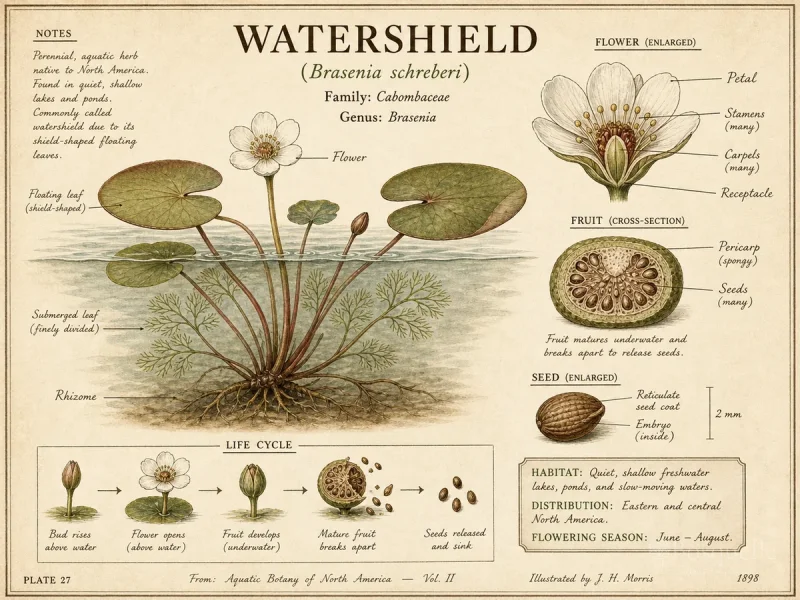
Grow watershield in full sun in still pond water. Watershield is Brasenia, also sold as water target or dollar bonnet.

Give it full sun and still pond water, with the roots in mud
| Factor | Recommended | Avoid |
|---|---|---|
| Light | Full sun | Do not plant it in dry shade on a bed |
| Water | Still or slow pond water over mud | Do not grow it in a dry pot |
| Soil | Heavy loam or pond mud in a pond basket | Do not use a light mix that floats away |
| Depth | About 8 to 10 inches of water over a new plant is the usual start; established plants can sit several feet deep | Do not drop a new rhizome off a deep shelf where the first leaves cannot reach the air |
| Winter | Leave the rhizomes in the mud | Do not lift them into a dry pot |
| Kind | Oval floating leaves with a gelatinous coating | Do not buy a round water-lily pad and expect this plant |
watershield wants full sun and still pond water, with the creeping rhizomes in mud. Oval leaves float on the surface, green above and often purple beneath, and a gelatinous coating — a clear jelly — covers the stems, buds, and undersides. [1] Small dull-purple flowers stand just above the water in summer. It is not a dry-bed shrub and not a windowsill houseplant. Still, lime-free water and a rich mud suit it better than a fast current or a chalky tank. [2]
How much sun does watershield need?
Give it full sun. Dry shade on a bed is the wrong home. The floating leaves need pond light.
How deep should I set it?
Start a new plant in about 8 to 10 inches of water so the first leaves can reach the air. Established plants can sit several feet deep.
Plant the rhizome in a pond basket, then set it in still water
Plant from a rhizome or a potted plant. Set the rhizome in heavy loam in a mesh pond basket, growing points up, and cover it so it stays wet. Start that basket in about 8 to 10 inches of still water so the new leaves can reach the surface. Once it is growing, it can sit several feet deep. Keep extras in the basket. This plant can cover a shallow pond in a few years if the rhizomes run free. [3]
- Keep the rhizome wet from the shop to the pond. Do not let it dry on a bench.
- Set it in heavy loam or pond mud in a mesh pond basket, growing points up, and cover the rhizome.
- Start the basket in about 8 to 10 inches of still water so new leaves can reach the air, then leave it, or lower it, as the leaf stalks lengthen.
- Cap the basket with a little gravel if the mix floats, and pull yellow pads so they do not rot in the water.
- Bag extras. Do not toss them into a lake, ditch, or storm drain. The rhizomes can fill a shallow pond.
How do I plant watershield?
Set the rhizome in heavy loam in a mesh pond basket, growing points up. Start it in about 8 to 10 inches of still water so the first leaves can reach the air.
Split a crowded rhizome in spring
Most gardeners start a new patch from a rhizome, not from seed. Lift a crowded clump in spring, keep a growing point on each piece, and replant at once in a fresh basket of heavy loam.
- Lift a crowded clump in spring so you can see the rhizomes.
- Cut a piece that has a growing point and some roots.
- Replant at once in a fresh basket of heavy loam, start it in shallow water, and keep the rhizome wet while it takes.
Not a water lily — and not spatterdock or floating heart
A tag that says water lily is often a round pad with a slit to the stalk and a showy flower. Watershield has smaller oval leaves with no slit, the stalk attached at the center, and a gelatinous coating on the underside — see How to Grow Water Lily. [4] Spatterdock, also called yellow pond lily, has heart-shaped leaves and yellow globe flowers. Floating heart has yellow fringed flowers — see How to Grow Floating Heart. Lotus leaves are large and stand above the water — see How to Grow Lotus.
Is this a water lily?
No. A water lily has round pads with a slit and showy flowers. Watershield has smaller oval leaves with no slit and a gelatinous coating on the underside.
Is this spatterdock?
No. Spatterdock has heart-shaped leaves and yellow globe flowers. Watershield has oval leaves and small dull-purple flowers.
Keep the pond still and sunny, plant the rhizome in a basket, and confirm the tag is not a water lily.
FAQ
Is fanwort the same plant?
No. Fanwort is usually Cabomba, a submerged aquarium plant with feathery leaves. This shop card is watershield, a pond plant with oval floating leaves and a gelatinous coating.
Can I grow watershield in a dry pot?
No. A mix that dries in a day dries the rhizome out, and it does not return. A pond basket works when the soil stays under water. It is not a dry patio plant.
Can I grow it from seed?
You can, but most gardeners plant a rhizome. Ripe seed needs to stay wet. The baskets still have to stay in the pond.
Can I eat the young leaves?
Do not eat this plant from the pond. Young shoots are eaten in parts of East Asia, but a garden pond is not a food crop. Grow it for the floating leaves, not as food.
Does it come back after ice?
Leave the rhizomes in the mud. New leaves return when the pond warms. Do not lift them into a dry pot. If the pond freezes to the bottom, move the basket to a wet, frost-free tub.
Recommended plants
References
- [1] NC State Extension -
https://plants.ces.ncsu.edu/plants/brasenia-schreberi/ - [2] Plants For A Future -
https://pfaf.org/user/Plant.aspx?LatinName=Brasenia_schreberi - [3] Missouri Department of Conservation -
https://mdc.mo.gov/discover-nature/field-guide/water-shield - [4] Minnesota Department of Natural Resources -
https://www.dnr.state.mn.us/aquatic_plants/floatingleaf_plants/watershield.html
More first-season notes by plant are gathered in How to Grow Guides.
Updated: Reviewed by Bosquelle Editors