
Grow Spanish broom in full sun, in poor soil that drains, and skip fertilizer. It is Spartium junceum, a rush-stem shrub about 6 to 10 feet tall, also sold as rush broom or weaver's broom. If the tag says Spanish broom but you have a 2- to 3-foot spiny cushion, that is Spanish gorse.
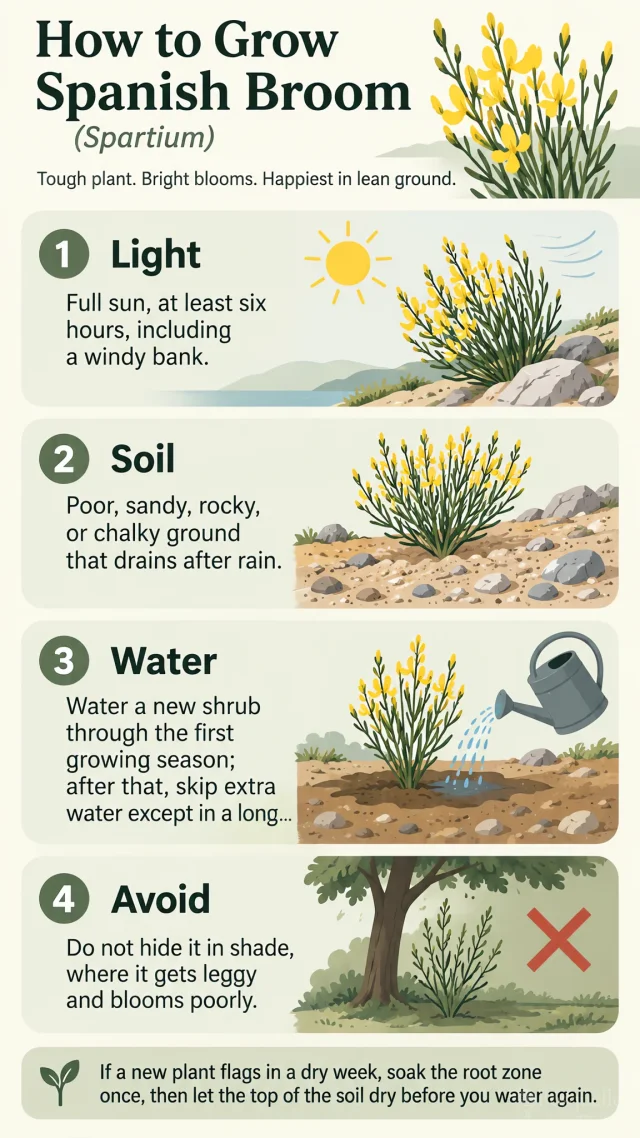
Give it full sun, poor soil that drains, and skip fertilizer
| Factor | Recommended | Avoid |
|---|---|---|
| Light | Full sun, at least six hours, including a windy bank | Do not hide it in shade, where it gets leggy and blooms poorly |
| Soil | Poor, sandy, rocky, or chalky ground that drains after rain | Do not plant it in a rich, wet hole, and do not work manure into the backfill |
| Water | Water a new shrub through the first growing season; after that, skip extra water except in a long drought | Do not keep the soil wet, and do not set it next to a lawn sprinkler |
| Feed | Skip fertilizer; the roots fix nitrogen | Do not dump nitrogen on it to force fast, weak growth |
| Cold | Give a first-year plant a frost-free start; an established shrub takes a mild winter in a warm-summer garden | Do not leave a young plant in a low frost pocket |
| Legal | Check your county noxious-weed list before you buy or plant it | Do not plant, sell, or sow it where it is listed or quarantined |
Spanish broom is a pea-family shrub with round, bright-green stems that stay nearly leafless most of the year. Give it a full day of sun and ground that dries after rain, and it will take ordinary dry weather once the roots are set. [1] A sheltered, rich bed makes it tall and sparse. Skip fertilizer. Water a new plant through its first growing season, then let the soil dry. [2] It is listed in parts of the West. Washington quarantines it, and some western states treat it as a noxious weed, so read the county list before you plant. [3] If the shrub has outgrown the driveway, see Prune Spanish Broom. Start from seed only where it is legal, on Growing Spanish Broom From Seed.
How much sun does Spanish broom need?
Full sun, at least six hours. Shade makes a leggy shrub with a thin bloom.
How often should I water Spanish broom?
Water a new shrub through the first growing season. After that, skip extra water except in a long drought. A wet hole still rots the roots.
Is it legal to plant Spanish broom?
Not everywhere. Check your county noxious-weed list. Do not plant, sell, or sow it where it is listed or quarantined.
Plant a young pot at the old soil line, in spring
Buy a young container plant and set the top of the root ball even with the surrounding soil. Spring is the usual window, once you can water and the soil is no longer frozen. A large, field-dug shrub sulks, so slide a pot you can lift without tearing the roots.
- Confirm the shrub is legal where you garden, then pick a full-sun bank that drains. Keep it off irrigated lawn.
- Soak the pot. Dig a hole as deep as the root ball and two to three times as wide. Tease circling roots.
- Set the old soil line even with the surrounding grade. Do not bury the green stems under extra backfill.
- Backfill with the soil you dug. Do not add compost or manure. Water to settle, and keep bark a few inches off the stems.
- Leave about 6 to 10 feet for a mature shrub. Read the size on the tag before you dig.
When do I plant it?
Spring, from a young pot, when you can water. Skip a heat wave, and do not plant into a hole that stays wet.
How far apart do I plant it?
Leave about 6 to 10 feet for a mature shrub. It outgrows a tight spot next to a driveway.
Not Spanish gorse — and not Scotch broom or gorse
Shop tags sometimes say Spanish broom on a low, spiny mound. That plant is Spanish gorse, Genista hispanica, about 2 to 3 feet tall. Grow it on How to Grow Genista. This shrub is Spartium junceum: round rush-like stems, small simple leaves that drop in summer, and fragrant yellow pea flowers in clusters at the tips. [4]
- Spanish broom — round, finely ribbed green stems; simple leaves; fragrant flowers at the branch tips; 6 to 10 feet.
- Scotch broom — five-angled stems; trifoliate leaves; flowers in the leaf axils, usually without that heavy fragrance. Grow it on How to Grow Scotch Broom.
- Spanish gorse — a 2- to 3-foot spiny cushion. The tag may still say Spanish broom.
Gorse is Ulex, with sharp spines. Butcher's broom is Ruscus, a different evergreen with red berries — see How to Grow Butcher's Broom. Desert broom is Baccharis — see How to Grow Coyote Brush if that is the tag. A witches' broom is a dense cluster of shoots on a tree, not a shrub you buy. French broom and Portuguese broom are other weedy pea shrubs with mostly trifoliate leaves. If the stems are round and green, the leaves are simple, and the Latin is Spartium, you still have this plant.
Is this Spanish gorse?
No. Spanish gorse is a low, spiny Genista cushion. Spanish broom is the 6- to 10-foot rush-stem shrub.
Is this Scotch broom?
No. Scotch broom is Cytisus, with ridged stems and flowers in the leaf axils. Spanish broom has round stems and flowers at the tips.
If a new plant flags in a dry week, soak the root zone once, then let the top of the soil dry before you water again.
FAQ
Are rush broom and weaver's broom the same plant?
Yes. Those are other shop names for Spartium junceum. The 6- to 10-foot rush-stem shrub is this plant.
Is Brockhill Compact a different kind?
It is a shorter garden form of the same species. It still wants full sun, poor soil that drains, and no extra fertilizer.
Can I keep Spanish broom in a pot?
A young plant can sit a season in a pot with a drainage hole and a mix that drains. A mature shrub wants open ground. It is not a houseplant.
Is Spanish broom toxic if eaten?
The shrub is harmful if eaten. Keep pets from chewing the stems, and do not cook with the flowers.
When does it bloom?
Fragrant yellow pea flowers open in summer and can run into fall. Small leaves drop in the heat; the green stems keep working.
What else likes this same dry bank?
Other Mediterranean shrubs that want full sun and soil that drains can share the bed. Do not pair it with a lawn or a wet perennial border.
Related guides
Recommended plants

References
- [1] NC State Extension Gardener -
https://plants.ces.ncsu.edu/plants/spartium-junceum/ - [2] Royal Horticultural Society -
https://www.rhs.org.uk/plants/68455/spartium-junceum/details - [3] Washington State Noxious Weed Control Board -
https://www.nwcb.wa.gov/weeds/spanish-broom - [4] UC IPM -
https://ipm.ucanr.edu/PMG/PESTNOTES/pn74147.html
This note is part of Spartium Guides.
More first-season notes by plant are gathered in How to Grow Guides.
Updated: Reviewed by Bosquelle Editors