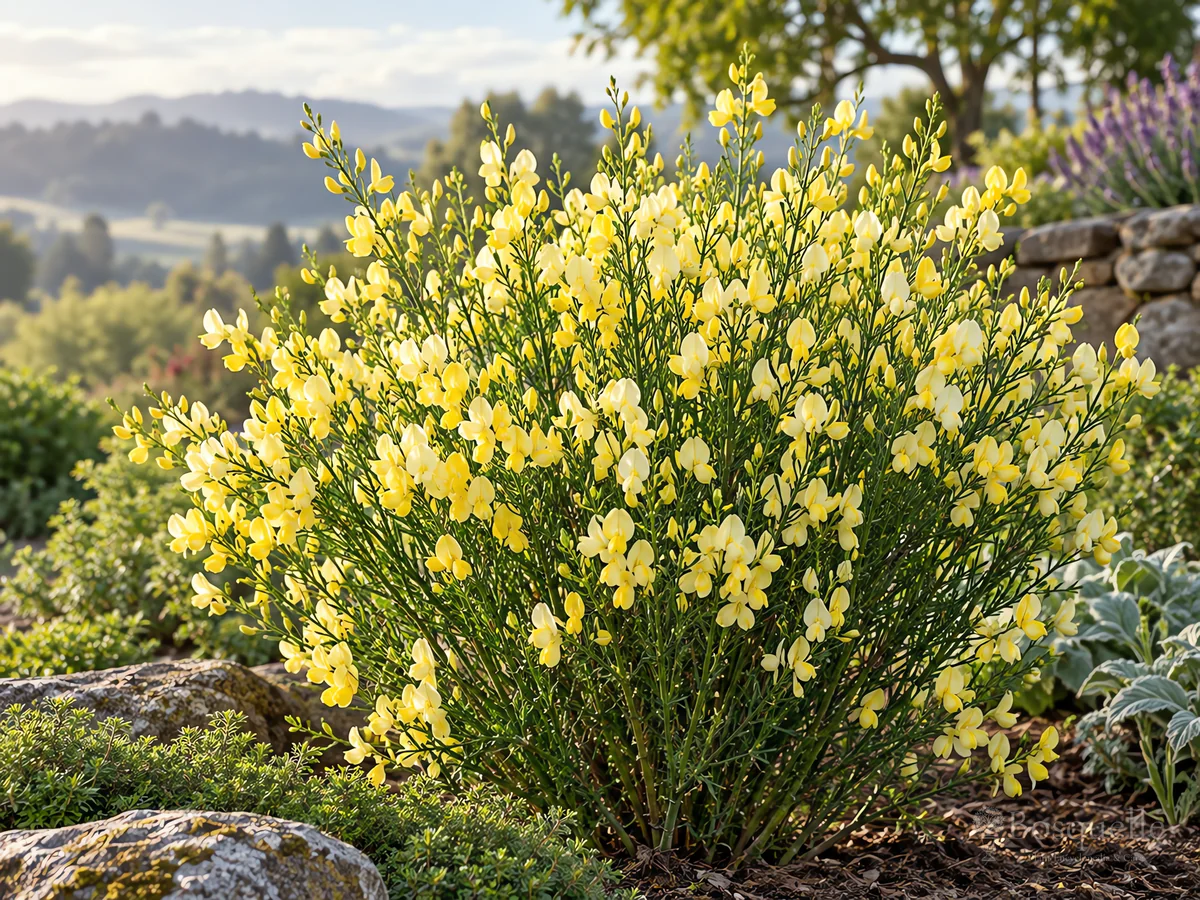
Grow Scotch broom in full sun, in poor soil that drains, and skip fertilizer. Scotch broom is Cytisus. Check your county noxious-weed list before you plant Cytisus scoparius, including Moonlight.
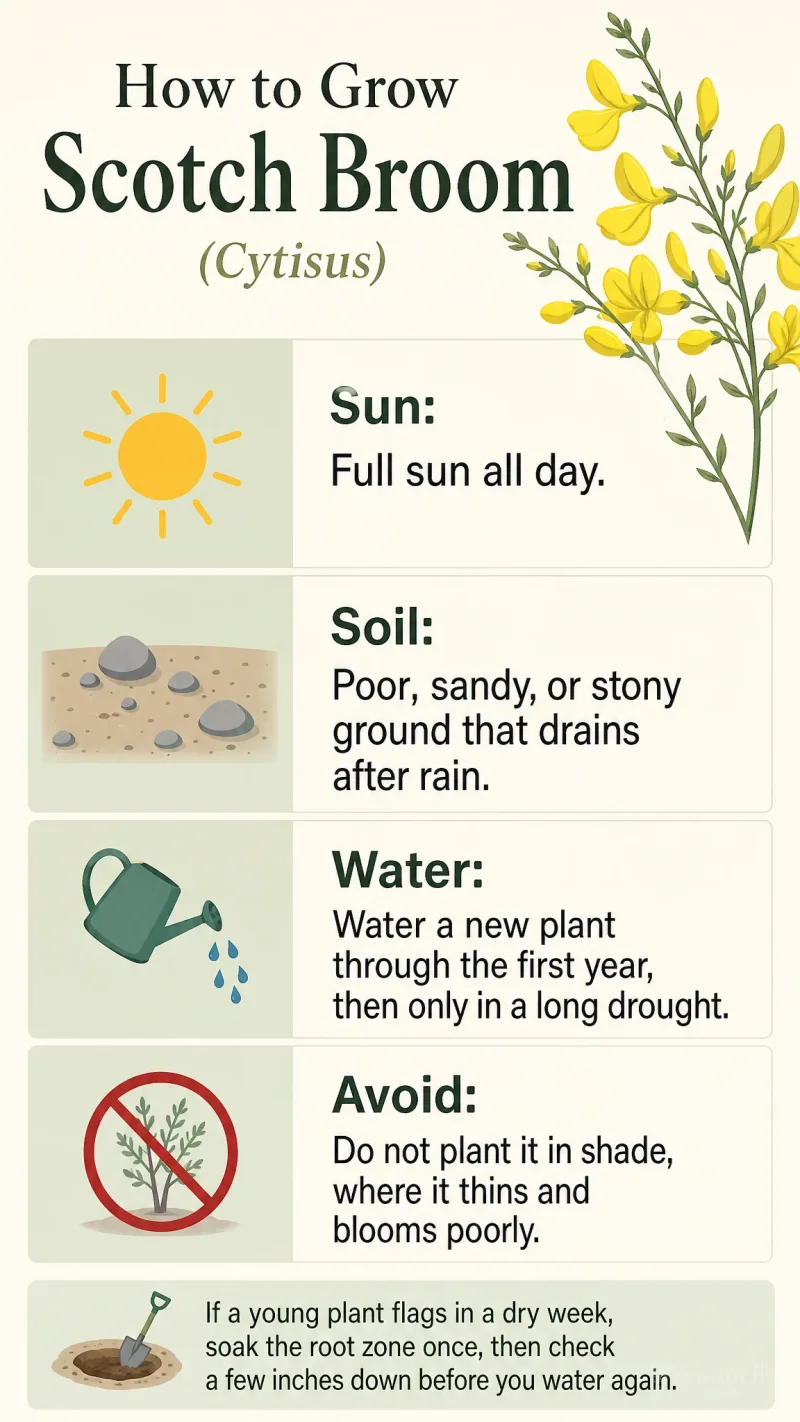
Give it full sun, lean soil that drains, and skip fertilizer
| Factor | Recommended | Avoid |
|---|---|---|
| Sun | Full sun all day | Do not plant it in shade, where it thins and blooms poorly |
| Soil | Poor, sandy, or stony ground that drains after rain | Do not plant it in a rich, soggy bed |
| Water | Water a new plant through the first year, then only in a long drought | Do not keep the roots wet once it is established |
| Feed | Skip fertilizer; this shrub lives longer in lean ground | Do not feed it on a lawn schedule |
| Kind | Warminster broom for an earlier 3- to 5-foot garden hybrid; Moonlight only where Cytisus scoparius is legal | Do not plant the noxious species where your county lists it |
Scotch broom wants full sun and poor soil that still drains. Extra water and fertilizer shorten its life. [1] It also takes dry ground and coastal salt once the roots are down. [2] Water a new plant through the first year, then let rainfall carry it except in a long dry spell. Warminster broom is the earlier garden hybrid. Moonlight is still Cytisus scoparius — check the list before you plant it. When the flowers fade, see Prune Scotch Broom.
How much sun does Scotch broom need?
Full sun. Shade thins the stems and cuts the spring bloom.
How often should I water Scotch broom?
Water a new plant through the first year. After that, water only in a long drought. Do not leave the roots in standing water.
Which broom should I buy?
Buy Warminster broom for a 3- to 5-foot earlier hybrid. Buy Moonlight only if Cytisus scoparius is legal where you garden.
Plant a young pot at the same depth, in spring or fall
Set a young container plant so the top of the root ball sits even with the surrounding soil. Plant in spring or fall, when you can water and the heat is not extreme. [3] A large, field-dug shrub sulks; buy a pot you can slide out without tearing the roots.
- Soak the pot, then dig a hole as deep as the root ball and two to three times as wide. Tease circling roots.
- Set the top of the root ball at the surrounding soil grade. Do not bury the stems under extra backfill.
- Leave about five to eight feet for a mature shrub. Read the size on the tag before you dig.
- Backfill with the original soil, water to settle, and mulch the root zone. Keep bark a few inches off the stems.
Moonlight uses that same depth. Warminster broom uses that same depth too; it only needs a little less room to the sides.
When should I plant Scotch broom?
Spring or fall, from a young pot, when you can water. Skip a heat wave, and do not plant into a hole that stays wet.
How far apart do I plant it?
Leave about five to eight feet for a mature shrub. Read the size on the tag before you dig.
Root a summer cutting if you want another plant
Named garden brooms root from a summer shoot. Do not sow Cytisus scoparius seed where the species is a noxious weed; pods throw seed several feet, and that seed can sit in the soil for years.
- After bloom, take a semi-ripe green shoot about four to six inches long.
- Strip the lower leaves, dip the cut in rooting hormone, and stick it in a sandy mix that drains.
- Keep the mix barely moist under a cover or mist until roots take. Do not sit the cutting in standing water.
Can I grow Scotch broom from seed?
Named plants root from summer cuttings. Do not sow Cytisus scoparius seed where the species is a noxious weed.
Not Genista, Spanish broom, or gorse
Scotch broom is Cytisus, a pea-family shrub with green ridged stems and yellow or cream pea flowers. Other plants share the word broom and they are not this one. [4]
- Scotch broom (Cytisus scoparius) — five-angled green stems; trifoliate leaves on the lower shoots; flowers in the leaf axils. ‘Moonlight’ is still this species.
- Warminster broom (Cytisus × praecox) — a smaller, earlier hybrid with mostly simple leaves. The shop tag may still say Scotch broom.
- Genista — another pea-family broom, often greener on alkaline ground. It is not this genus — see How to Grow Genista.
- Spanish broom — Spartium junceum, with round stems and flowers in clusters at the tips, not in the leaf axils.
Gorse is Ulex, with sharp spines. Butcher's broom is Ruscus, a different evergreen with red berries. A witches' broom is a dense, witchy cluster of shoots on a tree, not a shrub you buy. Desert broom is Baccharis — see How to Grow Coyote Brush if that is the tag. If the stems are green and ridged, the flowers are pea shaped, and the Latin starts with Cytisus, you still have this plant.
Is witches' broom the same plant?
No. A witches' broom is a dense cluster of shoots on a tree. Scotch broom is Cytisus, a pea-family shrub.
Is butcher's broom the same plant?
No. Butcher's broom is Ruscus, a different evergreen. Scotch broom is Cytisus.
If a young plant flags in a dry week, soak the root zone once, then check a few inches down before you water again.
FAQ
Can I grow Scotch broom in a pot?
A young plant can live a season in a pot with a drainage hole and a mix that drains. A mature shrub wants open ground that stays lean and dry.
Is Scotch broom legal to plant?
Cytisus scoparius is a noxious weed in much of the West and in some eastern counties. Check your county list before you plant it. Warminster broom is a garden hybrid, not the noxious species.
Are the seeds poisonous?
Seeds and stems can poison people and livestock if eaten. Keep livestock off the shrub, and do not leave pods where animals browse.
What pests hit Scotch broom?
It is usually clean. Leaf or stem blight can show in wet, still air. Give it sun and draining soil. If the shrub is seeding into wild ground, pull it before the pods pop.
Is Moonlight a Warminster broom?
No. Moonlight is Cytisus scoparius with cream flowers. Warminster broom is Cytisus × praecox.
Related guides
Recommended plants


References
- [1] JC Raulston Arboretum -
https://jcra.ncsu.edu/horticulture/plant-profiles/details.php?ID=70 - [2] NC State Extension Gardener -
https://plants.ces.ncsu.edu/plants/cytisus-x-praecox/ - [3] BBC Gardeners' World -
https://www.gardenersworld.com/how-to/grow-plants/how-to-grow-and-care-for-a-broom-plant/ - [4] NC State Extension Gardener -
https://plants.ces.ncsu.edu/plants/cytisus-scoparius/
This note is part of Cytisus Guides.
More first-season notes by plant are gathered in How to Grow Guides.
Updated: Reviewed by Bosquelle Editors