
Grow snow-in-summer in full sun, in dry soil that drains. Snow-in-summer is Cerastium. Shops also say Jerusalem star or woolly mouse-ear chickweed. Dusty miller printed on this tag is still this silver mat, not the bedding plant sold as dusty miller.
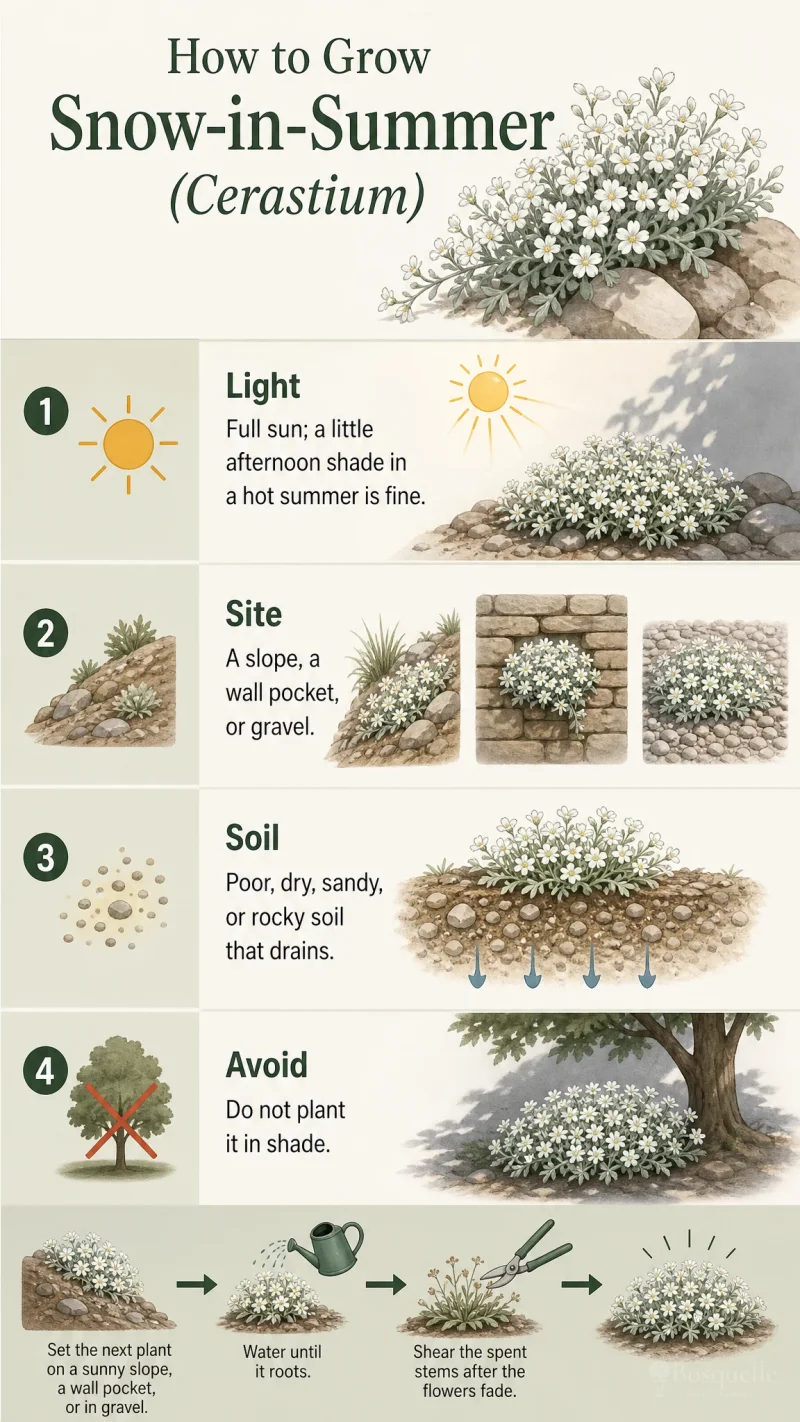
Give it full sun and dry soil that drains
| Factor | Recommended | Avoid |
|---|---|---|
| Light | Full sun; a little afternoon shade in a hot summer is fine | Do not plant it in shade |
| Soil | Poor, dry, sandy, or rocky soil that drains | Do not plant it in heavy, wet clay |
| Water | Water until it is established, then only when the soil is dry | Do not keep the crown wet |
| Site | A slope, a wall pocket, or gravel | Do not use it as a lawn you walk on |
| Heat | A cooler, drier summer; the mat thins in hot, humid weather | Do not expect a thick carpet in a steamy wet bed |
| Deer | They usually leave this plant | Do not treat it as a fence; a hungry deer can still browse |
snow-in-summer is an evergreen silver mat with narrow gray-green leaves felted in white hairs. Give it full sun and soil that drains fast. Poor, sandy, or rocky ground is the right home, because rich, wet soil holds water at the crown and the roots rot. [1] Once the roots take, water only when the soil is dry. In a hot, humid summer the mat often thins, even when the winter was fine. [2]
How much sun does snow-in-summer need?
Full sun. Shade makes a thin, leggy mat with few flowers. Light afternoon shade is fine in a hot summer.
How often do I water it?
Water until it is established, then only when the soil is dry. A wet crown is a poor site.
Plant it on a slope, a wall, or in gravel
Set it where water cannot sit at the crown: a sunny bank, a stone wall, or a gravel bed. Put the crown at soil level. In a wall, press the root ball into a gritty pocket so the mat sits on the face of the stone. The plant spreads by underground runners, so give it a hard edge or a pocket of its own if you do not want it in the next bed. In a cool summer it can overrun small alpines if you leave the runners unchecked. [3]
- Plant in spring, in full sun, after the soil drains.
- Set the crown at soil level. In a wall, press the root ball into a mix of soil and grit so the mat sits on the face of the stone.
- Space plants 9 to 12 inches apart so the mats can meet. In a mixed border, set a hard edge so runners stay in their strip.
- Water until the planting is established, then let the soil dry between waterings.
Grow it in a trough that drains
A shallow trough or a terracotta pot with a hole in the bottom can hold one mat on a patio. Use a gritty mix, not a peaty mix that stays wet. Water when the mix is dry, and dump any water that sits in a saucer. This is an outdoor wall plant, not a houseplant.
- Choose a trough or terracotta pot with a hole in the bottom.
- Fill it with a gritty mix, and plant one mat.
- Water when the mix is dry. Empty standing water from the saucer.
How do I plant it on a slope or a wall?
Press the root ball into a gritty pocket so the mat sits on the face of the stone, then water until it roots. On a slope, set the crown at soil level.
Does it spread too far?
It can, in a cool, dry summer. Keep a hard edge around the strip, and pull runners that cross into the next bed.
Can I grow it in a pot?
Yes, in a trough or terracotta pot with a drainage hole and a gritty mix. Water when the mix is dry.
Shear the spent stems after the flowers fade
When the white flush finishes, shear off the spent flower stems. Stems left in place set seed, and the mat then pops up in the next bed. Cut it after bloom, not in fall. A fall cut leaves the evergreen foliage open to winter wet. [4]
- Wait until the flowers fade, usually late spring or early summer.
- Shear off the spent stems, or mow a large planting on a high setting.
- Do not prune in fall. Leave the silver foliage through winter.
Divide the mat, or root a cutting in early summer
Non-flowering stem cuttings taken in early summer root in a sandy mix. If the mat is crowded or the center has died out, lift it in spring or fall, split it into pieces with roots and foliage, and replant at once. Cuttings and division are more even than a packet of seed.
- Take two- to three-inch tip cuttings in early summer, after you shear the spent stems.
- Strip the lower leaves, stick the cuttings in sand or a gritty mix, and keep the mix barely moist until roots form.
- Divide a crowded mat in spring or fall, and replant the pieces at the same depth.
When do I cut it back?
After the flowers fade in late spring or early summer. Shear off the spent stems, and skip a fall prune.
Not dusty miller — and not chickweed
Dusty miller in a bedding six-pack is Jacobaea, a silver mound grown for foliage, not this white carpet. See How to Grow Dusty Miller if that is the plant you bought. Dusty miller printed on this Cerastium tag is still snow-in-summer.
Woolly mouse-ear chickweed on this tag is still this ornamental mat. Chickweed in a lawn is a different plant, usually Stellaria, and it is a weed, not a ground cover you plant on purpose. Lambs-ear is Stachys, a thicker silver leaf — see How to Grow Lambs-Ear if the tag is Stachys. Sandwort is Arenaria, a dark-green mat, not this felted silver one — see How to Grow Sandwort if that is the plant you bought.
Purple rock cress is Aubrieta — see How to Grow Rock Cress if the flowers are purple on a hairy green cushion. White wall rock cress is Arabis — see How to Grow Mountain Rock Cress if the tag says Arabis. Moss phlox is Phlox — see How to Grow Phlox if you bought a creeping phlox. Shops also sell Asiatic jasmine as Snow-N-Summer. That is a vine or a green mat, not this silver Cerastium. See How to Grow Star Jasmine if the tag is Trachelospermum.
Is dusty miller the same plant?
No. Bedding dusty miller is Jacobaea, grown for silver foliage. This plant is Cerastium, a silver mat that covers itself in white flowers. Dusty miller on this tag is still snow-in-summer.
Is this the chickweed in my lawn?
No. Chickweed in a lawn is a weed, usually Stellaria. Woolly mouse-ear chickweed on this tag is still snow-in-summer, the ornamental silver mat.
Set the next plant on a sunny slope, a wall pocket, or in gravel, in grit, water until it roots, then shear the spent stems after the flowers fade.
FAQ
Can I grow it from seed?
You can, from a purchased packet, but stem cuttings in early summer and division are more even. Direct-sown seed often waits until the second year to flower. Sow only if you want to raise a batch and can wait.
What about Yo Yo or Silver Carpet?
Those are named selections of this same plant. They still want full sun, dry drain, and a shear after bloom. Compact kinds spread more slowly, but they are the same job as the species mat.
Is it a houseplant?
No. Grow it outdoors on a slope, a wall, or a trough that drains. A windowsill pot that stays wet will rot.
Recommended plants

References
- [1] NC State Extension -
https://plants.ces.ncsu.edu/plants/cerastium-tomentosum/ - [2] The Morton Arboretum -
https://mortonarb.org/plant-and-protect/trees-and-plants/snow-in-summer/ - [3] Cornell Home Gardening -
http://www.gardening.cornell.edu/homegardening/scenef96a.html - [4] Gardeners Path -
https://gardenerspath.com/plants/flowers/grow-snow-in-summer/
More first-season notes by plant are gathered in How to Grow Guides.
Updated: Reviewed by Bosquelle Editors