
Grow skeleton-leaf goldeneye in full sun on soil that drains, and water it only in a long dry spell once it has settled in. Skeleton-leaf goldeneye is Viguiera stenoloba, also called resinbush — a Texas and New Mexico shrub with threadlike leaves, not showy goldeneye.
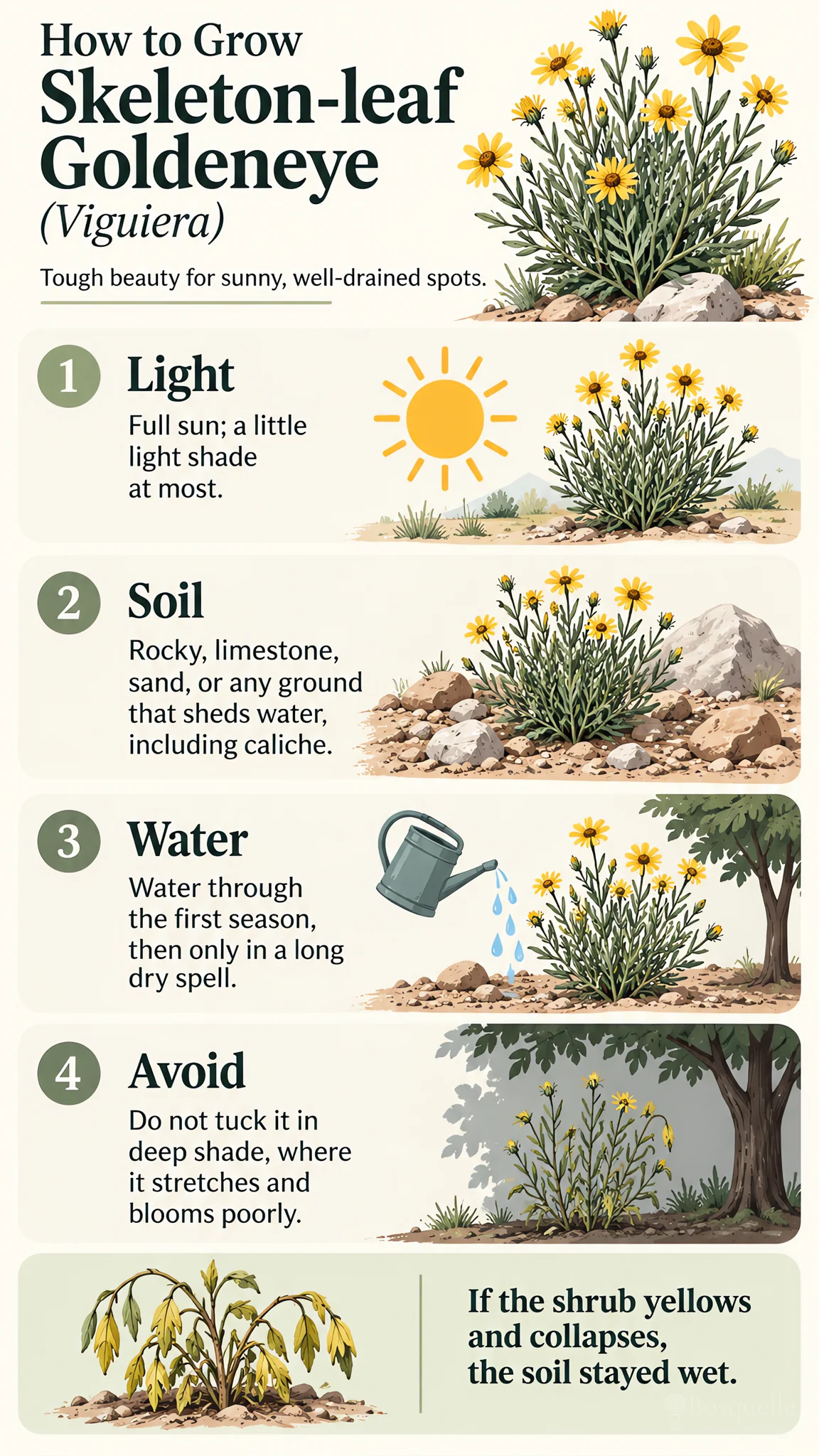
Give it full sun and soil that drains
| Factor | Recommended | Avoid |
|---|---|---|
| Light | Full sun; a little light shade at most | Do not tuck it in deep shade, where it stretches and blooms poorly |
| Soil | Rocky, limestone, sand, or any ground that sheds water, including caliche | Do not plant it in a low, wet clay pocket where water stands after rain |
| Water | Water through the first season, then only in a long dry spell | Do not keep the soil soggy or run drip on it all summer once the roots have taken |
| Feed | Little or none — lean ground keeps the mound tight | Do not feed it richly, because soft growth opens up and flowers less |
skeleton-leaf goldeneye is a rounded native shrub about two to four feet tall and about as wide, with narrow, threadlike leaves and yellow-orange daisies on leafless stalks. Sit it in full sun. It will take a little light shade, but the mound is denser and the bloom heavier in open light. [1] The plant is built for dry, rocky ground, so drainage is the real test. Limestone, caliche, sand, and ordinary loam all work if water can leave the roots. In heavy clay, raise a small berm and work in decomposed granite so the crown does not sit wet. [2] Water a new plant through its first season. After that it is drought tolerant and needs a deep soak only in a long dry spell. Pair it with other plants that also want sun and lean, dry ground.
How do you grow skeleton-leaf goldeneye?
Give it full sun and soil that drains. Water it through the first season, then only in a long dry spell. Rich, wet ground is the usual reason the roots rot.
How often do I water skeleton-leaf goldeneye?
Water a new plant through the first season. Once it is established, water only in a long dry spell. Weekly drip after that is the usual reason the roots rot.
Plant it high in clay, and water the first year
Plant from a nursery pot in spring or fall, when the soil is workable and the heat is not at its peak. Dig a hole no deeper than the root ball, and set the crown level with the finished grade or a little high so water cannot pool against the stems. In clay, plant on a small berm. Space plants about two to three feet apart for a continuous mound, or a little wider if you want each shrub to stand alone. [3]
- Choose a sunny spot that sheds water. In clay, build a small berm and mix in coarse grit or decomposed granite.
- Dig a hole as deep as the root ball and a little wider. Do not bury the crown.
- Set the plant so the top of the root ball sits at grade or slightly above, then backfill with the native soil, not a rich planting mix.
- Water deeply after planting, then keep the soil from staying soggy. Water regularly through the first growing season, then taper off.
When do I plant skeleton-leaf goldeneye?
In spring or fall from a nursery pot. Set the crown at grade or a little high, berm it in clay, and water through the first year.
Cut it back hard in late winter
Left alone, the shrub gets woody and open in the middle, with fewer flowers. Cut the whole mound back in late winter, after the coldest weather, to about six inches. In a mild winter the foliage may stay green; cut it anyway so new growth comes in dense. In a hard freeze the top may die back to the base and then resprout in spring — leave the blackened stems until the cold has passed, then cut to live wood. [4]
- Wait until late winter, after the coldest nights. Do not shear it in fall, which pushes tender growth into the next freeze.
- Cut the mound back to about six inches, or cut freeze-killed stems to live wood.
- Through the bloom season, snip spent heads if you want a tidier plant and more flowers, or leave them so birds can take the seed.
When should I prune skeleton-leaf goldeneye?
In late winter, after the coldest weather. Cut the mound back to about six inches. Do not do that hard cut in fall.
To start new plants from cuttings, see How to Propagate Skeleton-leaf Goldeneye.
Not showy goldeneye — and not a garden sunflower
Skeleton-leaf goldeneye is a woody shrub with fine, threadlike leaves. Showy goldeneye is Heliomeris multiflora, a herbaceous western meadow plant that is sometimes sold under the older name Viguiera multiflora. That is a different plant, with broader leaves and many small heads on a clump, not this resinous Texas shrub. If that is what you have, read How to Grow Showy Goldeneye.
The garden sunflower is Helianthus, with a few large heads on a tall stalk. False sunflower, or oxeye, is Heliopsis, a taller border perennial that also gets called goldeneye. Neither is this shrub. See How to Grow Sunflowers or How to Grow False Sunflower if that is the plant in the pot. Tags may also list this shrub as Heliomeris tenuifolia or Aldama stenoloba — those are names for the same skeleton-leaf goldeneye, not a second kind.
Is skeleton-leaf goldeneye the same as showy goldeneye?
No. Showy goldeneye is Heliomeris multiflora, a meadow wildflower. Skeleton-leaf goldeneye is Viguiera stenoloba, a dry-land shrub with threadlike leaves.
If the shrub yellows and collapses, the soil stayed wet. Sit the next one in full sun on a berm that drains, water it through the first year only, and cut it hard in late winter.
FAQ
Is there more than one kind of skeleton-leaf goldeneye?
Viguiera stenoloba is the plant here, also listed as Heliomeris tenuifolia or Aldama stenoloba — the same shrub. Other goldeneyes in the trade are different plants, and they are not in this catalog.
Can I grow skeleton-leaf goldeneye in a pot?
An outdoor pot that drains can work if you water it more often than a plant in the ground. It is not a houseplant.
Will deer eat skeleton-leaf goldeneye?
The leaves are aromatic and resinous, and deer often pass the shrub by. Hungry deer still browse it, so do not treat it as deer-proof.
Does skeleton-leaf goldeneye have pest problems?
Few, if the soil drains. Wet ground rots the roots. Occasional mites show up in hot, dusty weather; a strong spray of water is usually enough.
Related guides
Recommended plants

References
- [1] Lady Bird Johnson Wildflower Center -
https://www.wildflower.org/plants/result.php?id_plant=VIST - [2] Central Texas Gardener -
https://www.centraltexasgardener.org/resource/skeleton-leaf-goldeneye/ - [3] City of Austin Grow Green -
https://www.austintexas.gov/watershed-protection/plant-guide/skeletonleaf-goldeneye - [4] Mountain States Wholesale Nursery -
https://mswn.com/wp-content/uploads/info-sheets/Viguiera-stenoloba.pdf
This note is part of Viguiera Guides.
More first-season notes by plant are gathered in How to Grow Guides.
Updated: Reviewed by Bosquelle Editors