
Grow Simpson's stopper in full sun to part shade. Water it through the first years, then back off. It is also called twinberry. The genus is Myrcianthes.
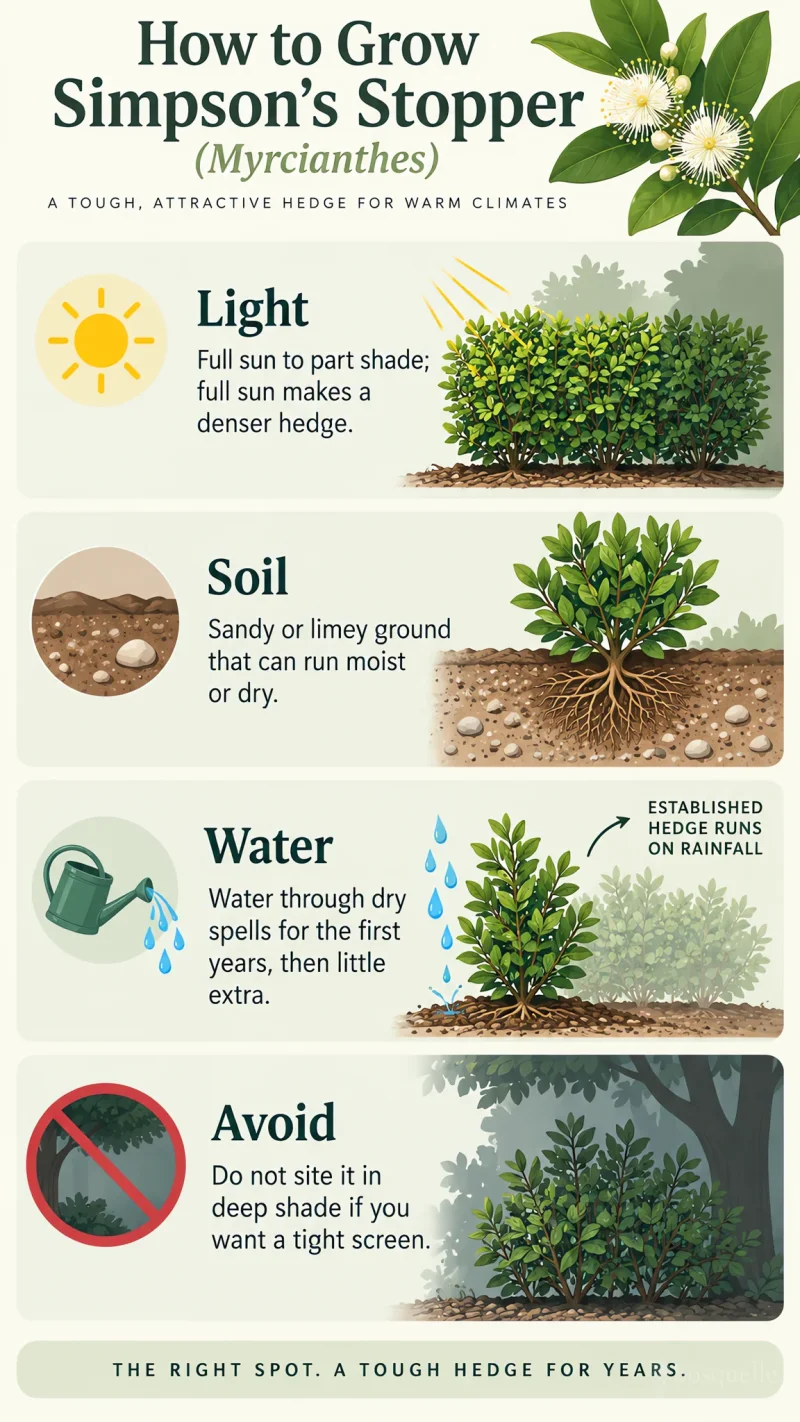
Give it full sun to part shade, water the first years, then back off
| Factor | Recommended | Avoid |
|---|---|---|
| Light | Full sun to part shade; full sun makes a denser hedge | Do not site it in deep shade if you want a tight screen |
| Soil | Sandy or limey ground that can run moist or dry | Do not keep a young plant in a bone-dry bed the first summers |
| Water | Water through dry spells for the first years, then little extra | Do not skip water on a new plant because the tag says drought-tolerant |
| Salt | A coastal or inland bed; it takes salt spray | Do not plant it where the roots sit in standing water for weeks |
Simpson's stopper is an evergreen myrtle-family shrub that can become a small tree if you let it. In full sun the crown stays dense and works as a hedge. In part shade the foliage opens, so you see more of the peeling bark. [1] It takes sandy or limey ground that runs moist to dry. An established plant also takes a poorly drained spell, but a new shrub still needs water in a long dry stretch for the first few years. After that, skip extra irrigation except in drought. [2] Salt spray is fine on a coastal lot, and so is inland heat once the roots are in. Pair it with other evergreen screens that like sun and a dry spell, not with shrubs that need a wet, rich bed. [3] Plants grown in sun stay denser and flower more. [4] When you are ready to set a nursery shrub in the ground, see Planting Simpson's Stopper.
Does Simpson's stopper need full sun?
Full sun to part shade. Full sun makes a denser hedge. Part shade opens the crown so the bark shows.
How often should I water Simpson's stopper?
Water it through dry spells for the first years. Once the roots are in, skip extra except in a long drought.
Is Simpson's stopper drought tolerant?
Once it is established, yes. Water a new plant through the first dry years, then back off.
Is Simpson's stopper salt tolerant?
Yes. It takes salt spray on a coastal lot. Still water a new plant until the roots are in.
Not crape myrtle — and not wax myrtle or twinberry
Crape myrtle is Lagerstroemia, a deciduous tree with big summer panicles — see How to Grow Crape Myrtle. Wax myrtle is Morella, an evergreen screen — see How to Grow Wax Myrtle. Chilean myrtle is Luma — see How to Grow Chilean Myrtle. Northern bayberry is Myrica — see How to Grow Northern Bayberry. Twinberry on a tag may be this shrub, or partridge berry, or honeysuckle — see How to Grow Partridge Berry and How to Grow Honeysuckle. Nursery Eugenia topiary is usually Australian brush cherry, not Simpson's stopper. Spanish stopper is Eugenia, a different native hedge. Common myrtle is Myrtus. Creeping myrtle is periwinkle — see How to Grow Periwinkle. Pineapple guava is Acca — see How to Grow Pineapple Guava.
Is Simpson's stopper a crape myrtle?
No. Crape myrtle is Lagerstroemia, a deciduous tree. Simpson's stopper is an evergreen Myrcianthes hedge.
Is twinberry the same plant?
This shrub is also sold as twinberry. The same name is used for partridge berry and for honeysuckle, which are different plants.
Keep water going through the first dry years, then let an established hedge run on rainfall, and check the tag is Myrcianthes, not a crape myrtle.
FAQ
Is there a dwarf Simpson's stopper?
Nurseries sell a compact form that stays shorter. Read the tag for mature size. The care is the same sun and first-year water.
Can I grow Simpson's stopper in a pot?
Yes, in a pot that drains, in full sun. A pot dries faster than a bed, so water it more often than an established hedge.
Are the berries edible?
The sweet pulp is edible. Do not eat the bitter seeds. Birds take most of the fruit, and that is a good use.
Will a freeze kill Simpson's stopper?
A freeze can scorch young tips. Wait until new growth shows, then cut only the dead wood. An established shrub usually stays evergreen.
Related guides


Recommended plants
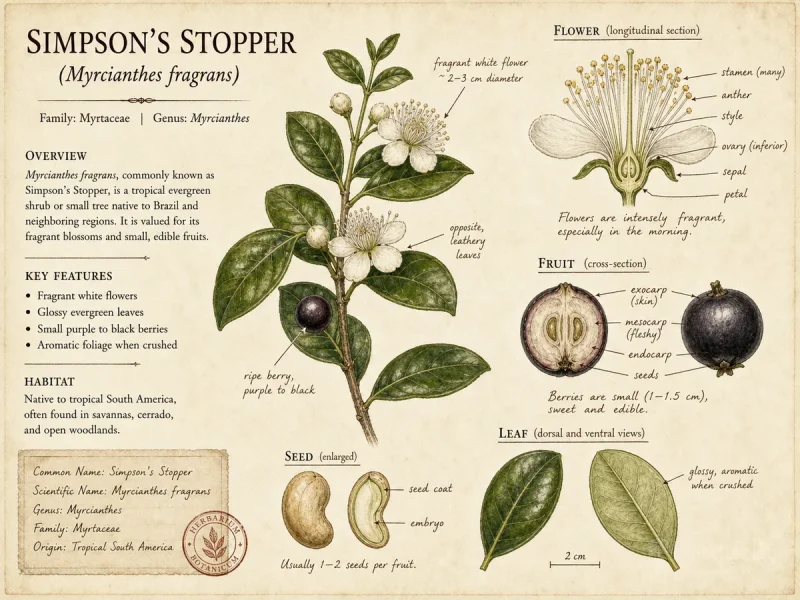
References
- [1] University of Florida IFAS -
https://gardeningsolutions.ifas.ufl.edu/plants/trees-and-shrubs/shrubs/simpsons-stopper/ - [2] Florida Wildflower Foundation -
https://www.flawildflowers.org/flower-friday-myrcianthes-fragrans/ - [3] University of Florida IFAS -
https://ffl-apps.ifas.ufl.edu/butterflies/browse/Details/257 - [4] Dave Creech, SFA Gardens -
https://dcreechsite.com/2023/07/19/myrcianthes-fragrans-simpsons-stopper/
This note is part of Myrcianthes Guides.
More first-season notes by plant are gathered in How to Grow Guides.
Updated: Reviewed by Bosquelle Editors