
Grow northern bayberry in full sun to part sun, in soil that drains, and water it through the first year. Northern bayberry is Myrica pensylvanica.
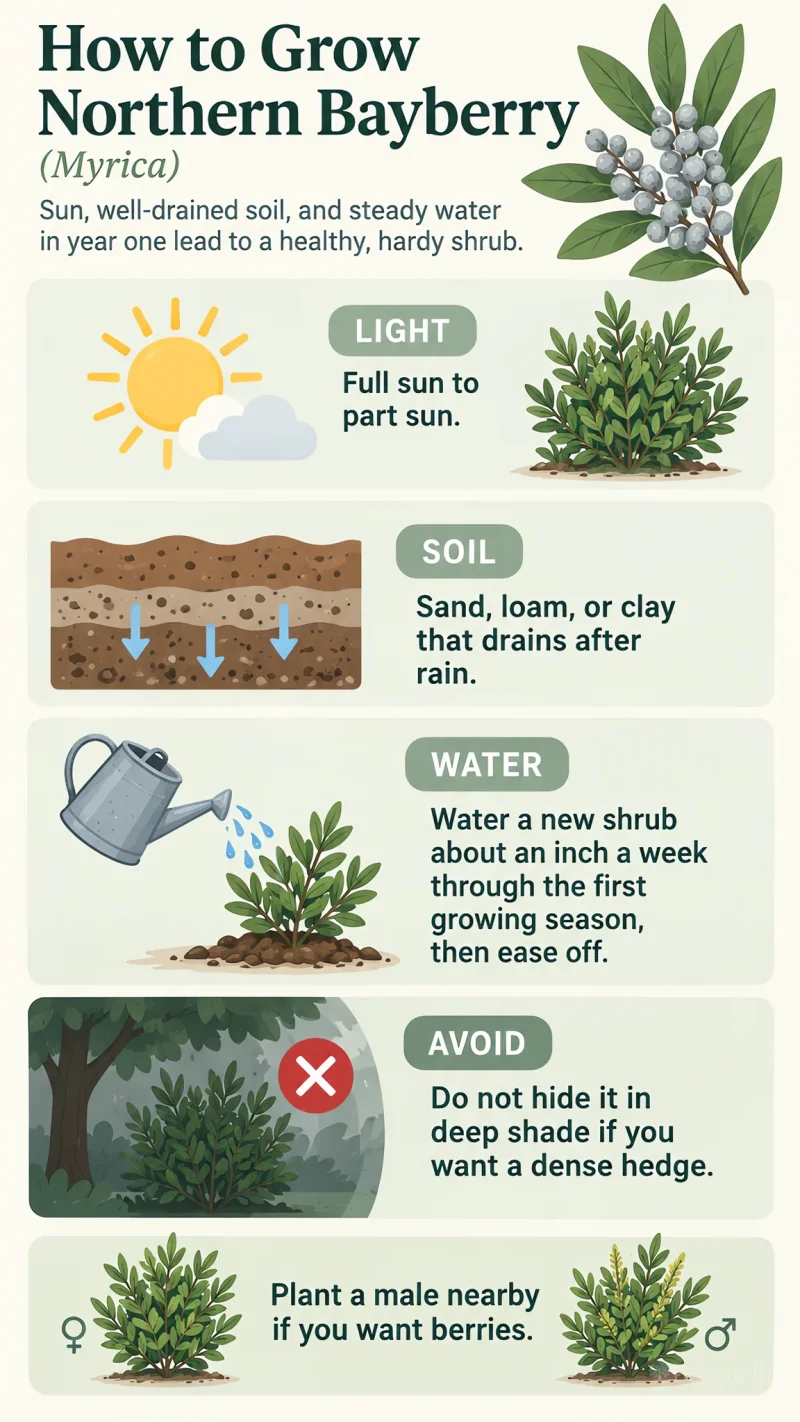
Give it full sun to part sun, soil that drains, and water until the roots take
| Factor | Recommended | Avoid |
|---|---|---|
| Light | Full sun to part sun | Do not hide it in deep shade if you want a dense hedge |
| Soil | Sand, loam, or clay that drains after rain | Do not plant it where water stands around the stem all season |
| Water | Water a new shrub about an inch a week through the first growing season, then ease off | Do not let a new plant dry out, and do not keep an established shrub on a weekly soak |
| Size | About 6 to 8 feet tall and 5 to 10 feet wide | Do not crowd the suckers |
| Salt and browse | Salt spray and a salted roadside are fine once the plant is set; deer and rabbits usually leave the leaves alone | Do not treat a new plant as drought-proof in its first summer |
Northern bayberry wants sun or part sun and soil that drains after a rain. Sand, loam, or clay is fine. Give it room to become a 6 to 8 foot rounded shrub that can spread 5 to 10 feet as suckers fill in. [1] northern bayberry is Myrica pensylvanica, also sold as bayberry or candleberry. Water a new shrub about an inch a week through the first growing season. After the roots take, skip extra water except in a long dry spell. [2] It fixes its own nitrogen, so skip fertilizer unless a soil test says otherwise. Crush a leaf and you get a resinous bay scent. This is a coastal and roadside shrub, not a houseplant.
How much sun does northern bayberry need?
Give it full sun to part sun. Deep shade makes a thin hedge.
How often do I water northern bayberry?
Water a new shrub about an inch a week through the first growing season. Then ease off. An established plant takes a dry spell better than a weekly soak.
How big does northern bayberry grow?
A mature shrub is about 6 to 8 feet tall and about 5 to 10 feet wide. Leave that room so suckers can fill in.
Plant at the same depth as the pot, and add a male if you want berries
Buy a nursery plant in a pot. Dig a hole as deep as the root ball and twice as wide. Set the top of the root ball even with the surrounding soil, water it in, and mulch a couple of inches out from the stems. [3] Male and female flowers sit on separate plants. Only a female sets the gray waxy fruit, and she needs a male nearby for wind pollination. If berries are the goal, plant at least one male for every few females, within about 10 feet.
- Plant in late summer to early fall, or in spring while the soil is workable, in sun to part sun that drains.
- Slide the shrub from its pot. Loosen circling roots. Set the root ball even with the surrounding soil. Do not bury the stem deeper than it grew in the pot.
- Space plants 5 to 10 feet apart. Set them closer if you want a hedge that knits; leave the wider gap if you want one specimen that can still sucker.
- Water to settle the soil. Keep the first season from drying out. Pull unwanted suckers if you want one shrub instead of a thicket.
- If you want fruit, include a labeled male. Buy plants in fruit if you can, so you can see which shrubs are female.
How do I plant northern bayberry?
Set the root ball even with the soil, in a hole twice as wide as the pot. Space plants 5 to 10 feet apart, and water after you plant.
Do I need a male and a female for berries?
Yes, if you want fruit. Male and female flowers usually sit on separate plants. Plant at least one male nearby. Birds eat the waxy fruit.
Prune in late winter — berries form on last year's wood
Northern bayberry holds a rounded mound with little cutting. Next season's catkins and fruit sit on last year's wood, so do not strip every old stem if berries are the goal. If you shape it, wait until late winter or early spring, before new growth.
- Cut dead, broken, or crossing wood any time.
- For a hedge or a tidier mound, cut in late winter or early spring. Light shaping is enough; a hard cut is for a shrub that has grown out of bounds.
- To make a small tree, take lower limbs back to a few strong stems at the same late-winter window.
- Leave last year's wood if you want berries. Pull suckers you do not want instead of shearing the whole colony to the ground.
When should I prune northern bayberry?
Cut in late winter or early spring, before new growth. Leave last year's wood if you want berries.
Start more plants from suckers, or take a summer cutting
The reliable garden start is a rooted sucker from a colony you already own. Lift it with some root, replant it at once, and water until it takes. Stem cuttings can root, but success varies by plant, so do not count on a cutting as the only way. [4]
- In the dormant season, find a rooted shoot at the edge of the colony. Cut it free with some root attached.
- Replant it at the same depth, in soil that drains, and water it in. Keep it moist until new growth shows.
- If you try a cutting, take a 4 to 6 inch piece of current-season wood in midsummer. Strip the lower leaves, wound the base, dip it in rooting hormone, and stick it in a mix that drains.
- Keep that cutting humid and out of hot midday sun until it resists a gentle tug, then pot it on and plant it out the next cool season.
Clean the wax off the seed and keep it cold
Ripe fruit is coated in wax. Rub or wash that coat off in warm soapy water, rinse well, then keep the seed cold and moist for about 90 days before you sow, or sow outdoors in fall and let winter do that work. Named selections will not come true from seed, and a seedling will not show its sex until it flowers.
- Collect ripe gray fruit in fall. Rub or wash off the waxy coat and rinse.
- Keep the cleaned seed cold and moist for about 90 days, or sow it outdoors after the soil has cooled.
- Sow barely covered in a mix that drains, and keep it moist until it sprouts.
How do I start more northern bayberry plants?
Lift a rooted sucker and replant it. A summer cutting can work with rooting hormone, but results vary.
Can I grow northern bayberry from seed?
Yes, if you wash the wax off and give the seed a cold, moist stretch for about 90 days. A sucker is faster, and seedlings will not match a named plant.
Not wax myrtle — and not crape myrtle, yangmei, or sweet gale
Northern bayberry is the colder, often deciduous eastern shrub with gray waxy fruit. Wax myrtle is Morella, an evergreen southern or Pacific screen; read How to Grow Wax Myrtle. If the tag says Morella pensylvanica, you still have this plant, not wax myrtle.
Crape myrtle is Lagerstroemia, grown for showy summer flowers — see How to Grow Crape Myrtle. If the tag says crepe or crape myrtle and the plant drops its leaves and blooms in big clusters, you have the wrong plant. Sweet fern is Comptonia, a smaller bayberry-family shrub with fern-like leaves; read How to Grow Sweet Fern. Sweet gale is a low bog shrub, not this hedge. Yangmei, or Chinese bayberry, is a fruit tree with juicy red fruit, not the gray candle berry, and it is not the strawberry tree either.
Is northern bayberry the same as wax myrtle?
No. Wax myrtle is an evergreen screen. Northern bayberry is a colder, often deciduous shrub. Older tags may say Morella pensylvanica; that is still this plant.
Is northern bayberry a crape myrtle?
No. Crape myrtle is Lagerstroemia, grown for showy summer flowers. Northern bayberry has tiny spring catkins and waxy gray fruit.
Set northern bayberry in sun, water it through the first year, and plant a male nearby if you want berries.
FAQ
Can I grow northern bayberry in a pot?
A nursery pot is how the shrub is sold, not a houseplant. Keep it outdoors in sun, in mix that drains, until you can set it in the ground. A 6 to 8 foot shrub is happier in the ground.
Is there more than one kind of bayberry?
Myrica pensylvanica is the plant here. Bayberry, candleberry, and Morella pensylvanica are the same shrub, not a second type. Wax myrtle and yangmei are different plants.
Will northern bayberry stay green in winter?
Leaves usually drop in a cold winter. In a mild southern winter they may hold. Gray fruit can stay on the stems. Do not wrap the shrub.
Can I plant it with other natives?
Yes, with other sun-and-drain shrubs that also take poor soil. Do not pack a wet lawn plant against the crown.
Can I make candles from the berries?
Grow the shrub for the hedge and for birds. Do not boil the fruit for candles, soap, or medicine.
Do I need to fertilize northern bayberry?
Usually no. The roots fix nitrogen. Skip fertilizer unless a soil test shows a real gap, and do not add nitrogen at planting.
Recommended plants

References
- [1] North Carolina Extension Gardener Plant Toolbox -
https://plants.ces.ncsu.edu/plants/myrica-pensylvanica/ - [2] University of Maine Cooperative Extension -
https://extension.umaine.edu/publications/2572e/ - [3] The Old Farmer's Almanac -
https://www.almanac.com/plant/northern-bayberry - [4] Natural Resources Conservation Service Plant Guide -
https://plants.sc.egov.usda.gov/DocumentLibrary/plantguide/pdf/pg_mope6.pdf
More first-season notes by plant are gathered in How to Grow Guides.
Updated: Reviewed by Bosquelle Editors