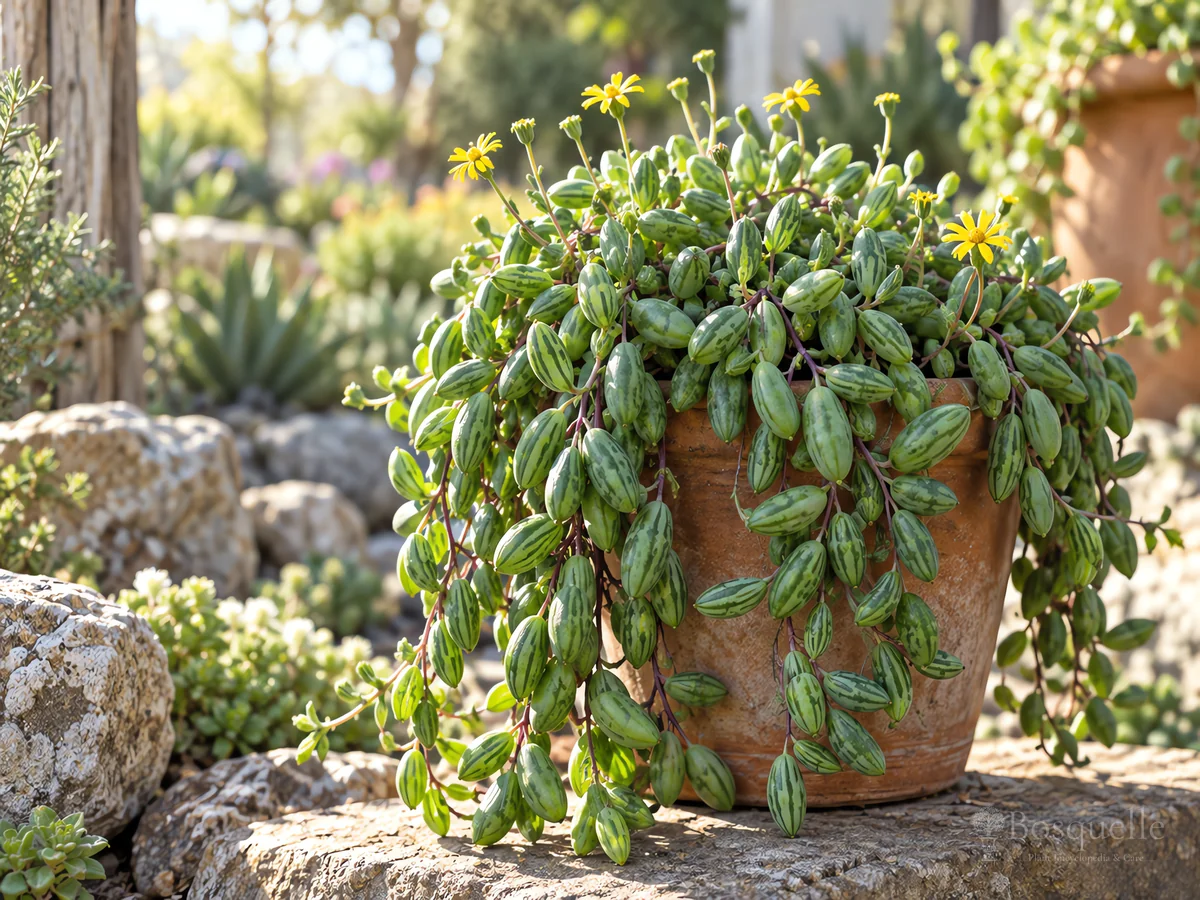
Grow ruby necklace in bright sun, in a mix that drains, and water when the mix is dry. It is Othonna capensis, a trailing succulent with pickle-shaped leaves, also sold as little pickles or string of rubies. Shop listings mean the plant, not a jewelry chain.
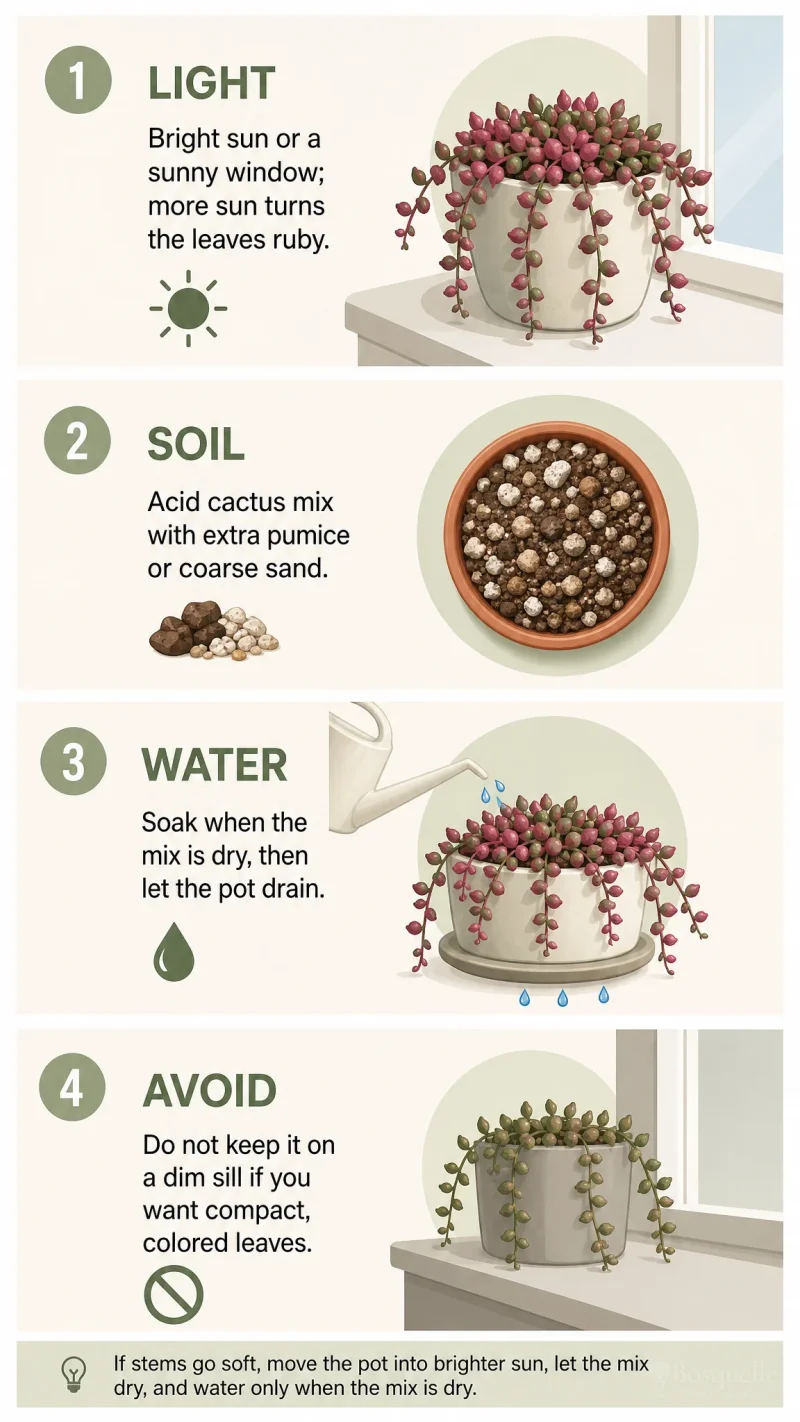
Give it bright sun, a mix that drains, and water when the mix is dry
| Factor | Recommended | Avoid |
|---|---|---|
| Light | Bright sun or a sunny window; more sun turns the leaves ruby | Do not keep it on a dim sill if you want compact, colored leaves |
| Water | Soak when the mix is dry, then let the pot drain | Do not keep the mix wet between waterings |
| Soil | Acid cactus mix with extra pumice or coarse sand | Do not use packed potting soil that stays wet |
| Warmth | Keep a hanging basket frost-free; prefer a room above about 50°F | Do not leave it wet in a cold room or outdoors in frost |
ruby necklace is Othonna capensis, a trailing succulent from the South African Cape. The leaves are cylindrical, about an inch long, and look like small pickles. In strong sun they blush purple to ruby. In weak light they stay green, stretch, and go skinny. [1] Give it a cactus mix that sheds water. While it is growing, water when the mix is dry, then empty the saucer. Soft, collapsing stems are usually rot from a wet mix, not a missed watering. Grown indoors without enough sun, the leaves turn greener, get longer, and will not stand up. [2] Yellow daisy flowers open on short stems from purple, pea-shaped buds. They often close in poor light. Take cuttings on How to Propagate Ruby Necklace.
How do I care for ruby necklace?
Give it bright sun, a gritty mix with a drainage hole, and water only when the mix is dry. Keep a hanging basket frost-free.
How often should I water ruby necklace?
In growth, soak the mix when it is dry, then let the pot drain. In winter, water much less, and only if the leaves wrinkle hard.
Why is it green instead of ruby?
Weak light keeps the leaves green and stretched. Stronger sun, or a dry spell, brings the ruby color. The green plant is still the same kind.
Bring it in before frost, and keep winter dry
A hanging basket is a tender start in most U.S. gardens. Bring the pot indoors before nights turn to frost. Keep it bright, and water much less. Many Othonna plants dislike a room colder than about 50°F, and a cool, wet mix is the usual collapse. [3] A windowsill rest that stays dry is safer than a wet porch.
Can ruby necklace stay outdoors in winter?
Only where nights stay frost-free and the bed stays dry. In a cold garden, bring the pot in before frost, keep it bright, and water less until spring.
Hang it in a pot that drains
The usual home is a hanging basket, a shallow pot, or a bright sill. Roots stay shallow, so a pot with a hole dries faster than a deep tub. Unglazed clay dries faster than plastic. Empty the saucer. Stems trail, so a basket lets them hang.
- Choose a hanging basket or a shallow pot with a drainage hole. Empty the saucer after you water.
- Fill it with cactus mix cut with pumice, coarse sand, or grit. Do not use packed houseplant soil.
- Set the plant no deeper than it grew in the nursery pot. Firm the mix around the stems without burying them in wet compost.
- Water once to settle the mix, then wait until the mix is dry before you water again.
- Wait to move it into a larger pot until the stems crowd the rim. A jump into a deep, wet tub is the usual rot.
Can I grow ruby necklace in a pot?
Yes. Use a hanging basket or a shallow pot with a hole, a gritty mix, and bright sun. Empty the saucer. It is not a dim indoor foliage plant.
Outdoors, plant it only where winter stays dry
In a frost-free garden it can mat as a dry groundcover or spill over a rock wall. Plant it in a raised bed or among rocks so water does not sit around the roots in winter. It does not like wet feet in the cold months. [4] For most U.S. gardens, a pot you can bring inside is the safer start.
- Pick a raised bed, a rock-wall pocket, or a gritty slope that sheds winter rain.
- Set the crown at the same depth it grew in the pot. Do not bury the stems in wet compost.
- Water once to settle, then let the soil dry before you water again. Spare water in winter.
Can I plant it in the ground?
Only in a frost-free, very well-drained raised bed or rock garden. For most U.S. gardens, a pot you can bring inside is the safer start.
Not string of pearls — and not ice plant or dusty miller
String of pearls is a hanging succulent with round bead leaves, not pickle-shaped cylinders. See How to Grow String of Pearls. String of bananas is the same hanging Senecio job with banana-shaped leaves, not a second watering calendar. String of hearts has heart-shaped leaves — see How to Grow String of Hearts.
Little pickles can look like a well-behaved green ice plant until the yellow daisies open. Ice plant is Delosperma — see How to Grow Ice Plant. Dusty miller is a silver bedding plant that sometimes still carries an old Othonna name — see How to Grow Dusty Miller. A tag that says Cape Aster may be this succulent or a woody blue daisy. Kingfisher daisy is Felicia — see How to Grow Kingfisher Daisy. African daisy is Osteospermum — see How to Grow African Daisy. Othonna is one shop card here. Extra species names on a listicle are not extra kinds we list.
Is ruby necklace the same as string of pearls?
No. String of pearls has round bead leaves. Ruby necklace has pickle-shaped leaves that blush ruby in strong sun. Both hang, but they are different plants.
Is little pickles the same as ice plant?
No. Ice plant is Delosperma. This plant is Othonna capensis. It can look similar as a low green mat until the yellow daisies open.
If stems go soft, move the pot into brighter sun, let the mix dry, and water only when the mix is dry. Bring a hanging basket in before frost.
FAQ
Do I prune it?
You do not shape it like a shrub. RHS lists no pruning for this plant. Cut a long, bare stem only if you want a shorter basket, and use the piece as a cutting.
Can I take cuttings?
Yes. Full steps are on How to Propagate Ruby Necklace.
Do you list other Othonna species?
No. This shop card is Othonna capensis, also labeled Crassothonna capensis. Green leaves and ruby leaves are the same plant under different light. Other species names belong to collector lists, not extra cards we list.
Is it safe around pets?
Grow it as an ornamental, not a snack. Keep pets from chewing the trailing stems the way you would with any houseplant.
Will it take over a garden?
In a U.S. pot it is a trailing succulent you can bring inside. In a warm, dry garden it can seed and mat. Do not dump stems outdoors in a frost-free bed unless you want them to root.
Related guides
Recommended plants

References
- [1] Royal Horticultural Society -
https://www.rhs.org.uk/plants/353589/crassothonna-capensis/details - [2] Kumbula Indigenous Nursery -
https://kumbulanursery.co.za/plants/othonna-capensis - [3] Fine Gardening -
https://www.finegardening.com/genus/othonna - [4] San Marcos Growers -
https://www.smgrowers.com/products/plants/plantdisplay.asp?plant_id=3799
This note is part of Othonna Guides.
More first-season notes by plant are gathered in How to Grow Guides.
Updated: Reviewed by Bosquelle Editors