
Grow kingfisher daisy in full sun on soil that drains. Kingfisher daisy is Felicia amelloides, also sold as blue daisy or blue marguerite. It is not African daisy, and a Swan River daisy tag is a different annual.
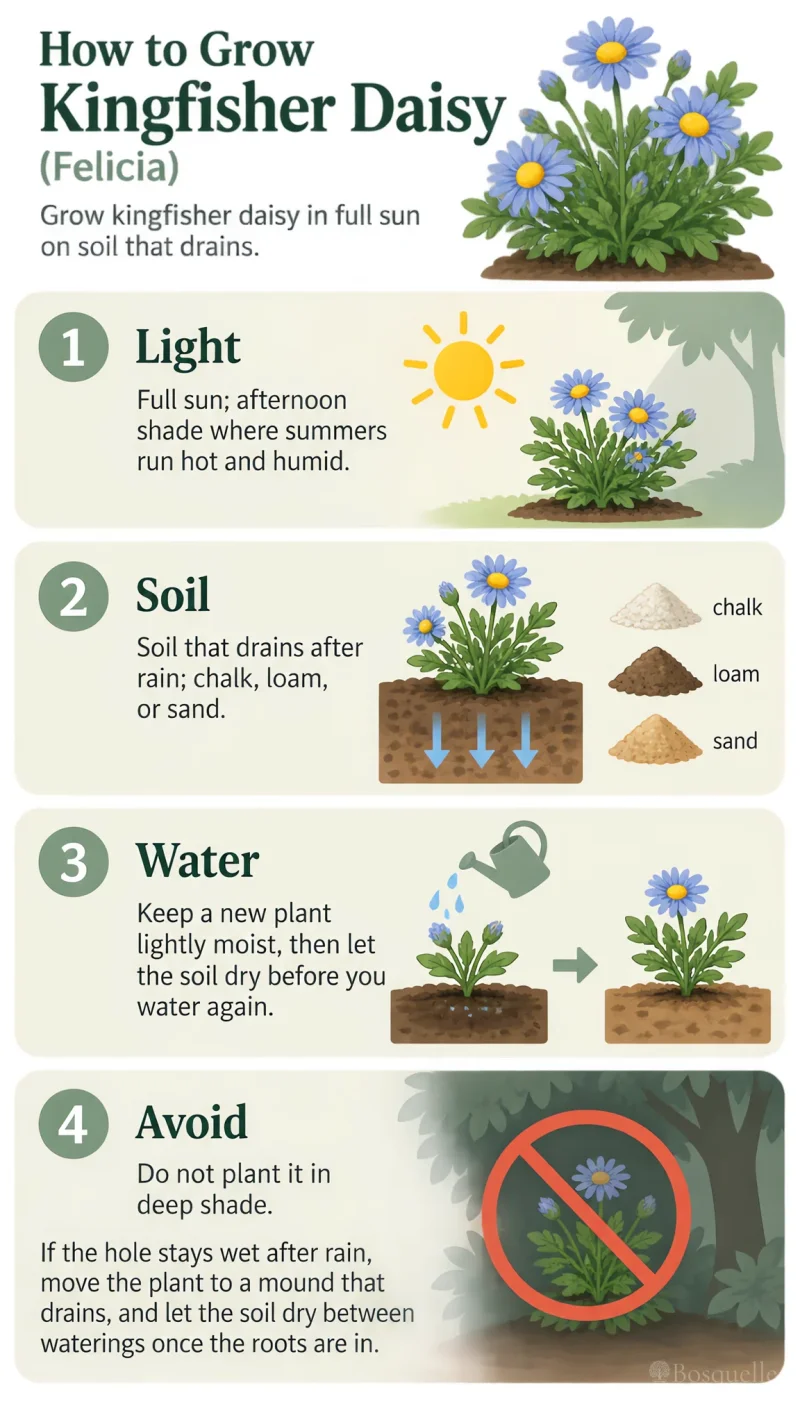
Give it full sun and soil that drains
| Factor | Recommended | Avoid |
|---|---|---|
| Light | Full sun; afternoon shade where summers run hot and humid | Do not plant it in deep shade |
| Soil | Soil that drains after rain; chalk, loam, or sand | Do not leave the roots in a puddle |
| Water | Keep a new plant lightly moist, then let the soil dry before you water again | Do not keep the roots wet |
| Season | Cooler nights; bloom from early summer while nights stay mild | Do not expect a midsummer flush in heat and humidity |
| Size | About 12 to 24 inches tall and wide | Do not crowd it against a wet hedge |
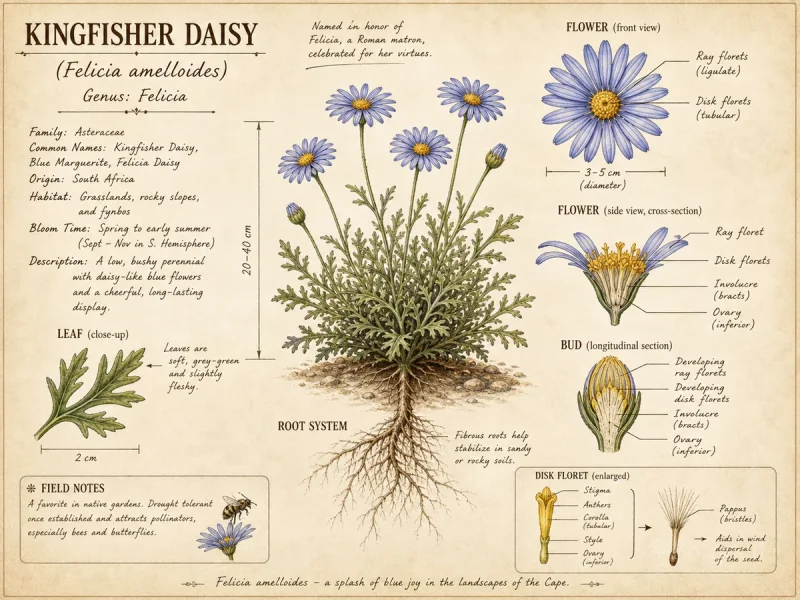
Kingfisher daisy is Felicia amelloides, a bushy woody-based subshrub with ovate, rough-hairy leaves and sky-blue daisy heads around a yellow disc. Give it full sun and soil that dries after rain. A little afternoon shade helps where summers run hot, but deep shade cuts the bloom. [1] Keep a new plant lightly moist until new growth shows, then let the soil dry before you water again. Wet soil around the roots is the primary cause of root rot. [2] In a hot, humid midsummer the bloom often stops. Start plants early enough that the first flush opens before that heat, and treat this as a frost-tender annual in most U.S. gardens, not a shrub you leave in an open bed through a hard freeze.
How much sun does kingfisher daisy need?
Give it full sun. Afternoon shade helps where summers run hot and humid. Deep shade opens the mound and cuts the blue bloom.
How often do I water kingfisher daisy?
Keep a new plant lightly moist until the roots take. Then let the soil dry before you water again. Wet soil around the roots is the primary cause of root rot.
How big does kingfisher daisy grow?
A mature plant is about 12 to 24 inches tall and about 12 to 24 inches wide. Leave that room so the mound can fill in.
When does kingfisher daisy bloom?
Sky-blue heads open from early summer where nights stay mild. In a hot, humid climate the bloom often stops by midsummer.
Plant a nursery pack after frost
The easiest start is a spring nursery pack set out after the last frost. Slide the root ball out and set the crown at the same depth it sat in the pot, in soil that already drains. Do not bury the woody base, and do not drop it into a wet, rich hole.
- Plant after the last frost, from a nursery pack or from a cell you started indoors.
- Dig a hole twice as wide as the root ball. Set the crown at the same depth it sat in the pot. Do not bury it.
- Backfill with the soil you dug, as long as it already drains.
- Water it in. Keep the soil lightly moist until new growth shows, then let the top dry.
- Keep mulch off the crown.
How do I plant kingfisher daisy?
Use a nursery pack after the last frost. Set the crown at pot depth, in soil that drains, and water until new growth shows.
Grow it in a pot that drains
A pot with a drainage hole can hold this plant on a sunny patio. Use a loam-based potting mix, not garden soil, and empty the saucer after you water. Keep the pot outdoors in full sun. In a cold winter, move it under glass or onto a bright, frost-free porch, and water sparingly. This is not a windowsill houseplant. [3]
- Choose a pot with a drainage hole, and fill it with loam-based potting mix.
- Set the crown at mix level, water it in, and do not leave the pot in a saucer of water.
- Keep it outdoors in sun. Move it under glass only if a hard frost is coming; do not grow it as a houseplant.
Can I grow kingfisher daisy in a pot?
Yes, in a pot that drains. Use a loam mix, keep it outdoors, and move it under glass if a hard frost is coming. Do not grow it as a houseplant.
Pinch young tips, then deadhead
Pinch the top inch of young shoots when the plants are a few inches tall so the mound stays bushy. Clip spent heads as they fade so the next flush can open. If bloom slows in midsummer, trim lightly to fresh leaves. In late summer, cut a tired plant back hard for new growth, or replace a woody plant that has gone straggly after a few years. [4]
- Pinch the top inch of young shoots when plants are a few inches tall.
- Clip spent heads as they fade, down to a leaf.
- If bloom slows in midsummer, trim lightly to fresh leaves.
- In late summer, cut a tired plant back hard, or replace a woody plant that has gone straggly.
How do I pinch or deadhead kingfisher daisy?
Pinch young tips when plants are a few inches tall, then clip spent heads as they fade. Trim lightly if bloom slows in midsummer, and cut a tired plant back hard in late summer.
Sow indoors 6 to 8 weeks before frost, or after frost
Start seed indoors 6 to 8 weeks before the last frost if summers run hot, so the first flush opens before midsummer heat. In a cool-summer garden, sow outdoors after frost and cover the seed lightly. Keep the mix barely moist until seedlings handle, then move them on. Do not set tender seedlings out while frost is still likely.
- Start seed indoors 6 to 8 weeks before the last frost if summers run hot.
- In a cool-summer garden, sow outdoors after frost and cover the seed lightly.
- Keep the mix barely moist until seedlings handle, then move them to a small pot or the bed.
- Do not set tender seedlings out while frost is still likely.
Can I grow kingfisher daisy from seed?
Yes. Start seed indoors 6 to 8 weeks before the last frost if summers run hot, or sow outdoors after frost in a cool summer and cover the seed lightly.
Start a new plant from a cutting
A stem-tip cutting in late summer is the home method if you want the same plant next year. Take a non-flowering shoot, cut just below a node, and stick it in damp sand or another mix that drains. Keep the mix barely moist until roots form, then pot it on and hold it frost-free.
- In late summer, take a non-flowering stem-tip cutting just below a node.
- Strip the lower leaves and stick the cut end in damp sand or a mix that drains.
- Keep the mix barely moist until roots form, then pot it on and hold it frost-free.
Can I grow kingfisher daisy from a cutting?
Yes. Take a non-flowering stem-tip cutting in late summer, stick it in a mix that drains, and keep the mix barely moist until roots form. Hold the new plant frost-free.
Not an African daisy — and not a Swan River daisy
African daisy is Osteospermum, a lower bedding plant grown for mixed petal colors. If the tag says osteospermum, cape daisy, or a tray of mixed African daisies, read How to Grow African Daisy. Kingfisher daisy is a woody South African subshrub with ovate hairy leaves and sky-blue daisies on leafless stalks.
Swan River daisy is Brachyscome, a fine-leaved annual, not this woody blue daisy — see How to Grow Swan River Daisy. Blue marguerite on this tag is Felicia amelloides. Marguerite daisy is Argyranthemum — see How to Grow Marguerite Daisy. A blue daisy anemone search is Anemone, not this plant — see How to Grow Anemones. Confirm the Latin on the tag is Felicia amelloides.
Is kingfisher daisy the same as African daisy?
No. African daisy is Osteospermum, a bedding plant. Kingfisher daisy is Felicia amelloides, a woody subshrub with sky-blue daisies.
Is kingfisher daisy the same as Swan River daisy?
No. Swan River daisy is Brachyscome, a fine-leaved annual. Kingfisher daisy is Felicia amelloides.
Is blue marguerite the same as marguerite daisy?
No. Blue marguerite on this tag is Felicia amelloides. Marguerite daisy is Argyranthemum. Read the Latin on the tag.
If the hole stays wet after rain, move the plant to a mound that drains, and let the soil dry between waterings once the roots are in.
FAQ
Is there more than one kind of kingfisher daisy?
Felicia amelloides is the plant here. Extra shop names such as blue daisy, blue marguerite, and blue daisy bush are the same shrublet, not a second type. A low annual packet labeled kingfisher daisy is often Felicia bergeriana, which is not in this catalog.
What should I plant with kingfisher daisy?
Pair it with other sun plants that like soil that drains, at the front of a border or in a patio pot. Do not crowd it against a wet, shady hedge.
Will kingfisher daisy come back after a frost?
Treat it as a frost-tender annual in most U.S. gardens. A draining pot you can move under glass, or a cutting taken in late summer, is safer than an open bed through a hard freeze.
Is kingfisher daisy safe for pets?
The plant is not known to be toxic if a cat, dog, or horse chews it. Still keep pets from flattening a new planting.
Recommended plants
References
- [1] NC State Extension -
https://plants.ces.ncsu.edu/plants/felicia-amelloides/ - [2] Gardening Know How -
https://www.gardeningknowhow.com/ornamental/flowers/felicia-daisy/growing-felicia-daisy-plants.htm - [3] Royal Horticultural Society -
https://www.rhs.org.uk/plants/7151/felicia-amelloides/details - [4] SANBI PlantZAfrica -
https://pza.sanbi.org/felicia-amelloides
More first-season notes by plant are gathered in How to Grow Guides.
Updated: Reviewed by Bosquelle Editors