
Grow quaking grass in full sun on soil that drains. Quaking grass is also called common quaking grass. It is not a quaking aspen.

Give it full sun and soil that drains
| Factor | Recommended | Avoid |
|---|---|---|
| Light | Full sun | Do not hide it in deep shade |
| Water | Water the first season; then skip extra water once the clump is set | Do not leave the crown in standing water |
| Soil | Soil that drains after rain; chalk, loam, or sand is fine | Do not plant it in a winter bog |
| Feed | Lean ground is enough | Do not pile on rich compost |
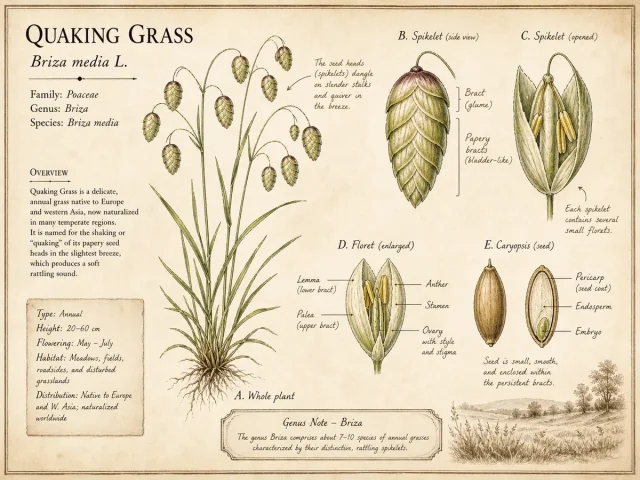
Quaking grass is a cool-season clump. Give it full sun and soil that drains. Deep shade makes thin bloom. Standing water around the crown rots the plant, especially in winter. Once the roots take, skip extra water; a long dry spell may send the blades dull until rain returns. [1] Quaking Grass is Briza media, a 2 to 3 foot tuft with heart-shaped heads that tremble on hair-thin stalks.
Does quaking grass need full sun?
Yes. Full sun makes the strongest heads. Light shade is tolerated, but bloom thins.
How often should I water quaking grass?
Water through the first growing season. Once the clump is set, skip extra water unless a long dry spell dulls the blades. Do not leave the crown in a puddle.
Sow in spring or fall, or plant a young clump
Scatter seed where the grass will stay, in fall or after the last spring frost. Press it onto the soil and keep that surface just moist until seedlings show, then thin to about a foot. A nursery clump goes in at the same depth it sat in the pot. [2]
- Sow outdoors in fall, or after the last spring frost. Press the seed onto the soil; do not bury it deep.
- Keep the surface just moist until seedlings show, then thin plants to about 12 inches.
- Set a nursery clump in spring at the same depth it sat in the pot, and water it in.
When do I sow quaking grass?
Sow outdoors in fall or after the last spring frost. You can also start seed in pots 6 to 8 weeks before frost and move the young plants out with care.
Divide a crowded clump in spring
When the tuft gets crowded, lift it in spring and split it into pieces that each have roots and green shoots. Replant at the same depth and water until the new clumps take.
- Lift the clump in spring as new blades start.
- Split it so each piece has roots and shoots, then replant at the same depth and water it in.
Cut it back in spring before new growth starts
Leave the old blades through winter if you want the tan heads for structure. In spring, before new growth starts, cut the clump back to a few inches above the crown so fresh blades can come. You can also snip spent heads in summer if they look tired. [3]
- Cut the old foliage to a few inches above the crown in spring, before new blades push.
- Snip spent flower spikes in summer if you want a cleaner mound.
When do I cut quaking grass back?
Cut it in spring before new growth starts. Leaving the old blades through winter is fine if you like the tan heads.
Cut stems for drying when they turn tan
For a dry bunch, cut stems when the heads are still green or have dried to tan, then hang them in a warm, dark place until they are crisp. This is a vase job, not a grain harvest.
- Cut stems when the heads are green or tan.
- Hang them in a warm, dark place until they are dry, then stand them in a vase.
Not a quaking aspen — and not rattlesnake master
Quaking aspen is a suckering tree with trembling leaves — see How to Grow Quaking Aspen. Quaking grass is the ornamental clump with heart-shaped heads. Rattlesnake grass on a seed packet is often the annual Briza maxima, a one-season plant with larger spikelets, not this perennial clump. [4] Rattlesnake master is a prairie forb with yucca-like leaves — see How to Grow Sea Holly. Rattlesnake fern is a woodland fern — see How to Grow Rattlesnake Fern. Confirm the Latin on the tag is Briza media.
Is quaking grass the same as quaking aspen?
No. Quaking grass is this ornamental clump. Quaking aspen is a tree.
Is rattlesnake grass the same plant?
Often no. Rattlesnake grass on a packet is usually the annual big quaking grass. This catalog holds the perennial Briza media.
If the clump sits wet through winter, move it onto soil that drains and cut the old blades in spring.
FAQ
Does quaking grass come back every year?
Yes. Common quaking grass is a perennial clump. Cut the old blades in spring and it comes from the crown.
Can I grow quaking grass in a pot?
A draining pot works for a start, but this grass is happier in the ground. Use potting mix, not garden soil, and do not leave the pot in a saucer of water.
Do you list big quaking grass?
No. This catalog holds common quaking grass, Briza media. Big quaking grass is an annual with larger heads. Give a shop annual the same sun and drain, and expect it to finish in one season.
Will deer eat quaking grass?
Deer often pass it by, but that is not a guarantee. Site it for sun and drain first.
Recommended plants
References
- [1] University of Illinois Extension -
https://web.extension.illinois.edu/hortanswers/plantdetail.cfm?PlantID=597&PlantTypeID=3 - [2] Harvest to Table -
https://harvesttotable.com/how-to-grow-briza-quaking-grass/ - [3] Royal Horticultural Society -
https://www.rhs.org.uk/plants/2406/briza-media/details - [4] NC State Extension Gardener -
https://plants.ces.ncsu.edu/plants/briza-maxima/
More first-season notes by plant are gathered in How to Grow Guides.
Updated: Reviewed by Bosquelle Editors