
Grow Prosthechea in bright filtered light, and water when the mix has dried. Prosthechea is the clamshell orchid, also called cockleshell orchid. It is not a Tampa butterfly orchid.
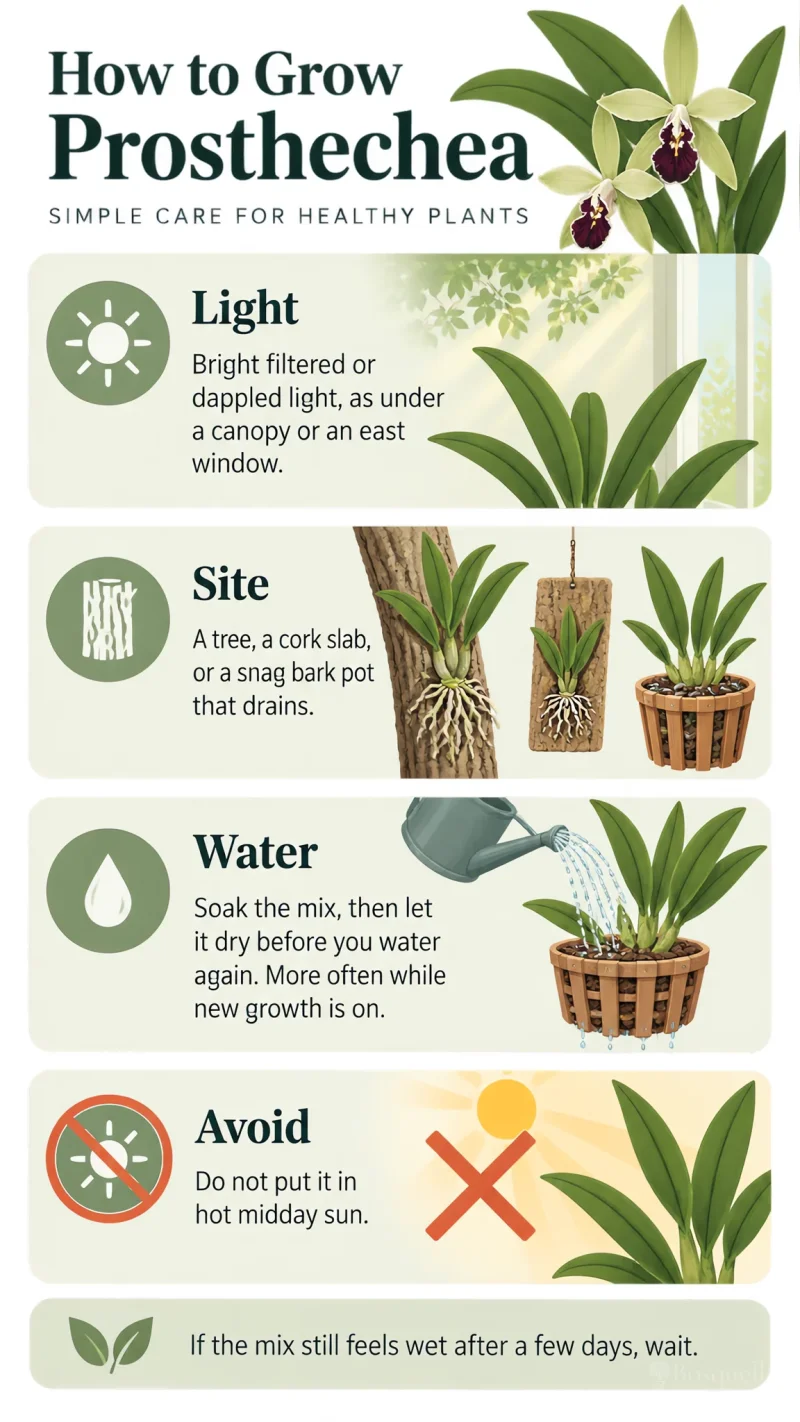
Give it bright filtered light, water when the mix has dried, and keep the air moving
| Factor | Recommended | Avoid |
|---|---|---|
| Light | Bright filtered or dappled light, as under a canopy or an east window | Do not put it in hot midday sun |
| Water | Soak the mix, then let it dry before you water again; more often while new growth is on | Do not leave the roots sitting wet |
| Air | Moving air and humid conditions | Do not grow it in still, soggy air |
| Site | A tree, a cork slab, or a snug bark pot that drains | Do not plant it in garden soil |
| Source | A nursery-propagated plant | Do not take a wild Florida plant |
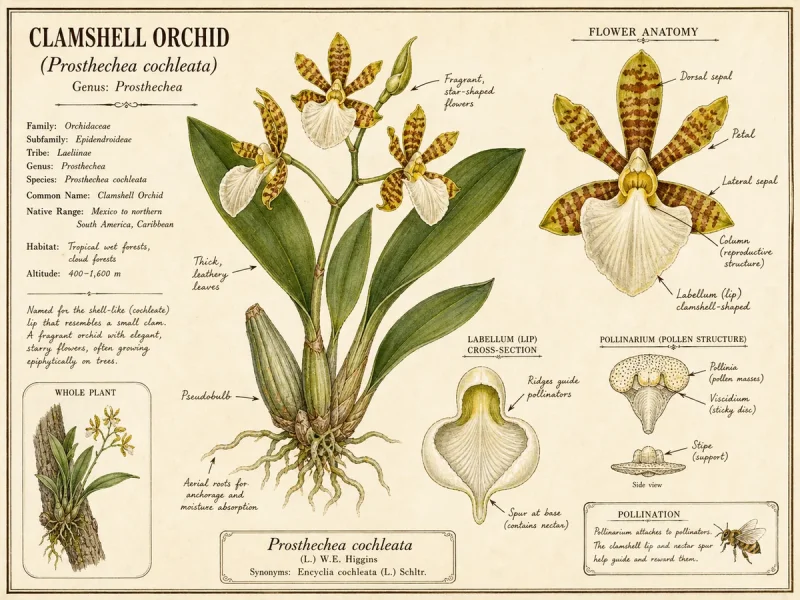
clamshell orchid is Prosthechea cochleata, an epiphyte. The flattened pseudobulbs store water, so the plant wants a full wet-then-dry cycle, not a constantly damp pot of mix. [1] Give it bright filtered light and moving air. Water about twice a week in warm weather while it is making new growth, then let the mix dry. [2] Flowers are held upside down compared with most orchids: a dark purple, shell-shaped lip sits on top, and yellow-green petals hang below. One stem can open flowers for months, a few at a time. [3] Florida lists wild plants as endangered, so buy a nursery plant rather than lifting one off a tree. [4] If you are tying a plant to live oak or mahogany, that job is on Planting Prosthechea. If the bark in the pot has collapsed, that job is on How to Repot Prosthechea.
How do you care for clamshell orchids?
Give them bright filtered light and water when the mix has dried. They fail in a dim, wet pot of garden soil.
When does it bloom?
A mature plant can open flowers for months from the same stem, a few at a time. In a pot that often runs from spring into fall. Wild Florida plants often peak in winter.
Water less in late fall, and leave the flower stem until it has gone brown
After the season’s new pseudobulbs have filled out, cut back on water so the mix dries more fully. Keep the plant above a freeze. Do not cut a green flower stem as if it were spent, because this orchid keeps opening flowers along the same stem.
- Keep the plant above a freeze. Cold, wet roots on a mount or in a soggy pot stop growth.
- Once the new bulbs look full, water less often — about once a week in cool weather is a starting point, then judge by how fast the mix dries.
- When a flower stem shows, return to regular watering so the buds do not blast.
- Pick faded flowers if you want, but leave the stem until it is brown and dry. Then snip it at the base. Leave firm green leaves and pseudobulbs in place.
What fails when the roots stay wet
Soggy mix, a saucer of standing water, or moss packed around the roots is the usual reason this orchid declines. Healthy roots are firm and pale. Mushy brown roots and a sour smell mean the mix stayed wet too long. Slightly wrinkled pseudobulbs after a dry spell often plump again after one thorough watering; mushy bulbs do not.
- Empty the saucer after you water. Do not leave the pot standing in water.
- If the mix smells sour or stays wet for days, the bark has collapsed. Lift the plant and use fresh coarse bark — see How to Repot Prosthechea.
- If the bulbs wrinkle but the roots are still firm, water once thoroughly, then wait until the mix dries again.
- Do not answer wrinkled bulbs with a little water every day. That keeps the remaining roots wet.
Not a Tampa butterfly orchid, not a moth orchid, and not a dark hybrid sold as black orchid
A Tampa butterfly orchid is Encyclia. It has yellow, copper, or bronze flowers that move like butterflies, not this plant’s dark shell-shaped lip on top. See How to Grow Encyclia if that is the plant on the bench. A yellow dancing-lady orchid is Oncidium — see How to Grow Oncidium if the lip is a frilly skirt.
A grocery moth orchid is Phalaenopsis. It has broad, thick leaves in a bark pot. See How to Grow Phalaenopsis if the tag says moth orchid. Cattleya is a related corsage orchid with larger flowers — see How to Grow Cattleya if the plant is a large bifoliate Cattleya. Lady of the night is Brassavola — see How to Grow Brassavola if the tag says lady of the night. A dark hybrid sold as black orchid is usually Fredclarkeara, not this species. An old tag that says Encyclia cochleata or Epidendrum cochleatum is still this plant, not a Tampa butterfly orchid and not a reed-stem Epidendrum.
What is Prosthechea cochleata?
It is the clamshell orchid, a Florida-native epiphyte with a dark shell-shaped lip on top of the flower and yellow-green petals hanging below.
Is this the same as a Tampa butterfly orchid?
No. Tampa butterfly orchid is Encyclia tampensis. This plant holds the lip on top of the flower, like a cockleshell.
Is this the Belize black orchid?
Belize uses this species as its national flower and calls it black orchid. A dark hybrid on a shop bench is usually a different plant.
If the mix still feels wet after a few days, wait. Do not water on a calendar while the roots sit wet.
FAQ
Can I grow it from seed?
The dust-like seed needs flask work, and Florida wild plants are endangered. Buy a nursery-propagated plant. Do not collect seed from wild plants.
Is rainbow orchid the same plant?
No. Rainbow orchid is Prosthechea prismatocarpa, a Central American cousin with spotted flowers. This card is Prosthechea cochleata.
Is octopus orchid a different species?
On this card, octopus orchid is a shop name for the hanging petals. It is the same clamshell orchid.
How do you fertilize it?
Use a balanced orchid fertilizer at about a quarter of the label rate every third or fourth watering while it is in growth. Skip fertilizer in the cooler, drier spell.
Related guides

Recommended plants
References
- [1] American Orchid Society -
https://www.aos.org/explore/prosthechea - [2] Sarasota Orchid Society -
https://sarasotaorchidsociety.org/wp-content/uploads/2024/11/Prosthechea-cochleata-Orchids-We-All-Should-Grow-.pdf - [3] North American Orchid Conservation Center -
https://goorchids.northamericanorchidcenter.org/species/prosthechea/cochleata/ - [4] Florida Wildflower Foundation -
https://www.flawildflowers.org/flower-friday-prosthechea-cochleata/
This note is part of Prosthechea Guides.
More first-season notes by plant are gathered in How to Grow Guides.
Updated: Reviewed by Bosquelle Editors