
Plant Prosthechea by tying a nursery plant to a live-oak or mahogany limb, or to a cork slab. Press the bare roots against rough bark. Do not take a wild Florida plant.
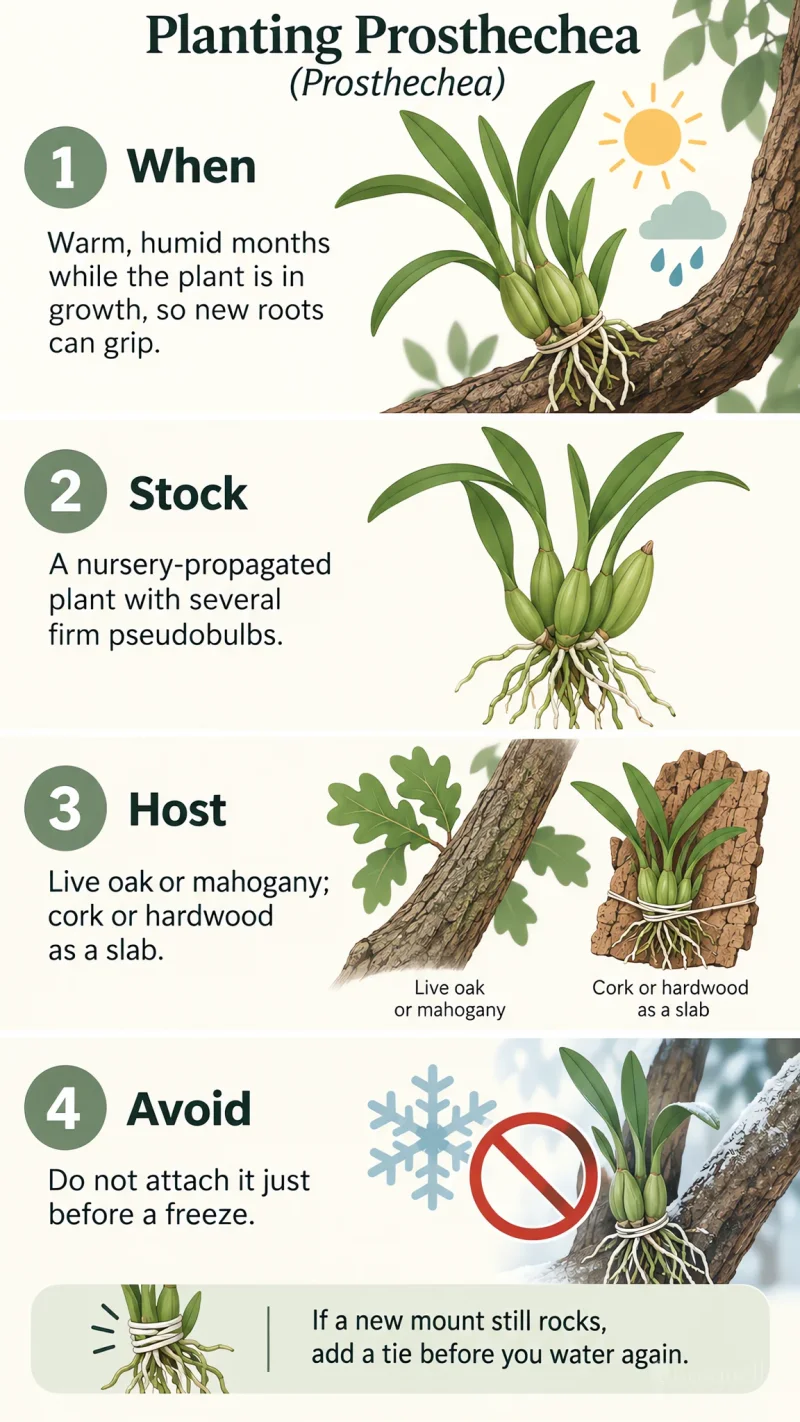
Tie a nursery plant to live oak or mahogany — do not take a wild plant
| Factor | Recommended | Avoid |
|---|---|---|
| When | Warm, humid months while the plant is in growth, so new roots can grip | Do not attach it just before a freeze |
| Stock | A nursery-propagated plant with several firm pseudobulbs | Do not take a plant off a wild Florida tree |
| Host | Live oak or mahogany; cork or hardwood as a slab | Do not use smooth, peeling bark |
| Contact | Bare roots tight against the bark | Do not wrap the roots in garden soil or a thick pad of wet moss |
clamshell orchid does not go in a hole. Live oak and mahogany are the usual restoration hosts. Cypress, mangrove, pond apple, mango, and avocado also hold it when the bark is rough. [1] A cork or hardwood slab works when you have no tree. Skip ficus, gumbo limbo, royal palm, and other smooth or peeling bark. [2] Florida lists this orchid as endangered. You may not harvest a wild plant without a permit. Buy a nursery plant. [3] Light, watering, and later care live on How to Grow Prosthechea.
Do I need a permit to take one off a Florida tree?
Yes, for wild plants. Florida treats this orchid as endangered. Buy a nursery-propagated plant instead.
When do I attach it to a tree?
In warm, humid weather while the plant is growing, so new roots can grip the bark. Do not attach it just before a freeze.
How to attach Prosthechea to a tree or a cork slab
Hold the plant so the newest roots touch the bark and the leaves face up. Tie it snug enough that wind cannot rock it, without crushing the pseudobulbs. [4]
- Choose a nursery plant with several firm pseudobulbs and live roots. Leave wild plants on the tree.
- Pick a live-oak or mahogany limb, or the north or east face of a trunk, or a cork or hardwood slab. Skip smooth or peeling bark.
- Soak the roots, then press them against the bark. Do not pack garden soil or a thick wet moss pad around them.
- Tie with jute or another natural twine so the plant cannot rock. Keep the pseudobulbs uncrushed.
- Water the roots in dry weather until new roots grip, then ease off so the roots can dry between waterings.
What fails if the bark is smooth or the roots stay wrapped wet
Roots that sit in a crotch of standing water, or on bark that sheds, rarely attach. A plant that wobbles in the wind tears new roots before they grip. Smooth bark gives the roots nothing to hold.
- Do not lodge the plant in a hole on the branch where rain collects.
- Do not wrap the roots in a thick, wet moss pad that never dries.
- Skip peeling bark, such as gumbo limbo or some eucalyptus, because the mount falls when the bark sheds.
- If the plant still rocks after a week, add a tie rather than soaking it every day in hope.
If a new mount still rocks, add a tie before you water again. Leave wild plants on the tree.
FAQ
Can I glue it instead of tying it?
A tight tie is the reliable home method. If you use a construction adhesive, put a small drop on the bark, let it get tacky, and press the pseudobulb — not the roots — into the drop.
Which tree if I have no live oak?
Mahogany is the next restoration host. Cypress, mangrove, pond apple, mango, and avocado work when the bark is rough. A cork slab is the indoor substitute.
Can I plant it in garden soil?
No. This orchid grows on bark, not in a hole. Garden soil around the roots stays wet and they rot.
Related guides

Recommended plants
References
- [1] Broward Native Orchids -
https://browardnativeorchids.com/wp-content/uploads/2026/04/prosthechea_cochleata.pdf - [2] National Tropical Botanical Garden -
https://ntbg.org/everglades-orchid-conservation/cockleshell-orchid/ - [3] Florida Wildflower Foundation -
https://www.flawildflowers.org/flower-friday-prosthechea-cochleata/ - [4] North American Orchid Conservation Center -
https://goorchids.northamericanorchidcenter.org/species/prosthechea/cochleata/
This note is part of Prosthechea Guides.
More planting notes by plant are gathered in Planting Guides.
Updated: Reviewed by Bosquelle Editors