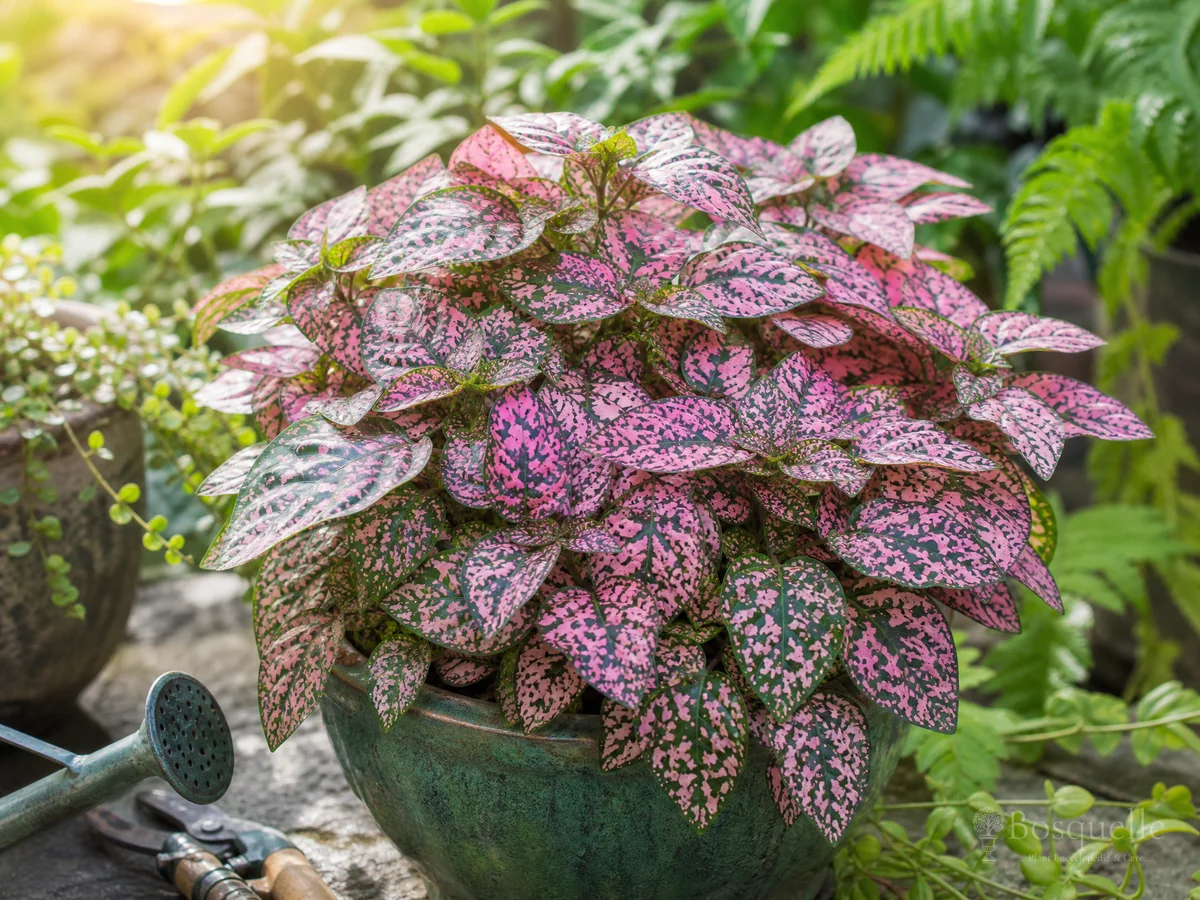
Grow polka-dot plant in bright indirect light, keep the mix barely moist, and raise humidity around the pot. Polka-dot plant is Hypoestes phyllostachya, also called freckle face — spotted leaves, not a polka-dot begonia and not a nerve plant.

Give it bright indirect light, keep the mix barely moist, and raise humidity
| Factor | Recommended | Avoid |
|---|---|---|
| Light | Bright, indirect light — an east or north window, or a few feet back from a brighter sill | Do not set it in hot midday sun, which crinkles and fades the spots |
| Water | Keep the mix barely moist, and water when the surface just starts to dry | Do not let the whole pot dry out, and do not leave it sitting in a saucer of water |
| Humidity | Keep humidity near 50 percent or higher with a pebble tray, a humidifier, a bathroom, or a terrarium | Do not grow it in dry furnace air with no extra moisture |
| Warmth | Keep it above about 54°F, ideally in the mid 60s to mid 70s | Do not leave it by a cold draft or a hot radiator |
polka-dot plant is Hypoestes phyllostachya, a Madagascar foliage plant with opposite ovate leaves splashed rose, pink, red, or white. It is grown for those spots, not for the small lilac flower spikes. Set it in bright, indirect light so the color stays strong. Too little light fades the spots and stretches the stems; hot sun crinkles the leaves. [1] Humidity near 50 percent or higher keeps the leaf edges from browning. A pebble tray, a humidifier, a steamy bathroom, or a terrarium raises the moisture in the air. Keep the room above about 54°F. [2]
Keep the mix barely moist, and water when the surface just starts to dry. If the plant droops and the mix is dry, water it thoroughly; it usually stands back up once the mix is wet again. If it wilts while the mix is still wet, the roots are rotting, so do not add more water. [3]
- Place it in bright, indirect light, an east or north window, or a few feet back from a brighter sill.
- Water when the surface of the mix feels just dry. Empty the saucer after water runs through.
- Raise humidity with a pebble tray, a humidifier, a bathroom, or a terrarium.
- Keep the room above about 54°F. If the plant droops and the mix is dry, water it; if the mix is wet and it still wilts, check the roots for rot.
How often should I water a polka-dot plant?
Water when the surface of the mix just starts to dry. Keep the rest barely moist, not soggy, and empty the saucer.
Why did it wilt?
The mix went dry. Water it thoroughly, and it usually stands back up. If the mix is still wet, the roots may be rotting.
Why are the leaf edges turning brown?
The air is too dry. Raise humidity with a pebble tray, a humidifier, a bathroom, or a terrarium.
Water a little less in winter, and keep it above about 54°F
Growth slows in short winter days. Water a little less, still without letting the mix go bone-dry, and skip fertilizer until new leaves show. Keep the plant indoors, and do not let the room drop below about 54°F.
Plant it in a small pot that drains
A 4- to 6-inch plastic or glazed pot with a drainage hole holds moisture better than unglazed terracotta, which dries too fast for this plant. A hanging basket with a hole works if you want the stems to spill. [4] Fill it with a peat-rich or peat-free houseplant mix that still drains, loosened with perlite if it packs. Set the crown at the mix surface. Wait to repot until spring, when roots show at the hole or the mix is tired, and step up only one pot size. Rooting a stem cutting is a separate job on How to Propagate Polka Dot Plant.
- Choose a 4- to 6-inch pot or a hanging basket with a drainage hole.
- Fill it with a moisture-holding mix that still drains, loosened with perlite if it packs.
- Set the plant so the crown sits at the mix surface, not buried.
- Water with room-temperature water until it runs out, then empty the saucer.
Can I grow it in a terrarium?
Yes. A terrarium holds humidity around a compact plant. Use mix that drains, and do not leave standing water in the bottom.
Pinch the tips so it stays bushy, and pinch the flower spikes
This plant stretches if you never pinch it, especially in lower light. Pinch a long stem just above a leaf so side shoots fill in. Cut off yellow or brown leaves at the base. The small lilac spikes take energy from the foliage, so pinch those buds off if you want denser leaves. To root the tips you pinched, use How to Propagate Polka Dot Plant.
- Pinch each long stem just above a leaf node.
- Repeat as new tips stretch, so the plant stays a mound instead of a few tall canes.
- Pinch off flower spikes when they show, so energy stays in the leaves.
Not a polka-dot begonia — and not a nerve plant
A shop tag that says polka-dot plant is sometimes confused with polka-dot begonia (Begonia maculata): an angel-wing begonia with silver spots on long leaves, not opposite ovate leaves with pink or red splatters. If the leaf is a cane-wing begonia, read How to Grow Begonias. Nerve plant is Fittonia, with a fine net of veins rather than splatters, and it stays lower and creeps; see How to Grow Nerve Plant.
Baby's tears on a creeping mossy carpet is Soleirolia, a round-leaf groundcover, not this upright spotted plant. Some tags also say flamingo plant; flamingo flower with waxy spathes is Anthurium, so use How to Grow Anthurium if that is what you bought. Coleus, sometimes called painted nettle, is a different blotched leaf; see How to Grow Coleus.
Is this a polka-dot begonia?
No. Polka-dot begonia is Begonia maculata, an angel-wing leaf with silver spots. This plant has opposite ovate leaves with pink, red, or white splatters.
Is this a nerve plant?
No. Nerve plant has a net of veins and creeps. Polka-dot plant is more upright, with splatters rather than veins.
Keep it in bright indirect light, with barely moist mix and extra humidity. Pinch the tips, and take a stem cutting if you want a second pot.
FAQ
What about pink, red, or white spots, or names like Confetti and Splash?
Shops sell many spot colors on the same plant. Bright indirect light, barely moist mix, and extra humidity still apply.
Is polka-dot plant toxic to cats or dogs?
Polka-dot plant is listed as non-toxic to cats, dogs, and horses. Still keep pets from chewing the leaves, because a stomach upset can come from any plant material.
Can I put it outside for the summer?
Yes, after nights stay above about 50°F, in part shade. That outdoor planting job is on How to Grow Polka Dot Plant Outdoors.
What about mealybugs or other sucking insects?
Wipe them off the leaves as soon as you notice them, and keep the mix from staying soggy.
Related guides


Recommended plants

References
- [1] NC State Extension -
https://plants.ces.ncsu.edu/plants/hypoestes-phyllostachya/ - [2] Wisconsin Horticulture -
https://hort.extension.wisc.edu/articles/polka-dot-plant-hypoestes-phyllostachya/ - [3] Royal Horticultural Society -
https://www.rhs.org.uk/plants/hypoestes/how-to-grow-hypoestes - [4] Almanac -
https://www.almanac.com/plant/polka-dot-plant
This note is part of Hypoestes Guides.
More first-season notes by plant are gathered in How to Grow Guides.
Updated: Reviewed by Bosquelle Editors