
Grow organ pipe cactus in full sun and cactus mix that dries. Water only after the mix is dry, then keep it almost dry in winter. The plant is Stenocereus thurberi, a Sonoran column that sends many stems from the ground. It is not a saguaro, and it is not Mexican fence post cactus.
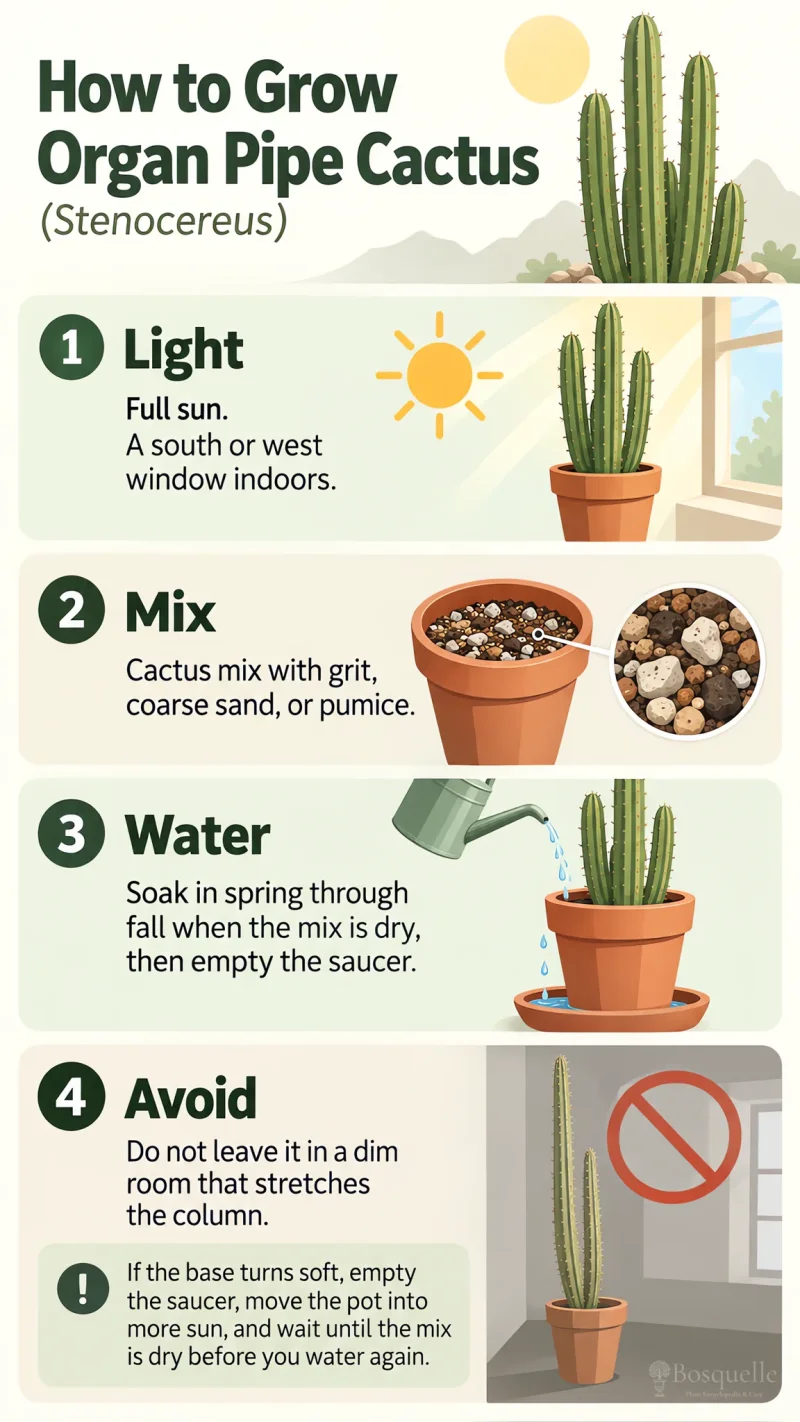
Give it full sun, mix that dries, and a dry winter
| Factor | Recommended | Avoid |
|---|---|---|
| Light | Full sun. A south or west window indoors | Do not leave it in a dim room that stretches the column |
| Mix | Cactus mix with grit, coarse sand, or pumice | Do not use peat that stays wet around the roots |
| Water | Soak in spring through fall when the mix is dry, then empty the saucer | Do not water on a winter calendar |
| Winter | Almost dry, and frost-free | Do not keep a warm, wet pot all winter |
| Drought | Dry spells once the mix drains | Do not keep the mix wet because a dry-garden tag is on the pot |
organ pipe cactus wants full sun once it is used to bright light. If the nursery kept it in shade, give it a few days of lighter sun before midday, so the skin does not scorch. [1] In the growing season, soak when the mix is dry, then empty the saucer. Established plants in draining ground can live on rainfall, but a soak twice a month in hot weather helps them put on new stem. [2] In winter, cut water back until the mix stays almost dry. That rest keeps the stem firm. Take a stem cutting on How to Propagate Organ Pipe Cactus.
How much sun does organ pipe cactus need?
Give it full sun. A south or west window is the indoor default. A dim room stretches the column and keeps the mix wet too long.
How often do I water it?
In spring through fall, soak when the mix is dry, then empty the saucer. In winter, keep it almost dry.
When does organ pipe cactus bloom?
Creamy-white or pale violet cups open at night on a mature plant that had a dry winter rest. A windowsill plant often skips bloom. Wild plants may wait decades for the first flower.
Bring it in before frost, or cup the growing tips
Young plants are tender below about 30 F. A mature clump may take a brief dip near 26 F, but new tips still burn. Where nights drop near frost, grow it in a pot you can carry inside, and bring it in before a freeze. Keep the indoor pot bright and almost dry until spring. Where a short dip is the only risk, set a foam cup upside down over each growing tip so the new tissue does not freeze. A wet pot in the cold often rots at the base.
Can organ pipe cactus stay outside in winter?
Only where frost stays off, or where a brief dip can be covered at the tips. In most of the United States, grow it in a pot and bring it in before a freeze. Keep that winter pot almost dry.
Plant it facing the same way, or keep a young one in a pot you can bring in
Where frost stays off, plant it in a sunny bed that drains. Mark the south side before you lift it, and set that same side south again, so the skin that already takes the sun stays on the hot face. [3] In most of the United States, grow it in a terracotta pot with a hole so you can bring it in before a freeze. Set the green stem at the same depth it grew in the nursery pot. Do not bury the ribs. Give it room to become a wide clump, and keep it off a walkway so you never have to saw an arm.
- Wear gloves, or wrap the stems in several layers of newspaper, before you lift it. The ribs carry stout spines.
- Mark the south side with chalk, string, or the nursery paint mark. Replant with that side facing south.
- Choose a pot a little wider than the root ball, with a drainage hole, or a mound of grit in open ground. Terracotta dries faster than plastic.
- Fill with cactus mix plus grit or coarse sand. Set the stem at the old soil line. Do not bury green tissue.
- Wait about a week after you plant or pot it before the first soak, so broken roots can dry. Then soak once, and wait until the mix is dry again.
- If the plant came from a shaded greenhouse, give it a few days of lighter sun before full midday light.
Can I grow it in a pot?
Yes. Use a pot with a hole and cactus mix that dries. Young plants live in pots for years. Bring the pot in before a freeze.
Not a saguaro — organ pipe cactus branches from the ground
Saguaro is Carnegiea gigantea, one thick trunk that may grow arms high up after many years. Grow that plant on How to Grow Saguaro. organ pipe cactus is a clump of many stems from a woody base, with no single trunk. [4] Mexican fence post cactus is Pachycereus marginatus, a cleaner column with five to seven ribs. Shops also call it Central Mexico organ pipe or organ cactus. That is a different plant. Grow it on How to Grow Totem Pole Cactus. Totem pole cactus is the knobby, nearly spineless form of Pachycereus. Senita is the whiskered typical form, not this clump. Barrel cactus is a globe, not a pipe cluster; grow that on How to Grow Barrel Cactus. Dragon fruit is a climbing night-blooming cactus sold as pitaya; grow that on How to Grow Dragon Fruit. Christmas cactus is a hanging holiday plant; grow that on How to Grow Christmas Cactus. Prickly pear is a pad cactus; grow that on How to Grow Prickly Pear.
Is this a saguaro?
No. A saguaro is one thick trunk. Organ pipe cactus sends many stems from the ground. Mexican fence post cactus is another lookalike with fewer ribs.
If the base turns soft, empty the saucer, move the pot into more sun, and wait until the mix is dry before you water again.
FAQ
Do you list all the species?
The shop plant is sold as organ pipe cactus, or Stenocereus thurberi. The genus also holds creeping devil and other Mexican pitaya columns, which we do not stock. Read the tag for the Latin name, then keep the same sun, grit, and dry-between watering.
Do I need to prune it?
No regular prune is required. Site it away from a walkway so you do not have to remove an arm. Cut a damaged stem in warm weather, let the wound dry, and you can root that piece as a cutting.
Do I fertilize it?
Fertilizer is not required in a gravel bed. In a pot, a weak cactus feed once in late spring is enough. Do not feed in winter.
Are the fruits edible?
Ripe fruit, called pitaya dulce, splits and shows red pulp. Eat it fresh if you grow a mature plant. Do not treat this as a jam or wine recipe. Do not pick fruit in a park unless you have that right.
Will deer or rabbits eat it?
The spines usually keep browsing animals off the stem. Still site it away from a path where people or pets brush the ribs.
Is it safe around pets?
The spines puncture skin. Keep the plant out of reach of pets and children. Do not let anyone chew the stem.
Do I need a permit to plant one?
Buy a nursery plant. Do not dig a wild organ pipe cactus. Wild native cacti in Arizona are protected.
Related guides
Recommended plants
References
- [1] University of Arizona Campus Arboretum -
https://arboretum.arizona.edu/snyder-preserve-stenocereus-thurberi - [2] Arizona-Sonora Desert Museum -
https://desertmuseum.org/visit/sheets/Stethu.pdf - [3] University of Arizona Cooperative Extension -
https://www.extension.arizona.edu/publication/how-transplant-cactus - [4] National Park Service -
https://www.nps.gov/orpi/learn/nature/organ-pipe-cactus.htm
This note is part of Stenocereus Guides.
More first-season notes by plant are gathered in How to Grow Guides.
Updated: Reviewed by Bosquelle Editors