
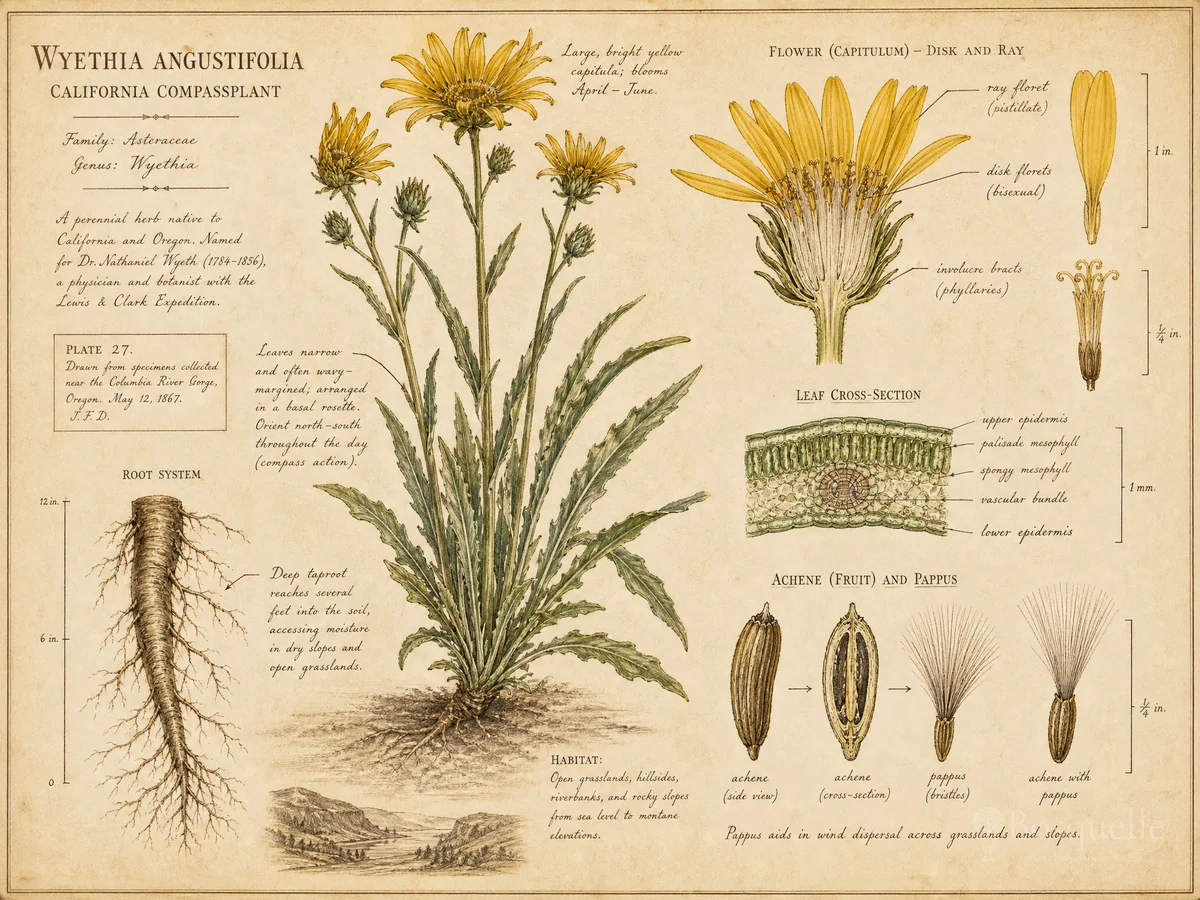
Grow mule's ears in full sun, on soil that drains. Mule's ears is Wyethia. California compassplant is another name for this plant, not prairie compass plant.

Give it full sun and soil that drains — then ease off water once it is rooted
| Factor | Recommended | Avoid |
|---|---|---|
| Light | Full sun | Do not plant it in deep shade |
| Soil | Sandy to loamy soil that drains; an open slope is fine | Do not plant it in a soggy low spot |
| Water | Water through the first season so the taproot takes, then skip extra water except in a long dry spell | Do not keep watering a dormant clump on a weekly calendar |
| Site | An open slope, meadow, or a sunny border that drains | Do not keep it in a patio pot as a long-term plant |
| Rest | Tops die back in summer or fall; new leaves come in spring | Do not dig it out because the leaves dried after bloom |
mule's ears is a western perennial with a deep taproot, a tuft of long tongue-shaped leaves, and yellow sunflower-like heads on a short stalk. Give it full sun and soil that drains. Water through the first season so the taproot takes. After that, skip extra water except in a long dry spell. The top dies back in summer or fall; that is rest, not a dead plant. New leaves come in spring. Soggy ground around the crown is the usual cause of rot. [1]
How much sun does mule's ears need?
Full sun. Deep shade makes a weak clump that rarely blooms well.
How often should I water it?
Water through the first season. After that, skip extra water except in a long dry spell. Do not keep watering after the leaves have died back.
Sow in fall, or chill the seed three months
Start from seed. A mature plant takes poorly to moving because the taproot is deep, so do not lift a clump from a hillside and expect it to reset. Sow outdoors in fall so winter cold and moisture break dormancy, and cover the seed only lightly. [2]
- Sow outdoors in fall, in full sun, on soil that drains.
- Cover the seed lightly. Do not bury it deep.
- If you start in a pot, sow in late fall in a deep, narrow pot, set it outside, and water only in a long dry spell.
- If you missed fall, give the seed about three months of cold, moist chill in a refrigerator, then sow. Germination can be slow and uneven. [3]
- Expect slow top growth. The taproot grows first. Bloom can take a few years.
Plant a young plug without folding the taproot
If you bought a young plug, plant it while the root still has room in the pot. Keep the taproot straight in a hole deep enough that it does not fold. Water until it takes, then ease off. Leave a mature plant in place. [4]
- Plant a young plug in fall or spring, in full sun, on soil that drains.
- Dig a hole deep enough for the taproot to sit straight. Do not fold it in a shallow hole.
- Set the crown at soil level and backfill.
- Water until the planting takes, then skip extra water except in a long dry spell.
- Do not lift a mature plant. It rarely resets after that move.
When do I sow the seed?
Fall, covered lightly, so winter can chill the seed. If you missed fall, chill the seed about three months in a refrigerator, then sow.
Can I move a mature plant?
No. The taproot is deep. Sow seed, or plant a small plug before the root fills the pot.
Not balsamroot — and not a garden sunflower or prairie compass plant
Arrowleaf balsamroot is Balsamorhiza. It has triangular, arrow-shaped leaves and usually one head on a leafless stalk. Mule's ears has long tongue-shaped leaves and yellow heads on a short stalk. See How to Grow Arrowleaf Balsamroot if the tag is Balsamorhiza. Do not buy balsamroot as this plant.
Garden sunflowers are Helianthus — see How to Grow Sunflowers if the tag is Helianthus. Prairie compass plant is Silphium, a tall prairie plant that can reach several feet, with leaves that may point north-south. California compassplant is another name for this mule's ears, not that prairie plant. See How to Grow Silphium if the tag is Silphium.
Elephant ear is Colocasia, a wet-soil leaf plant — see How to Grow Colocasia if the leaves are huge and the soil stays wet. Lamb's ear is Stachys, a fuzzy silver groundcover — see How to Grow Lamb's Ear if the leaves are thick and woolly, not long green tongues.
Is this balsamroot?
No. Arrowleaf balsamroot is Balsamorhiza. Mule's ears is Wyethia, with long tongue-shaped leaves.
Is this prairie compass plant?
No. Prairie compass plant is Silphium. California compassplant is another name for this mule's ears.
Sow the next packet in fall on soil that drains, or set a small plug with the taproot straight, then ease off water once it is rooted.
FAQ
Can I grow it in a pot?
Only as a young plug in a deep pot, and only until you can plant it out. It is not a patio plant or a windowsill houseplant.
Do I prune it?
There is no wood to train. Cut spent flower stalks if you want a tidier clump. Leave the leaves until they die back on their own.
Is northern mule's ears a different kind we sell?
We hold narrowleaf mule's ears. Northern mule's ears and white mule's ears are other wild names you may see. They want the same sun and soil that drains.
Does it come back after the leaves die?
Yes. The top dies back after bloom. New leaves come from the taproot the next spring.
Recommended plants
References
- [1] Lady Bird Johnson Wildflower Center -
https://www.wildflower.org/plants/result.php?id_plant=WYAN - [2] Larner Seeds -
https://larnerseeds.com/products/wyethia-angustifolia-mules-ear - [3] Native Plant Network -
https://rngr.net/renderNPNProtocolDetails?selectedProtocolIds=asteraceae-wyethia-684 - [4] Sevenoaks Native Nursery -
https://sevenoaksnativenursery.com/product/wyethia-angustifolia/
More first-season notes by plant are gathered in How to Grow Guides.
Updated: Reviewed by Bosquelle Editors