
Grow mouse plant in part shade, in moist woodland soil that drains. Mouse plant is Arisarum. It is a small woodland aroid, not jack-in-the-pulpit.
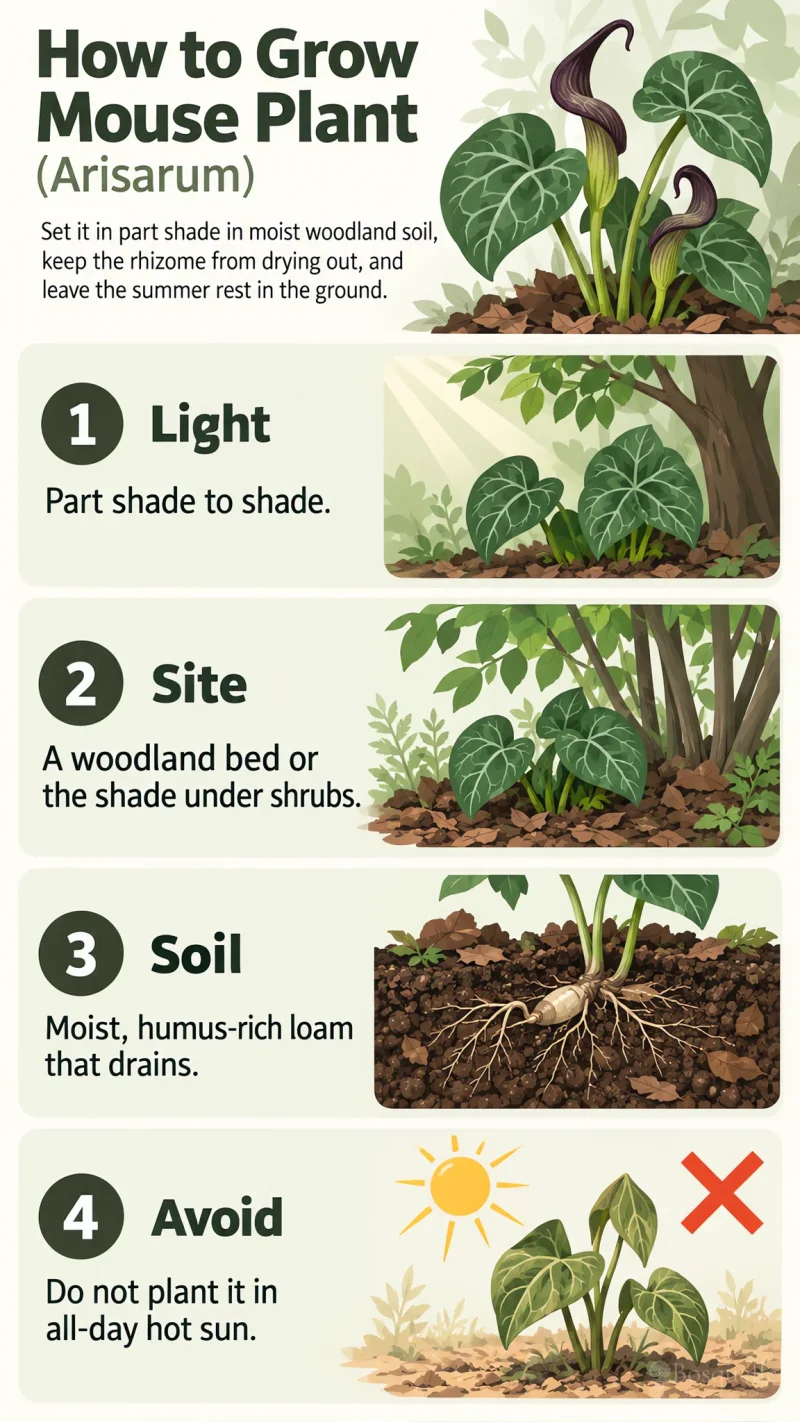
Give it part shade and moist woodland soil that drains
| Factor | Recommended | Avoid |
|---|---|---|
| Light | Part shade to shade | Do not plant it in all-day hot sun |
| Soil | Moist, humus-rich loam that drains | Do not plant it in heavy clay that stays soggy |
| Water | Keep the soil moist while the leaves are up | Do not let the rhizome dry out |
| Site | A woodland bed or the shade under shrubs | Do not treat it as a dry gravel plant |
| Rest | Expect the top to die back in early summer | Do not assume the plant is dead when the leaves yellow |
mouse plant is a short woodland aroid from Spain and Italy. It makes a low carpet of glossy, arrow-shaped leaves, about 3 to 6 inches tall. Give it the same moist, humus-rich shade it uses in a woodland, not a hot, dry border. [1]
How much shade does mouse plant need?
Part shade to shade. All-day hot sun scorches the leaves and dries the rhizome.
Where are the flowers?
In spring, under the leaves. Each spathe looks like a small purple-brown mouse with a long tail. Lift a leaf if you want to see it.
Plant the rhizome in spring, and keep it from drying out
Set a nursery plant or a dormant rhizome in spring, in part shade. The underground stem is a short rhizome. Shops may call it a tuber once. Keep the soil moist after planting, because the rhizome does not tolerate sitting dry. [2]
- Plant in spring, in part shade.
- Set a potted plant at the same soil line as the nursery pot, or barely cover a bare rhizome with moist, humus-rich soil that drains.
- Water so the soil stays moist. Do not let the rhizome dry out after planting.
- Leave room for a slow colony. Do not plant it in heavy clay that stays soggy.
Can I plant it in fall?
Spring is the usual window. If you plant a potted plant later, keep the soil moist and do not let the rhizome dry.
Let the leaves die back in summer, and keep the bed from going dry
Leaves come in late winter. In early summer they yellow and the top dies back until the next spring. That rest is normal. Leave the rhizomes in the ground, and keep the bed from going bone-dry. In the wild this plant still gets some summer moisture. [3] [4]
- When the leaves yellow in early summer, leave them until they are brown. Do not cut green leaves.
- Keep the empty bed from going bone-dry. Do not soak it into a puddle either.
- Leave the rhizomes in the ground. Do not lift and store them dry like a tender bulb.
- Expect new leaves in late winter or early spring.
Did it die when the leaves vanished?
Usually no. The top dies back in summer. Keep the soil from going dry and wait for leaves next late winter.
Split a crowded clump in autumn or winter
Once a patch is crowded, lift it in autumn or winter and tease the short rhizomes apart. Replant them at once in moist woodland soil so they do not sit dry.
- In autumn or winter, lift a crowded clump.
- Tease the short rhizomes apart.
- Replant them at once in moist woodland soil. Do not let them sit dry.
Not jack-in-the-pulpit — and not a calla lily or Mickey Mouse shrub
Jack-in-the-pulpit is Arisaema. It is a taller woodland aroid with three leaflets and a hooded spathe, often 1 to 2 feet tall. See How to Grow Jack-in-the-Pulpit if that is the plant on the tag. Mouse plant is a 4-inch carpet with a long-tailed spathe hidden under the leaves.
Calla lily is Zantedeschia, a larger garden spathe. See How to Grow Calla Lily if you bought a calla. Caladium is grown for colored leaves — see How to Grow Caladium if the tag says caladium. Italian arum is a different woodland aroid — see How to Grow Italian Arum if the tag says Arum. Wild ginger is Asarum, a shade carpet with no mouse-tail spathe — see How to Grow Wild Ginger if you bought ginger as a groundcover.
Mickey Mouse plant in U.S. shops is usually Ochna, a shrub with yellow flowers and later black fruit on red sepals. That is not this aroid. A tag that says mousetail is not rat-tail cactus either — see How to Grow Rat Tail Cactus if the plant is a hanging cactus stem.
Is this the same as jack-in-the-pulpit?
No. Jack-in-the-pulpit is Arisaema, a taller native aroid with three leaflets. Mouse plant is a 4-inch carpet.
Is Mickey Mouse plant the same?
No. Mickey Mouse plant is usually Ochna, a shrub. Mouse plant is a small woodland aroid.
Set it in part shade in moist woodland soil, keep the rhizome from drying out, and leave the summer rest in the ground. If the tag says jack-in-the-pulpit or calla, that is a different plant.
FAQ
Can I grow it from seed?
You can sow seed in a cold frame in spring, but most gardeners start with a nursery plant or a divided rhizome.
Is it a houseplant?
No. Grow it outdoors in moist woodland soil. A dry windowsill pot is the wrong home.
Is friar's cowl the same plant?
No. Friar's cowl is Arisarum vulgare, a Mediterranean cousin that wants a dry summer rest. Mouse plant wants some moisture even after the leaves die back.
Is it safe around pets?
It is harmful if eaten, and the sap can irritate skin and eyes. Wear gloves when you divide it, and keep pets from chewing the leaves.
Recommended plants

References
- [1] Royal Horticultural Society -
https://www.rhs.org.uk/plants/1569/arisarum-proboscideum/details - [2] Wikipedia -
https://en.wikipedia.org/wiki/Arisarum_proboscideum - [3] Plant Delights Nursery -
https://www.plantdelights.com/products/arisarum-proboscideum - [4] Pacific Bulb Society -
https://pacificbulbsociety.org/pbswiki/index.php/Arisarum
More first-season notes by plant are gathered in How to Grow Guides.
Updated: Reviewed by Bosquelle Editors