
Grow Italian arum in part shade to full shade, in moist soil that drains. Shops also call it Italian lords-and-ladies. Do not eat the leaves, tubers, or berries.

Give it part shade to full shade, and moist soil that drains
| Factor | Recommended | Avoid |
|---|---|---|
| Light | Part shade to full shade; a woodland edge or the north side of a shrub | Do not site it in a hot, dry full-sun bed |
| Soil | Humus-rich ground that stays moist and still drains | Do not leave the tuber in a puddle with no outlet |
| Water | Keep the soil moist while leaves are up; once the tops die in summer, stop watering on a schedule | Do not soak a dormant summer bed on a schedule |
| Place | A shady border you can leave, after you check the local invasive list | Do not plant it where the species is listed as a noxious weed |
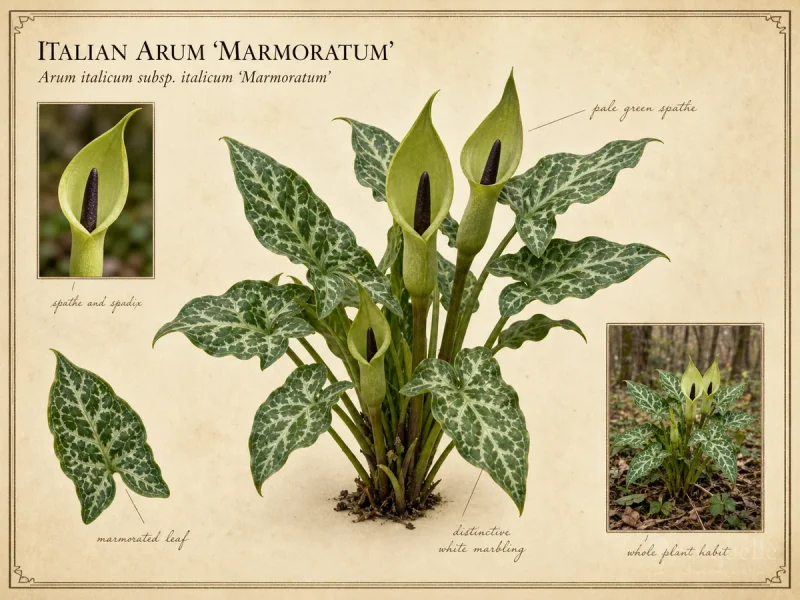
Italian arum is Arum italicum, a tuberous woodland perennial. Site it in part shade to full shade, in soil that stays moist and still drains. Leaves come up in fall. In a cold winter they die and return in spring. In a mild winter they stay green through the cold months. In every climate the tops die in summer while the tuber rests. [1] It sits under shrubs in a woodland bed. The cream-veined form sold as Marmoratum is the same shade and moisture job, not a different watering rule.
How much sun does Italian arum need?
Part shade to full shade. A hot, dry full-sun bed scorches the leaves and dries the tuber.
How often should I water Italian arum?
Keep the soil moist while leaves are up. When the tops die in summer, stop watering on a calendar — the plant is dormant.
Check whether Italian arum is listed invasive before you plant
Before you add a new clump, check whether Italian arum is listed as invasive where you garden. In parts of the Pacific Northwest it is a listed noxious weed, and tubers plus berries make it hard to remove. Wear gloves. Cut and bag the berries before they ripen, and put plant parts in the trash — do not compost them. [2] If the plant is already in the bed, keep working the same way: gloves, bag the berries, and do not move soil that still holds tubers.
Is Italian arum invasive?
It is listed in parts of the Pacific Northwest and it spreads by tubers and berries. Check your local list before you plant a new clump.
Grow it in a pot if you need to keep the tubers in one place
If you need to stop tubers from running through a bed, grow the plant in a pot instead of open ground. Pick berries before they ripen so seed does not leave the pot.
- Choose a pot with a drainage hole, large enough for a clump about a foot across.
- Fill it with a mix that stays moist and still drains — compost worked into ordinary potting mix is enough.
- Set the tuber at the same depth you would use in the ground, water once to settle it, and pick off berries before they turn orange-red.
Can I grow Italian arum in a pot?
Yes, if you need to keep tubers from running through a bed. Use a pot with a drainage hole and pick off berries before they ripen. It is not a year-round houseplant.
Plant the tubers about three inches deep in late summer or early fall
Plant while the plant is dormant, in late summer or early fall, before a hard frost. Wear gloves — the sap can irritate skin. [3]
- Wait until late summer or early fall, when the tops are gone and before a hard frost.
- Work compost into the top of a shady bed so the soil stays moist and still drains.
- Set each tuber about three inches deep and eight to thirteen inches apart.
- Water once to settle the soil. Mulch after the leaves come up in fall.
Divide clumps in summer while the plant is dormant
If a clump is crowded, lift it in summer while the tops are gone. Separate the tubers and replant them at the same depth, still wearing gloves. Do not put broken tubers in the compost pile.
When should I plant Italian arum?
Late summer or early fall, while the plant is dormant and before a hard frost.
How deep do I plant a tuber?
About three inches deep, and eight to thirteen inches apart.
Sow seed in fall after you clean the pulp
Italian arum also grows from seed. The pulp around the seed can irritate skin, so wear gloves and rinse it off before you sow. [4] Division is faster if you already have a clump you like.
- Wear gloves, and squeeze the ripe berries to free the seed.
- Rinse off the pulp, then sow the seed in fall in a pot of mix that drains.
- Keep the mix moist, and leave the seedlings in that pot through the first year.
Can I grow Italian arum from seed?
Yes. Clean the pulp off the berries in fall, sow in a pot that drains, and wait. Division is faster if you already have a clump.
Not a calla lily — and not jack-in-the-pulpit
Italian arum is Arum. Calla lily is Zantedeschia, on How to Grow Calla Lily. A shop tag that says arum lily usually means calla: a tall funnel spathe, not cream-veined arrow leaves that rest all summer.
Jack-in-the-pulpit is Arisaema, a native woodland plant with a three-part leaf and a hooded spathe. Italian arum has a simple arrow-shaped leaf and a spike of orange-red berries after the leaves die. Wild ginger is Asarum, on How to Grow Wild Ginger — heart-shaped leaves and no berry spike. In Pacific Northwest wetlands, wapato (Sagittaria) has a similar arrow leaf without the cream veins; that native plant is not this one. Lords-and-ladies in UK lists is often Arum maculatum, a species we do not hold.
Is Italian arum the same as a calla lily?
No. Calla lily is Zantedeschia. Arum lily on a shop tag is usually calla, not this plant.
Is Italian arum jack-in-the-pulpit?
No. Jack-in-the-pulpit is Arisaema, with a three-part leaf. Italian arum has a simple arrow-shaped leaf.
Check the local invasive list, then site it in shade that stays moist. Plant the tubers in late summer, and let the tops rest in summer.
FAQ
Does Italian arum come back after summer?
Yes. The tops die in summer while the tuber rests. New leaves come up in fall, or in spring after a cold winter.
Is Italian arum a houseplant?
No. You can hold a pot outdoors to confine the tubers, but the plant wants a winter-to-spring leaf season outdoors, not a windowsill year-round.
Can I eat the berries?
No. All parts of the plant can irritate the mouth and skin. Keep pets and children from chewing leaves or berries.
Is Marmoratum a different plant?
No. Marmoratum is the cream-veined form of Italian arum. It wants the same shade, moisture, and summer rest.
Is this the same as lords-and-ladies?
Italian lords-and-ladies is this species. Plain lords-and-ladies in UK lists is often Arum maculatum, which we do not hold.
Do I prune Italian arum?
You do not shear it on a calendar. Let the leaves die back in summer so the tuber can rest. Cut and bag berries before they ripen if you need to stop seed from spreading.
Recommended plants

References
- [1] NC State Extension Gardener -
https://plants.ces.ncsu.edu/plants/arum-italicum/ - [2] Oregon State University Extension -
https://solvepestproblems.oregonstate.edu/weeds/italian-arum - [3] Weekand -
https://www.weekand.com/home-garden/article/plant-arum-italicum-18054845.php - [4] Fine Gardening -
https://www.finegardening.com/plant/italian-arum-arum-italicum
More first-season notes by plant are gathered in How to Grow Guides.
Updated: Reviewed by Bosquelle Editors