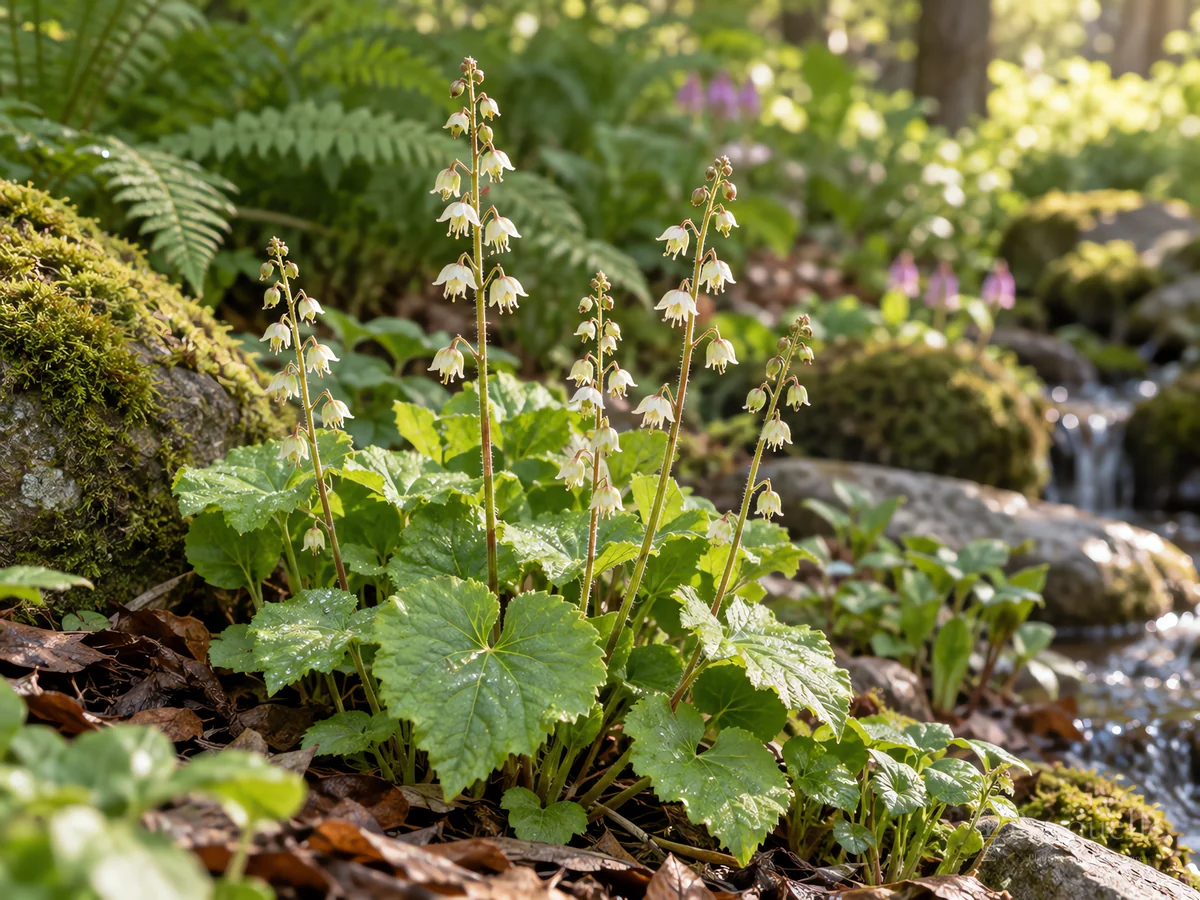
Grow miterwort in part shade to full shade and moist, humus-rich woodland soil. Miterwort is Mitella diphylla, also called bishop's cap — an eastern woodland wildflower, not the cactus sold under that name, and not foamflower.

Give it shade, moist woodland soil, and a leaf mulch
| Factor | Recommended | Avoid |
|---|---|---|
| Light | Part shade to full shade, with spring light under deciduous trees before the canopy closes | Do not plant it in hot midday sun, which scorches the leaves |
| Soil | Moist, humus-rich woodland soil that still drains, with leaf mold worked in | Do not plant it in a soggy low spot, and do not strip the leaf litter |
| Water | Keep new plants evenly moist through the first growing season | Do not let a new planting stay bone dry; once it is settled, a drier shady site is fine |
| Mulch | A loose layer of shredded leaves or leaf mold to keep the roots cool | Do not pile thick bark against the crown |
Miterwort is a small clump from a short rhizome, native to rich woods of eastern North America. Sit it under deciduous trees so it gets light in early spring and shade once the canopy closes. [1] Keep the soil evenly moist while it settles. Dry ground in that first year is the usual reason a clump stalls; once it is established, it can take a drier shady site. A loose leaf mulch holds that moisture and keeps the roots cool. [2] It grows in acidic woodland humus and also on sometimes limey ground, so do not chase a special pH. Top-dress with leaf mold in fall, and skip a rich fertilizer. [3]
How much shade does miterwort need?
Part shade to full shade, ideally under deciduous trees. It uses the spring light before the leaves come out, then needs shade through summer heat.
How often should I water miterwort?
Water new plants whenever the top of the soil starts to dry, through the first season. A settled clump in shade can take a drier spell; do not let a new planting stay bone dry.
Plant it in spring or fall, at the same depth as the pot
Set nursery plants in early spring or in fall, in a shady, moist bed. Keep the crown at the same soil line it had in the pot, firm the backfill, and water it in the same day. Space clumps about 8 to 12 inches apart so the basal leaves can fill without crowding. Keep the soil moist while it settles, and pull weeds around young plants, because they do not compete well. Do not lift plants from the woods.
- Pick a shady, moist woodland bed with room for a low clump about 8 to 16 inches tall.
- Plant in early spring or fall, with the crown at the same soil line it had in the container.
- Space plants about 8 to 12 inches apart, then firm the soil so there are no air pockets around the rhizome.
- Water thoroughly the same day, mulch with leaves, and keep the soil evenly moist while the clump settles.
Can I move an established clump?
Only if you must. Miterwort is slow to settle after a move, so pick the shade and moisture now and leave it there. If you split a large clump, wait until spring or fall and see Growing Miterwort From Seed.
Leave the seed cups so rain can splash the seed
Miterwort opens tiny white flowers from April into June, widely spaced on a slender stalk about 8 to 16 inches tall. Each bloom is about an eighth of an inch across, with five deeply fringed petals that look like a snowflake up close, so plant it next to a path. After bloom, the flower becomes an open cup that holds shiny black seed. Leave those cups standing. Rain hitting the cup splashes the seed a short distance, which is how a patch fills in. Do not cut the stalks back for a tidy look until the seed has gone. To raise plants from collected seed, see Growing Miterwort From Seed.
Plant it with other woodland neighbors that share shade and moist humus, such as How to Grow Foamflower, How to Grow Wild Ginger, How to Grow Trillium, and How to Grow Coral Bells, and keep aggressive spreaders off the clump.
When does miterwort bloom?
From April into June, depending on how far north you are. Each flower is tiny, so put it where you will walk past it.
Not foamflower — and not bishop's cap cactus
The maple-like basal leaves look like foamflower until you see the bloom stalk. Foamflower carries a dense, foamy cluster on a leafless stalk, and the petals are entire. Miterwort has one pair of opposite, nearly stalkless leaves halfway up the stalk, and the petals are deeply fringed. [4] If the tag says false miterwort, you have foamflower — see How to Grow Foamflower. Coral bells have similar basal leaves but heavier flower wands; see How to Grow Coral Bells.
Bishop's cap is also a shop name for a ribbed cactus, Astrophytum, which wants sun and a dry mineral mix, not woodland shade. Bishop's hat is usually epimedium, with spurred flowers — see How to Grow Epimedium if that is the tag. Naked miterwort is a smaller northern plant with no pair of stem leaves; it is not in this catalog.
Is miterwort the same as foamflower?
No. Foamflower has a leafless bloom stalk and unfringed petals. Miterwort has two opposite leaves on the stalk and fringed white flowers.
If the clump stalls, the sun was probably too hot or the first season stayed dry. Put the next plants in shade with a leaf mulch, and keep them moist until they settle.
FAQ
Is there more than one kind of miterwort?
Mitella diphylla is the plant here, the eastern woodland species with two stem leaves. Naked miterwort, Mitella nuda, is smaller, has no pair of stem leaves, and is not in this catalog.
Can I grow it in a pot?
Yes, in a pot of moist, humus-rich mix in shade, with a drain hole. Keep the mix evenly moist the first season, and do not let the pot sit in a saucer of water.
Will it come back after winter?
Yes, from the rhizome, as long as it is in shade that does not bake. A leaf mulch through winter is enough; you do not lift it.
Is miterwort used as medicine?
It is not a home medicine, and it is not a crop. Do not make a tea from the leaves, and do not eat the seed.
Related guides

Recommended plants

References
- [1] NC State Extension -
https://plants.ces.ncsu.edu/plants/mitella-diphylla/ - [2] Johnson's Nursery -
https://kb.jniplants.com/two-leaf-miterwort-mitella-diphylla - [3] Lady Bird Johnson Wildflower Center -
https://www.wildflower.org/plants/result.php?id_plant=midi3 - [4] Go Botany / Native Plant Trust -
https://gobotany.nativeplanttrust.org/species/Mitella/diphylla/
This note is part of Mitella Guides.
More first-season notes by plant are gathered in How to Grow Guides.
Updated: Reviewed by Bosquelle Editors