
Grow ladies' tresses in wet, acid soil, in sun or part sun. Ladies' tresses here is Spiranthes, a nodding white fall orchid, not a lady's slipper.

Keep it in wet, acid soil, in sun or part sun
| Factor | Recommended | Avoid |
|---|---|---|
| Light | Full sun or part sun; in a hot summer, give midday shade | Do not plant it in deep shade under shrubs |
| Soil | Wet, acid sand, peat, or leaf compost | Do not use ordinary dry border soil |
| Water | Keep the ground damp through the growing season | Do not let the fleshy roots sit dry |
| Site | An open wet meadow, seepage, or a purpose-built bog bed | Do not collect a wild plant |
| Source | A nursery-raised plant | Do not dig it from a wild meadow or roadside |
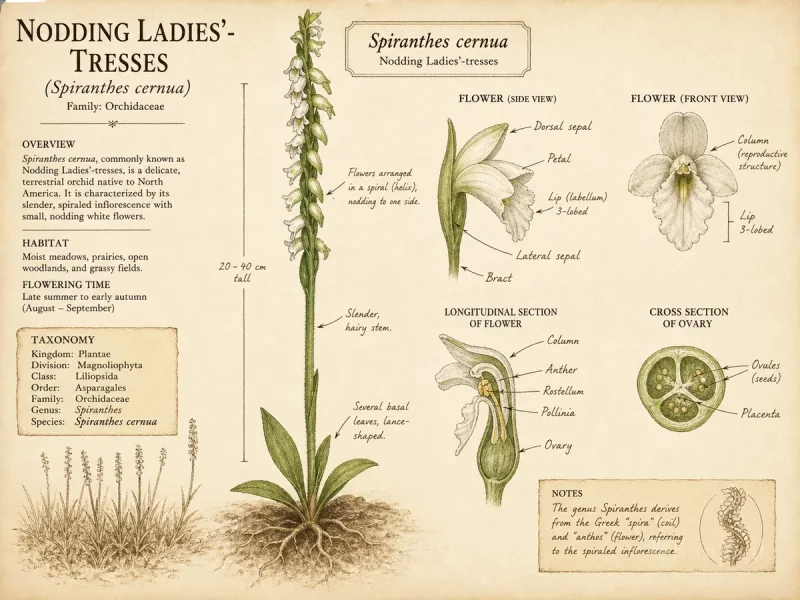
ladies' tresses is a small terrestrial orchid. A basal rosette of strap leaves grows in spring and usually withers before the spiral of nodding white flowers opens in late summer. Give it the same wet, acid ground it uses in a meadow or bog. Ordinary garden soil that dries out is the wrong home. [1] Most garden plants of this orchid want full sun or part sun and moist sandy or peaty soil. In a hot summer, afternoon shade keeps the leaves from scorching. [2]
How much sun does ladies' tresses need?
Full sun or part sun. In a hot summer, give it midday shade. Deep shade under shrubs is a poor site.
How wet should the soil stay?
Keep the ground damp. Do not let the fleshy roots sit dry, and do not plant it in a dry border.
Set a nursery plant in spring — do not dig a wild plant
Shops sell this orchid as a potted plant more often than they sell most native orchids, and a plant lifted from a wild meadow almost never takes. If you have a nursery-raised plant, set the fleshy roots in a loose, wet mix of sand, leaf compost, and peat in spring, then leave the plant in that spot. [3]
- Buy a nursery-raised plant. Do not dig a wild plant, even if the meadow is on your land and the spiral is showy.
- In a cold-winter garden, plant in spring so the roots settle before winter. In a mild-winter garden, spring or fall both work.
- Set the fleshy roots at the same depth they sat in the pot, in wet sand, leaf compost, and peat. Do not bury the crown.
- Water so the mix stays damp after planting. Leave the plant in that spot. A later move rarely helps.
Can I transplant one from a wild meadow?
No. A wild plant almost never takes, and digging it can wipe out a local stand. Leave it where it is.
When do I plant a nursery pot?
In spring in a cold-winter garden, so the roots settle before frost. In a mild-winter garden, spring or fall both work.
After frost, cut the spent spike and mulch the crown
The basal leaves are already gone when the white spiral opens. After frost cuts the flowers down, cut the spent stalk and any seedpods so the plant puts energy into the fleshy roots and into the small plantlets that form on those roots. Leave those roots in wet soil through winter, and mulch with chopped leaves or pine needles. This is a hardy meadow perennial, not a bulb you lift and store dry.
- After a hard frost, cut the spent flower stalk and seedpods down.
- Leave the fleshy roots in wet soil. Do not lift and store them dry.
- Spread 1 to 2 inches of chopped leaves or pine needles over the crown for winter.
When do the leaves show?
In spring. The basal strap leaves usually wither before the white spiral opens in late summer.
Do I cut it back for winter?
After frost, cut the spent spike. Leave the fleshy roots in wet soil and mulch the crown. Do not lift and store it dry.
Divide the fleshy roots when the plant is dormant
This orchid spreads by offsets from the roots, and the tips of those roots can curve up and make new plants. Division is the reliable way to make more. Wait until the plant is dormant — after the frost cut, or just as new leaves show in spring — then lift a nursery clump, tease apart the fleshy roots, and replant each piece at once in the same wet mix.
- Wait until the plant is dormant. Do not split it in bloom.
- Lift a nursery clump. Tease the fleshy, finger-like roots apart so each piece has roots and a growing point.
- Replant each piece at once, at the same depth, in wet sand, leaf compost, and peat. Keep the mix damp while it settles.
Can I grow it from seed?
The dust-like seed needs a fungus in the soil, so home sowing rarely works. Divide a nursery plant instead, and do not collect seed from wild plants.
When do I divide it?
When the plant is dormant — after the frost cut, or just as new leaves show in spring. Replant the pieces at once and keep them damp.
Not a lady's slipper — and not a nodding onion
A lady's slipper is a woodland orchid with a pouch. See How to Grow Lady's Slipper if that is the plant on the tag. Ladies' tresses is a wet-meadow orchid with a spiral of small nodding white flowers and no pouch. [4]
Nodding onion is Allium. It has a drooping umbel of pink or white bells on drained soil, not a wet spiral. See How to Grow Alliums if you bought a nodding onion. Lady's mantle is Alchemilla, with scalloped leaves that hold dew — see How to Grow Lady's Mantle if that is the plant. Lady fern is Athyrium, a fern with fronds — see How to Grow Lady Fern if you bought a fern. Rattlesnake plantain is Goodyera, a woodland orchid with netted evergreen leaves, not this fall spiral.
Is this a lady's slipper?
No. A lady's slipper has a pouch. Ladies' tresses has a spiral of small nodding white flowers and no pouch.
Is nodding onion the same plant?
No. Nodding onion is Allium, a drained-soil bulb with a drooping umbel. This plant is a wet-meadow orchid.
Is rattlesnake plantain the same orchid?
No. Rattlesnake plantain is Goodyera, with netted evergreen leaves in woodland shade. Ladies' tresses is a wet-meadow spiral that blooms after the basal leaves wither.
If you have a nursery plant, set it in wet, acid soil in sun or part sun, cut the spent spike after frost, and divide the fleshy roots only when the plant is dormant. If you found a wild plant, leave it in the meadow.
FAQ
Can I grow it as a houseplant?
No. Grow it outdoors in wet, acid soil. A windowsill pot of ordinary mix will dry out or rot.
Is Chadds Ford a different kind?
No. Chadds Ford is a shop selection of this same nodding ladies'-tresses complex. The plant in the catalog is Spiranthes cernua.
Are spring or slender ladies'-tresses other kinds I can buy?
Those are other wild Spiranthes species, not extra shop cards here. The plant nurseries sell for the garden is nodding ladies'-tresses.
Will it come back every year?
In wet, acid soil it can spread by offsets from the fleshy roots. Leave those roots in the ground, mulch the crown, and do not expect a dry-border perennial.
Recommended plants
References
- [1] NC State Extension -
https://plants.ces.ncsu.edu/plants/spiranthes-cernua/ - [2] Illinois Wildflowers -
https://www.illinoiswildflowers.info/prairie/plantx/nodding_orchidx.htm - [3] Fine Gardening -
https://www.finegardening.com/plant/ladies-tresses-spiranthes-cernua-chadds-ford - [4] North American Orchid Conservation Center -
https://goorchids.northamericanorchidcenter.org/species/spiranthes/cernua/
More first-season notes by plant are gathered in How to Grow Guides.
Updated: Reviewed by Bosquelle Editors