
Grow Japanese aster in full sun, in soil that drains. Japanese aster is Kalimeris incisa. It is not a fall aster.

Give it full sun, soil that drains, and water the first year
| Factor | Recommended | Avoid |
|---|---|---|
| Sun | Full sun for the thickest bloom; a half day of sun is tolerated | Do not site it in deep shade — the mound gets thin and floppy |
| Soil | Average soil that stays moist and drains; clay is fine if water does not stand | Do not plant in a soggy low spot. Standing water around the crown is the usual cause of root rot |
| Water | Water a new plant through the first year. Keep the soil evenly moist | Do not skip water the first summer because an established clump tolerates dry spells later |
| Feed | Little fertilizer once the roots take | Do not dump nitrogen on a new planting |
| Drought | Once roots take, the clump tolerates dry spells and hot, humid weeks | Do not treat a first-year plant as drought-proof |
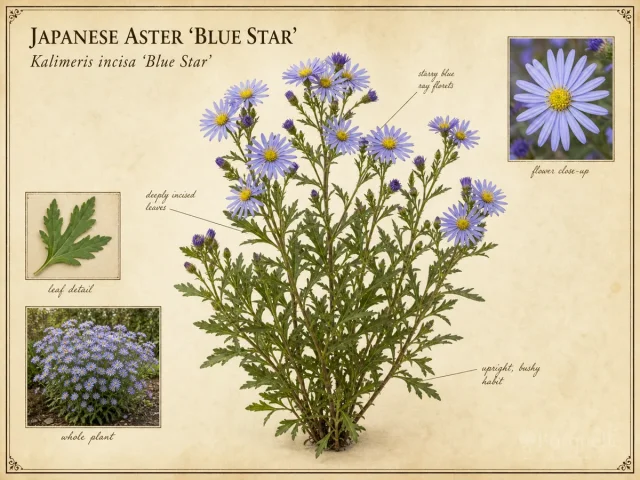
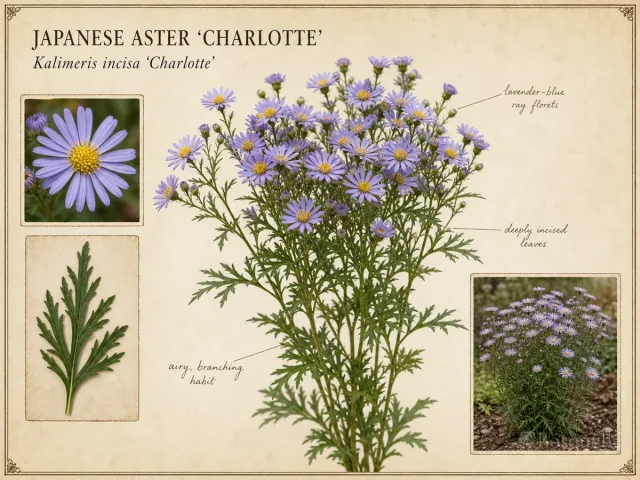
Japanese aster wants a sunny border and soil that drains. It takes clay and summer heat once the roots are in, but a new plant still needs regular water through the first year. After that, water during a long dry spell. [1] [2] Blue Star wants that same sun and drain. Charlotte and Madiva want the same care.
Does Japanese aster need full sun?
Full sun gives the thickest bloom. A half day of sun is fine. Deep shade makes a thin, floppy mound with fewer daisies.
How often should I water Japanese aster?
Water a new plant through the first year so the roots take. After that, water during a long dry spell. Do not leave the crown in standing water.
Plant at the same depth as the pot, with room to clump
Plant after frost, or in fall while the soil is still warm. Set the crown even with the surrounding soil. Leave 12 to 18 inches between plants so each mound can fill in without crowding. [3] [4]
- Plant after frost in spring, or in early fall while the soil is workable.
- Dig a hole as deep as the pot and a little wider. Set the crown even with the soil. Do not bury it.
- Space clumps 12 to 18 inches apart.
- Water after you plant, then keep the soil moist until the roots take.
How far apart do I plant it?
Leave 12 to 18 inches between clumps. The mound fills that space; it does not run across the bed.
Pinch in early summer, then cut spent stems for more bloom
Pinch the tips once in early summer so the mound stays dense. After the first flush fades, cut the spent stems back and the plant often opens a second round of daisies. When bloom is finished, cut the stems to the ground, or wait until late fall.
- In early summer, pinch the stem tips once so the plant branches instead of stretching.
- When the first flush fades, shear the spent stems to encourage more flowers.
- After the last bloom, or in late fall, cut the stems to the ground.
When do I pinch Japanese aster?
Pinch the tips once in early summer. After the first flush fades, cut the spent stems. Cut the rest to the ground when bloom is finished.
Divide the clump every few years in spring
When the center thins or the mound outgrows its space, lift and split it in spring. Replant the strong outer pieces at once, at the same depth.
- Lift the clump in spring when new shoots show.
- Split it so each piece has roots and shoots.
- Replant at once at the same depth, and water in.
Not a fall aster — and Blue Star is not Amsonia
Japanese aster blooms from early summer into fall on a short, upright mound. Fall garden asters bloom late and often sprawl — see How to Grow Asters. Amsonia Blue Star is a different plant with starry spring flowers and willow-like leaves — see How to Grow Bluestar. Blue Star creeper is a groundcover, not this daisy. If the tag says Blue Star and the flowers are small pale daisies all summer, you have Kalimeris.
Is Japanese aster a true aster?
No. Japanese aster is Kalimeris incisa. Fall garden asters are a different group. Blue Star on this tag is not Amsonia.
Is Blue Star Japanese aster the same as Blue Star creeper?
No. Blue Star creeper is a low groundcover. Blue Star Japanese aster is a clumping daisy about a foot and a half tall.
If the first flush has faded, shear the spent stems so a second round of daisies can open.
FAQ
Can I grow Japanese aster in a pot?
A draining pot can hold a compact clump on a patio if you water it through the first summer. The usual plant is in the ground, where the mound can fill in.
Is this the same as Boltonia?
No. Some older lists called this plant Boltonia incisa, and some shops still say false aster. Boltonia is a different tall white daisy. Read Kalimeris on the tag.
Do you list Alba or the double kind?
This catalog lists Blue Star, Charlotte, and Madiva. Alba is a white form we do not carry. The double Japanese aster is Kalimeris pinnatifida, a different species.
Is Japanese aster the same as Japanese anemone?
No. Japanese anemone is a buttercup with larger saucer flowers on tall stems in late summer. See How to Grow Anemones. Japanese aster is the small pale daisy on this page.
Recommended plants

References
- [1] NC State Extension Gardener -
https://plants.ces.ncsu.edu/plants/aster-incisus/ - [2] Hoosier Gardener -
https://hoosiergardener.com/japanese-aster-a-long-time-bloomer/ - [3] North Creek Nurseries -
https://www.northcreeknurseries.com/plant-name/Kalimeris-incisa-Blue-Star - [4] Garden Sanity by Pet Scribbles -
https://www.petscribbles.com/blue-star-kalimeris-or-false-aster/
More first-season notes by plant are gathered in How to Grow Guides.
Updated: Reviewed by Bosquelle Editors