
Grow Indian plum in sun or part shade, in moist soil that drains, and water it through the first dry summers. Indian plum is Oemleria cerasiformis, a western deciduous shrub also called osoberry.
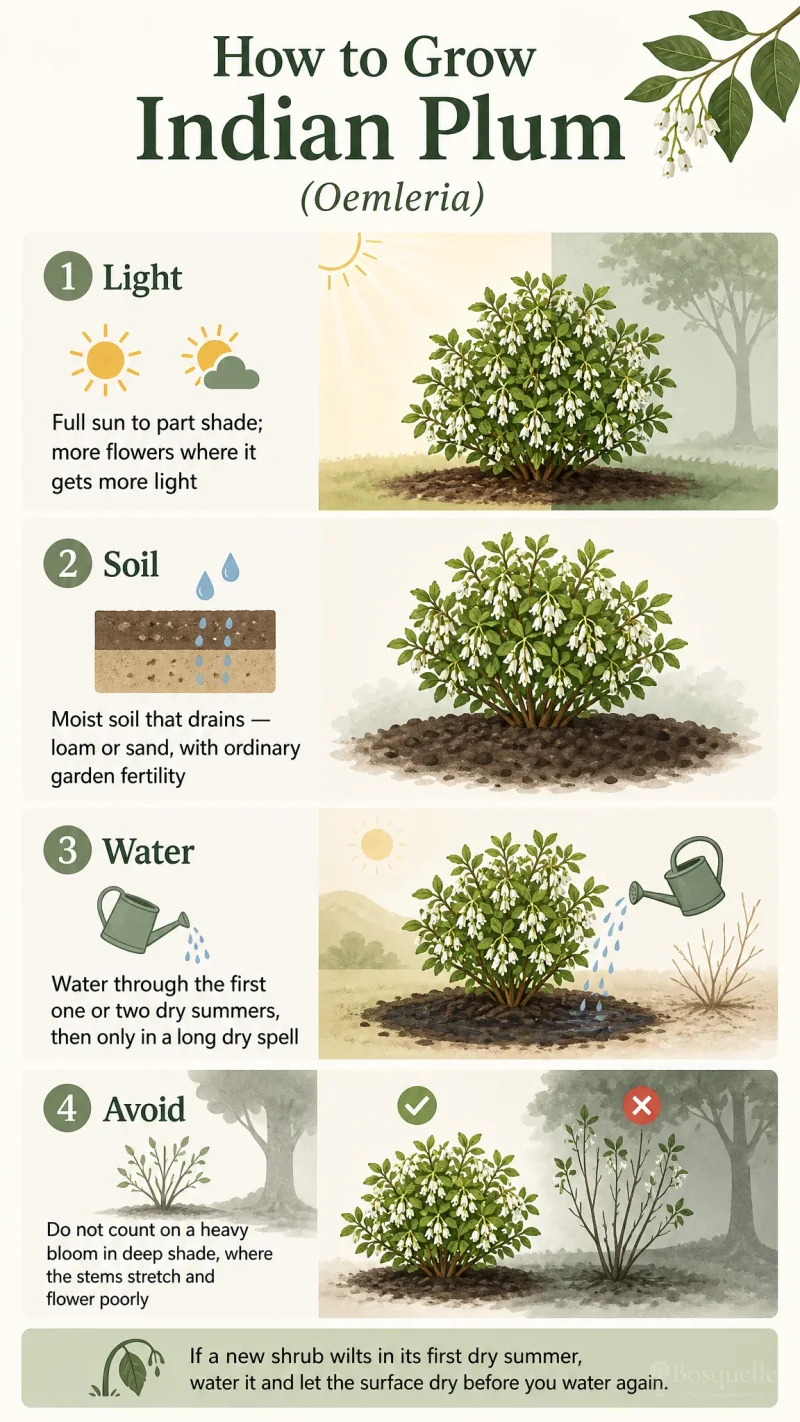
Give it sun or part shade, moist soil that drains, and water the first summers
| Factor | Recommended | Avoid |
|---|---|---|
| Light | Full sun to part shade; more flowers where it gets more light | Do not count on a heavy bloom in deep shade, where the stems stretch and flower poorly |
| Soil | Moist soil that drains — loam or sand, with ordinary garden fertility | Do not plant it in a winter-wet pocket, and do not set it on shallow chalky ground, which yellows the leaves |
| Water | Water through the first one or two dry summers, then only in a long dry spell | Do not keep the soil soggy after the shrub is established |
| Feed | Little or none — lean ground keeps the stems sturdy | Do not feed it richly, because soft growth flops and needs more water |
| Size | Leave room for about 8 to 20 feet tall and for suckers around the base | Do not crowd it against a path as if it would stay a small mound |
Indian plum is a many-stemmed western shrub with lance-shaped leaves that smell like cucumber when you crush them. Give it sun or part shade. The bloom is heavier in more light; deep shade stretches the stems and cuts the flower crop. [1]
Water it through the first dry summer, and through a second summer if the weather stays dry, so the shallow roots settle. After that, extra water is only for a long dry spell. A winter-wet pocket around those roots is a worse problem than a dry week you can skip. [2] [3] Part shade at a woodland edge is a natural fit, and it grows in ordinary moist soil that drains. [4]
It sits well with other western woodland shrubs such as red elderberry, red-osier dogwood, and salal. If a hard cut or a fire takes the top, the crown can sprout again. When you are ready to set a nursery shrub in the ground, read Planting Indian Plum.
Does Indian plum need summer water once it is settled?
Only in a long dry spell. Water a new shrub through the first one or two dry summers, then back off. A winter-wet hole is a worse problem than a dry week you can skip.
Greenish-white flowers in late winter, then fruit only if you planted a female
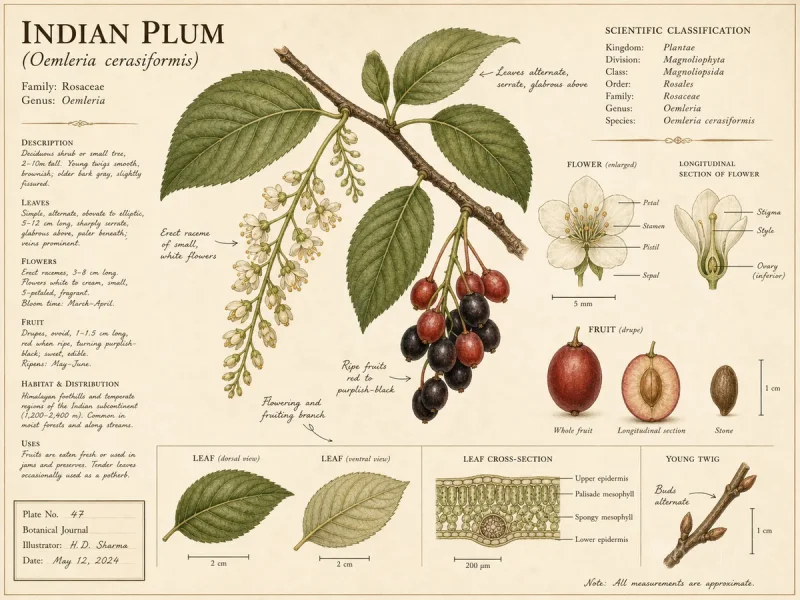
Hanging clusters of small greenish-white flowers open in late winter, often February through April, as the leaves come out. This is one of the first western native shrubs to bloom. The flowers are fragrant. Bees, early butterflies, and hummingbirds work the clusters while they are open.
Male and female flowers sit on separate plants. Only a female makes the small plum-like fruit, and only if a male is nearby. The fruit starts tan or salmon, then turns pink to reddish purple, and ripens purple-black in early summer. Birds take it fast. If you want fruit, pair the sexes when you plant — that pairing is on Planting Indian Plum. If you need to cut spent clusters or extra suckers, that cut is on Pruning Indian Plum.
When does Indian plum bloom?
Hanging greenish-white clusters open in late winter, often February through April, as the leaves come out. Fruit follows on female plants if a male is nearby.
Not a garden plum — and not Indian hawthorn or serviceberry
Indian plum is in the rose family, but it is not a garden plum or a flowering cherry. Those are How to Grow Prunus. This shrub has smooth-edged leaves that smell like cucumber when crushed, hanging flowers before most other deciduous shrubs leaf out, and chambered pith inside the twig. A true plum or cherry usually has toothed leaves and a later bloom.
An evergreen sold as Indian hawthorn is How to Grow Indian Hawthorn, a different plant. A needle-leaved shrub sold as plum yew is How to Grow Plum Yew. A spring-blooming fruit shrub with toothed leaves is often How to Grow Serviceberry. Chokeberry is How to Grow Chokeberry, not this plant, even though an old name for Indian plum was Osmaronia. Bird cherry and Oregon plum are other names for this shrub; they are not a separate kind to buy.
Is Indian plum the same as a garden plum?
No. Garden plums and flowering cherries are Prunus. Indian plum is Oemleria cerasiformis, a western native with cucumber-scented leaves and hanging late-winter flowers.
If a new shrub wilts in its first dry summer, water it and let the surface dry before you water again. Do not keep the hole soggy in winter.
FAQ
Is there more than one kind of Indian plum?
The plant sold as Indian plum is Oemleria cerasiformis, the only species in the genus. Osoberry, oso berry, Oregon plum, and Indian peach are names for the same shrub. There are no named cultivars in the usual nursery trade.
Can I keep Indian plum in a pot?
Only as a holding step. It wants room in the ground for a large suckering shrub. Move it out once the pot is tight.
Can people or pets eat the fruit?
The ripe purple-black fruit is eaten in small amounts when it is fully soft. Do not eat the pits, and do not let pets chew pits or wilted leaves, which hold the same bitter almond compounds as other stone fruits.
Related guides


Recommended plants
References
- [1] NRCS Plant Materials Center, Corvallis -
https://plants.sc.egov.usda.gov/DocumentLibrary/factsheet/pdf/fs_oece.pdf - [2] Oregon State University Landscape Plants -
https://landscapeplants.oregonstate.edu/plants/oemleria-cerasiformis - [3] Plant Native -
https://plantnative.org/native-plants/indian-plum-oemleria-cerasiformis.htm - [4] Native Plants PNW -
https://nativeplantspnw.com/indian-plum-oemleria-cerasiformis/
This note is part of Oemleria Guides.
More first-season notes by plant are gathered in How to Grow Guides.
Updated: Reviewed by Bosquelle Editors