
Grow hornwort fully under water, and let it float. Hornwort is Ceratophyllum, also sold as coontail or Coon's Tail. A different plant called hornwort is a tiny moss on damp soil.
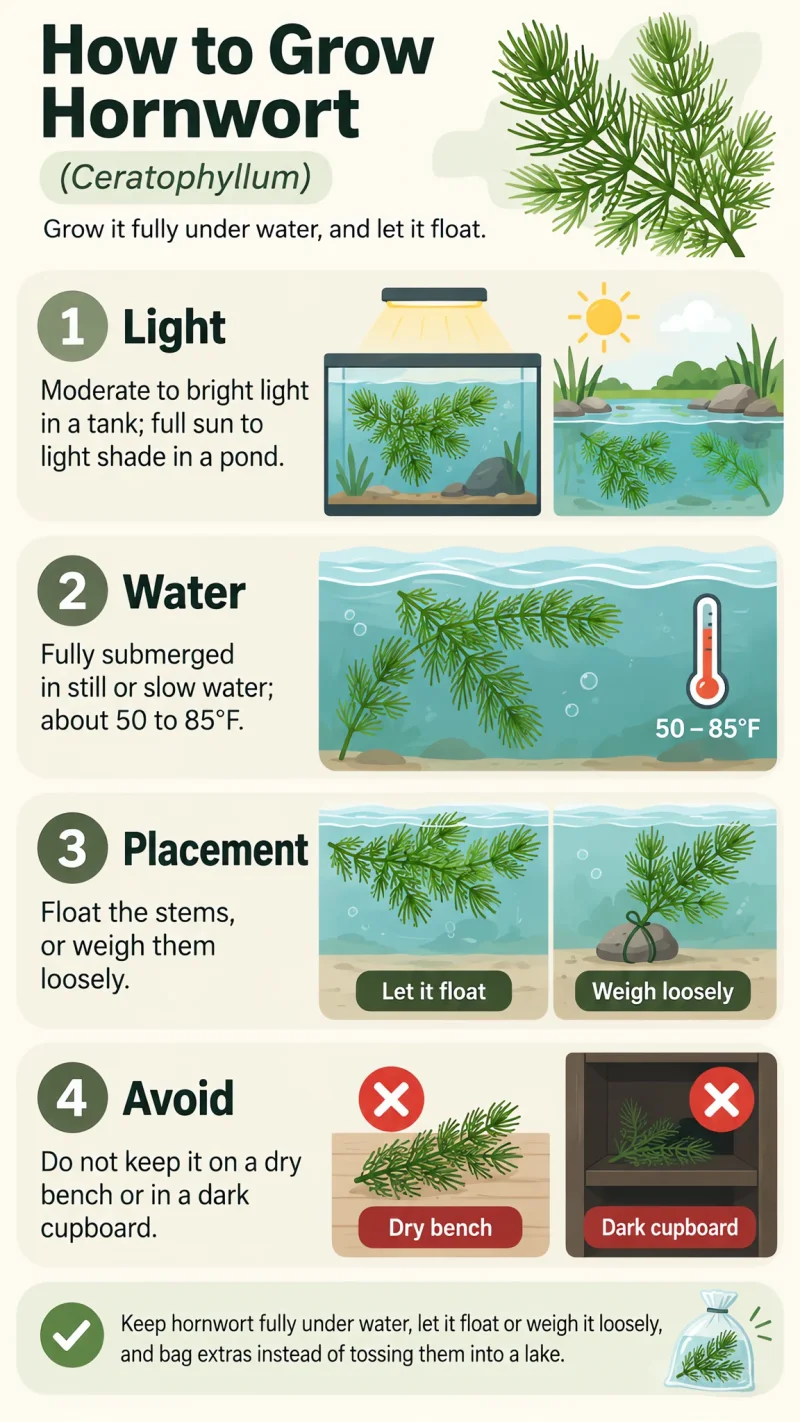
Keep it fully under water, and let it float
| Factor | Recommended | Avoid |
|---|---|---|
| Light | Moderate to bright light in a tank; full sun to light shade in a pond | Do not keep it on a dry bench or in a dark cupboard |
| Water | Fully submerged in still or slow water; about 50 to 85°F | Do not let the stems dry in air |
| Placement | Float the stems, or weigh them loosely | Do not bury the stems in gravel |
| Flow | Gentle current | Do not let loose needles pack a strong filter intake |
| Winter | In a legal outdoor pond, leave the stems in the water | Do not lift them into a dry pot |
| Kind | Stiff forked leaves in whorls, denser at the tips | Do not buy a flat green moss mat and expect this plant |
hornwort has to stay under water. It has no true roots, so the stems take what they need from the water. Let the bunch float in still or slow water. About 50 to 85°F covers a tank and most outdoor ponds. [1] In a pond, full sun to light shade both work. In a tank, moderate light is enough. Stems that dry on a bench do not recover. A few small flowers may sit at the leaf bases under water in summer; they are easy to miss. It is not a dry-bed plant, and it is not a windowsill plant in potting mix.
How to grow hornwort?
Keep it fully under water and let it float. Still or slow water at about 50 to 85°F is enough. Do not bury the stems, and do not let them dry.
Why is my hornwort dropping needles?
New bunches often shed needles for a few weeks after a move, especially after a big change in water. Keep the firm green stems. Scoop the fallen needles so they do not rot. New side shoots usually follow if the water stays stable.
Float the stems, or weigh them loosely — do not bury them
Shop bunches arrive tied. Cut the rubber tie, rinse the stems, and decide whether they will float or sit in one spot. Hornwort has no true roots, so burying the ends in gravel rots them. If you want a background clump, rest a small stone or a loose plant weight at the base and leave the stems in the water. [2] Keep extras in the tank or pond. Bag what you do not want.
- Cut the rubber tie and separate the stems. Discard any mushy or broken pieces.
- Rinse the bunch in tank or pond water so loose needles do not cloud the water later.
- Float the stems, or rest a small stone or a loose plant weight at the base. Do not bury the stems in gravel or pond mud.
- Keep the bunch out of a strong filter intake, because loose needles clog the screen.
- Bag extras. Do not toss stems into a lake, ditch, or storm drain. Fragments grow into new plants.
Does hornwort need substrate?
No. It has no true roots. Float it, or weigh it loosely. Do not bury the stems in gravel. Buried ends rot.
How do I plant hornwort?
Rinse the bunch, then float the stems or rest a small stone at the base. Do not bury them. Bag extras instead of tossing them into a lake.
Cut a healthy stem and float it again
Most gardeners start a new clump from a stem cutting, not from seed. Cut a healthy piece a few inches long and float it the same way as the first stems. The cut stump branches if light still reaches it.
- Cut a healthy stem a few inches long, just below a node.
- Float the cutting, or weigh it loosely the same way as the first stems.
- Bag any extra pieces you do not replant.
Not the moss named hornwort — and not milfoil or fanwort
The name hornwort also belongs to a tiny moss: a flat green pad on damp soil with horn-like stalks. That plant is not this one. Pond hornwort has stiff, forked leaves in whorls and lives fully under water. [3] Milfoil has feather-shaped leaves with leaflets along a midrib, not forked needles. Fanwort stays under water with opposite fan-shaped leaves on short stalks — see How to Grow Fanwort. [4] A water lily has round pads with a slit and a showy flower — see How to Grow Water Lily.
What is a hornwort?
This card is Ceratophyllum, a submerged plant with stiff forked leaves, also sold as coontail. The moss named hornwort is a different plant that grows as a flat pad on damp soil.
Is this milfoil or fanwort?
No. Milfoil has feather leaves along a midrib. Fanwort has opposite fan-shaped leaves on short stalks. Hornwort has stiff, forked, toothed leaves in whorls and often floats with no roots.
Keep hornwort fully under water, let it float or weigh it loosely, and bag extras instead of tossing them into a lake.
FAQ
Can I grow the soft or tropical kinds from this card?
This shop card is common rigid hornwort. Soft or tropical kinds sold for tanks want the same fully submerged floating water, but they are different plants. Read the tag.
Can I grow hornwort in a dry pot?
No. Mix that dries in a day kills the stems. A tank, a water garden, or a pond works only when the plant stays under water. It is not a dry patio plant.
Can I grow it from seed?
You can, but most gardeners float a stem cutting. Seed is slow and often scarce. The new plants still have to stay under water.
Will fish eat it?
Some goldfish, koi, and plant-eating fish nibble the stems. Many community fish leave it alone and hide in it. It is not a toxic houseplant, but it is not a food crop either.
Is it legal to plant in my pond?
It is native across much of North America, but dense mats can take over a small pond, and extra stems from tanks have started wild stands. Check local rules before you buy. Keep it in a closed tank or pond, and never toss it into a lake.
Does it come back after ice?
In a legal outdoor pond, leave the stems in the water. Tight buds often sink and sprout when the water warms. A cap of ice on the water is usually fine. If the pond freezes to the bottom, move a wet bunch to a frost-free tub.
Recommended plants

References
- [1] Aquarium Co-Op -
https://www.aquariumcoop.com/blogs/aquarium/hornwort-care - [2] Pond Informer -
https://pondinformer.com/hornwort-ceratophyllum-demersum/ - [3] Missouri Department of Conservation -
https://mdc.mo.gov/discover-nature/field-guide/hornworts - [4] Rutgers New Jersey Agricultural Experiment Station -
https://njaes.rutgers.edu/fs1236/
More first-season notes by plant are gathered in How to Grow Guides.
Updated: Reviewed by Bosquelle Editors