
Grow fanwort fully submerged in bright still or slow water. Fanwort is Cabomba, also sold as Carolina fanwort. A tag that says Carolina watershield is often the pond plant with oval floating pads.

Keep it fully submerged in bright, still or slow water
| Factor | Recommended | Avoid |
|---|---|---|
| Light | Bright light — full sun to light shade in a pond, or a well-lit tank | Do not keep it in a dim tank or on a dry shady bed |
| Water | Fully submerged in still or slow water; about 72 to 82°F in a tank | Do not let the stems dry on a bench |
| Substrate | Fine sand, aqua soil, or pond mud | Do not crush the stems in coarse gravel |
| Planting depth | About 1 inch of stem in the substrate, with the rest under water | Do not bury so much stem that it rots |
| Winter | In a legal outdoor pond, leave rooted stems in the mud | Do not lift the stems into a dry pot |
| Kind | Opposite fan-shaped underwater leaves | Do not buy oval watershield pads and expect this plant |
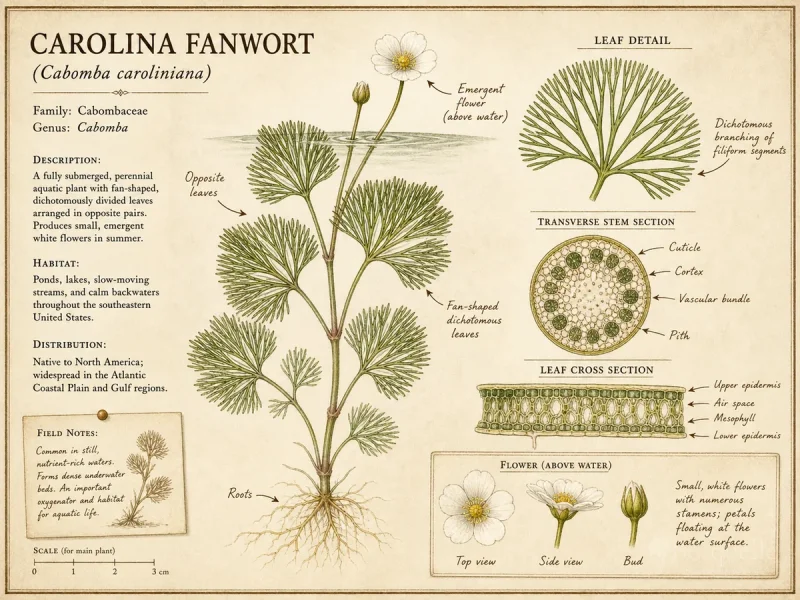
fanwort has to stay under water. In a tank, that means a strong light over still or gently moving water. In a pond, give it full sun to light shade in still or slow water. [1] Soft to moderately hard water holds the fine leaves; very alkaline water sheds them, and stems that dry on a bench do not recover. [2] Small white to pale-yellow flowers sit just above the water in summer, and a few small diamond-shaped leaves may float then. It is not a dry-bed shrub, and it is not a windowsill plant in potting mix.
How much light does fanwort need?
Give it bright light. In a tank, a dim fixture stretches the stems and the lower leaves drop. In a pond, full sun to light shade keeps the fans dense.
Can I grow it in a pond and in a tank?
Yes, if it stays fully under water in bright still or slow water. A tank needs stronger light. A pond needs full sun to light shade. Check local sale and planting rules before you buy.
Separate the bunch and plant each stem an inch deep
Shop bunches arrive tied. Cut the rubber tie, rinse the stems, and plant each one on its own so water can move between them. Strip the leaves that would sit under the substrate, then push about an inch of stem into fine sand, aqua soil, or pond mud. [3] Metal plant weights crush these soft stems. If a stem floats, rest a small stone at the base until roots take. Keep extras in the tank or pond. Bag what you do not want.
- Cut the rubber tie and separate the stems. Discard any mushy or broken pieces.
- Strip the lower leaves so 2 or 3 nodes will sit in the substrate with clean stem.
- Push about an inch of stem into fine sand, aqua soil, or pond mud. Space stems about 1 to 2 inches apart.
- If a stem floats, rest a small stone at the base. Do not wrap metal weights around it.
- Bag extras. Do not toss stems into a lake, ditch, or storm drain. Fragments root and spread.
How do I plant fanwort?
Separate the bunch, strip the leaves that would sit under the substrate, and plant each stem about an inch deep in fine sand or pond mud. Do not wrap metal weights on the stems.
Cut a healthy top and plant it again
Most gardeners start a new clump from a stem cutting, not from seed. When a stem reaches the surface, cut a healthy top 4 to 6 inches long, strip the lower leaves, and plant it the same way as the first stems. The cut stump branches if light still reaches it.
- Cut a healthy top 4 to 6 inches long, just below a node.
- Strip the lower leaves so clean stem will sit in the substrate.
- Plant about an inch deep, and bag any extra pieces you do not replant.
Not watershield — and not milfoil or hornwort
A tag that says Carolina watershield is often the other plant: oval floating pads with the stalk at the center and a gelatinous coating on the underside — see How to Grow Watershield. Fanwort stays under water with opposite fan-shaped leaves on short stalks. [4] Milfoil has feather-shaped leaves in whorls, not opposite fans. Hornwort, also called coontail, has stiff, toothed leaves in whorls and often floats with no roots. A water lily has round pads with a slit and a showy flower — see How to Grow Water Lily.
Is fanwort the same as watershield?
No. Watershield is Brasenia, a pond plant with oval floating pads and a gelatinous coating. Fanwort is Cabomba, a submerged plant with feathery fan-shaped leaves.
Is this milfoil or hornwort?
No. Milfoil has feather leaves in whorls. Hornwort is stiff, toothed, and often has no roots. Fanwort has opposite fan-shaped leaves on short stalks.
Keep fanwort fully under water in bright light, plant the stems an inch deep, and bag extras instead of tossing them into a lake.
FAQ
Can I grow the red or yellow kinds from this card?
This shop card is green Carolina fanwort. Red and yellow kinds sold for tanks want the same fully submerged bright water, but they are different plants and often need even more light. Read the tag.
Can I grow fanwort in a dry pot?
No. Mix that dries in a day kills the stems. A tank, a water garden, or a submerged pot works only when the plant stays under water. It is not a dry patio plant.
Can I grow it from seed?
You can, but most gardeners plant a stem cutting. Seed is slow and often scarce in the north. The new plants still have to stay under water.
Will fish eat it?
Some koi and plant-eating fish nibble the soft leaves. Peaceful community fish usually leave it alone. It is not a toxic houseplant, but it is not a food crop either.
Is it legal to plant in my state?
In some U.S. states it is prohibited to sell or plant, and extra stems from tanks have started wild stands. Check local rules before you buy. Keep it in a closed tank or pond, and never toss it into a lake.
Does it come back after ice?
In a legal outdoor pond, leave rooted stems in the mud. A cap of ice on the water is usually fine. Cut and bag the tops before they rot in the water. If the pond freezes to the bottom, move a submerged pot to a wet, frost-free tub.
Recommended plants
References
- [1] Pond Informer -
https://pondinformer.com/carolina-fanwort-cabomba-caroliniana/ - [2] USGS Nonindigenous Aquatic Species -
https://nas.er.usgs.gov/queries/FactSheet.aspx?speciesID=231 - [3] Canton Aquatics -
https://www.cantonaquatics.com/blogs/guide-to-aquascaping/cabomba-plant-care-guide-growing-cabomba-caroliniana-in-your-aquarium - [4] Washington State Department of Ecology -
https://fortress.wa.gov/ecy/gisresources/lakes/AquaticPlantGuide/descriptions/cabcar.html
More first-season notes by plant are gathered in How to Grow Guides.
Updated: Reviewed by Bosquelle Editors