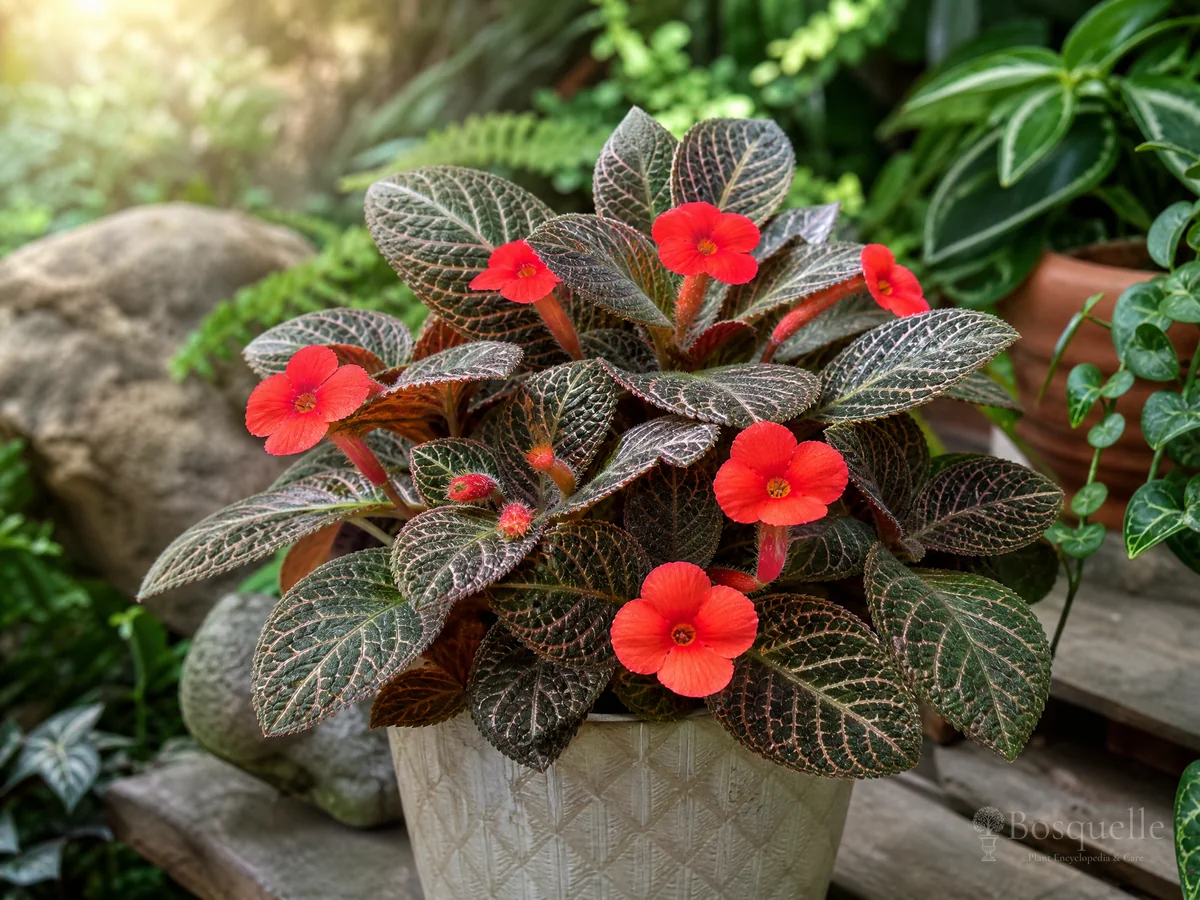
Grow flame violet in bright indirect light, keep the mix barely moist, and raise humidity without wetting the velvety leaves. Flame violet is Episcia cupreata. An African violet is a tighter rosette that does not send out these strawberry-like runners.

Give it bright indirect light, keep the mix barely moist, and raise humidity without wetting the leaves
| Factor | Recommended | Avoid |
|---|---|---|
| Light | Bright, indirect light, about three to four feet from an east or west window | Do not set it in hot afternoon sun, which scorches the leaves |
| Water | Keep the mix slightly moist, and let only the surface dry; use room-temperature water at the mix, not on the leaves | Do not use cold water, and do not leave the pot sitting in a saucer of water |
| Humidity | Keep humidity above about 50 percent with a humidifier, a pebble tray, or a group of plants | Do not mist the fuzzy leaves, which spot and rot when they stay wet |
| Warmth | Keep it between about 65 and 80°F, away from drafts and vents | Do not let the room drop near 60°F, which stops growth, or below 50°F, which can kill it |
flame violet is Episcia cupreata, a creeping gesneriad from Colombia, Venezuela, and Brazil. It makes a low rosette of velvety leaves with copper, silver, or green markings, then sends out stolons tipped with baby rosettes. Small tubular flowers, usually red or orange, rise above the foliage in spring and summer. [1] Set it in bright, indirect light. An east or west window three to four feet away is enough; a sheer curtain on a brighter sill also works. Keep the mix slightly moist, and let only the surface dry between waterings. Always use room-temperature water, and pour it onto the mix so the leaves stay dry. [2] Humidity above about 50 percent keeps the leaf edges from browning. A humidifier, a pebble tray, or a cluster of plants raises the moisture in the air without wetting the foliage.
If bloom stalls, move it a little brighter, still off hot glass. Cold water spots the foliage white, so keep the spout under the leaves.
- Place it in bright, indirect light, about three to four feet from an east or west window.
- Water when the surface of the mix feels just dry. Use room-temperature water on the mix, then empty the saucer.
- Raise humidity with a humidifier, a pebble tray, or nearby plants. Keep water off the leaves.
- Keep the room between about 65 and 80°F, away from cold drafts and heating vents.
How much light does flame violet need?
Bright, indirect light. Set it about three to four feet from an east or west window, and keep it off hot afternoon sun.
How often should I water it?
Water when the surface of the mix feels just dry. Keep the rest of the mix slightly moist, not soggy, and empty the saucer.
Why are the leaf edges turning brown?
The air is too dry, or the mix dried out. Raise humidity above about 50 percent and keep the mix slightly moist.
Water less in winter, and keep it above about 60°F
Growth slows in short winter days. Water a little less, still without letting the mix go bone-dry, and skip fertilizer until new leaves show. Keep the plant as a houseplant. A few hours below 50°F can kill it, and growth already stalls near 60°F, so bring a patio pot in before a cool night. [3]
Plant it in a wide, shallow pot or hanging basket with a hole
The roots stay shallow, and the stolons want room to trail. A wide, shallow pot, or a hanging basket with a drainage hole, fits that habit better than a deep, narrow cup. [4] Fill it with an African-violet mix, or a peat or coco blend loosened with perlite or vermiculite, so water moves through. Set the crown at the mix surface. Wait to repot until spring, when the mix is tired or the clump crowds the rim, and step up only a little. Rooting a plantlet is a separate job on How to Propagate Flame Violet.
- Choose a wide, shallow pot or a hanging basket with a drainage hole.
- Fill it with African-violet mix, or a peat or coco blend with perlite or vermiculite.
- Set the rosette so the crown sits at the mix surface, not buried.
- Water with room-temperature water on the mix until it runs out, then empty the saucer. Hang or set it where the stolons can trail.
Can I grow it in a hanging basket?
Yes. Use a basket with a drainage hole and African-violet mix, and hang it where the runners can trail.
Snip extra stolons if you want a tighter clump
This plant does not need pruning like a shrub. Cut brown leaves at the base, and cut spent flowers so new buds can open. If the basket is a tangle, snip extra stolons. To pot a plantlet, use How to Propagate Flame Violet.
Not an African violet — and not a strawberry begonia
A shop tag that says flame violet is sometimes confused with African violet (Saintpaulia): a tighter, fuzzier rosette with clustered flowers and no trailing runners. This plant trails. Cape primrose is Streptocarpus, with long strap leaves. See How to Grow Cape Primrose if that is the plant you bought. Strawberry begonia is Saxifraga stolonifera, a different family that also runs; see How to Grow Saxifrage. Lace flower is Alsobia, split from this genus, with small green leaves and white fringed flowers. A succulent labeled Chocolate Soldier is Kalanchoe, watered dry between soaks; see How to Grow Kalanchoe. The same name also shows up on some Episcia and Alsobia tags, so read the leaf: velvety patterned foliage with tubular flowers is this plant, felted succulent paddles are not.
Is this an African violet?
No. African violet is a tighter rosette with clustered flowers. Flame violet trails on stolons and holds solitary tubular flowers.
Is Chocolate Soldier a succulent?
The succulent Chocolate Soldier is Kalanchoe. Flame violet is a gesneriad. Water this plant so the mix stays slightly moist, not on a cactus calendar.
Keep it in bright indirect light, with barely moist mix and dry leaves. Pot a four-leaf plantlet if you want a second basket.
FAQ
What about Pink Panther or other leaf colors?
Shops sell many leaf patterns and flower colors on the same trailing plant. Bright indirect light, barely moist mix, and dry leaves still apply.
Is flame violet toxic to cats or dogs?
Flame violets are listed as non-toxic to cats and dogs. Still keep pets from chewing the leaves, because a stomach upset can come from any plant material.
What about mealybugs or other sucking insects?
Wipe them off the leaves as soon as you notice them, and keep the mix from staying soggy. Do not soak the fuzzy leaves with a spray.
Related guides

Recommended plants

References
- [1] NC State Extension -
https://plants.ces.ncsu.edu/plants/episcia-cupreata/ - [2] Clemson HGIC -
https://hgic.clemson.edu/factsheet/flame-violets-episcia-spp-indoor-care-growing-tips-plant-guide/ - [3] University of Arkansas Extension -
https://www.uaex.uada.edu/yard-garden/resource-library/plant-week/Episcia-cupreata-Flame-Violet-03-22-2019.aspx - [4] Gardener's Path -
https://gardenerspath.com/plants/houseplants/grow-flame-violets/
This note is part of Episcia Guides.
More first-season notes by plant are gathered in How to Grow Guides.
Updated: Reviewed by Bosquelle Editors