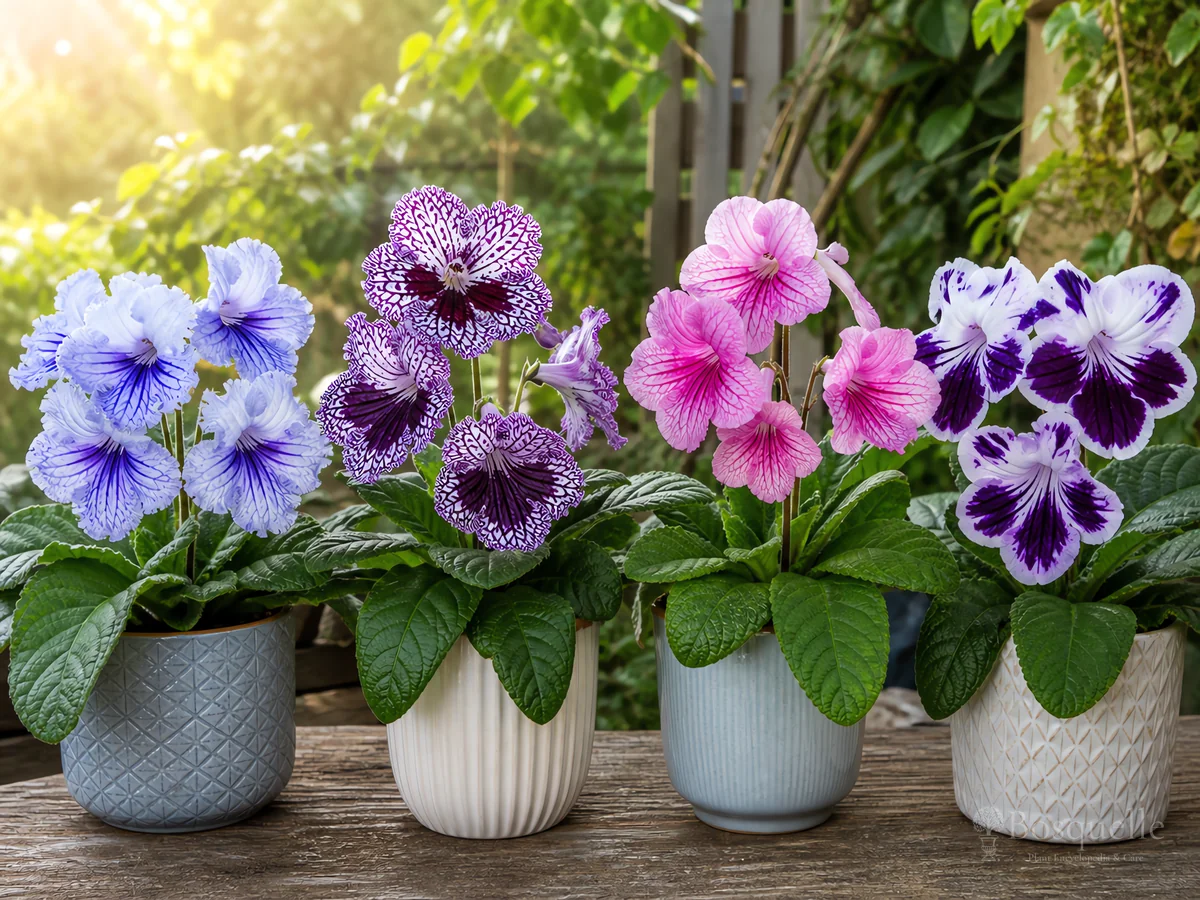
Grow Streptocarpus in bright indirect light — an east or west windowsill works well. Water when the top of the mix is dry, and keep the room between 60 and 78°F. Cape primrose is the common name. African violet is a close relative in the same family, but needs less light and wetter soil.
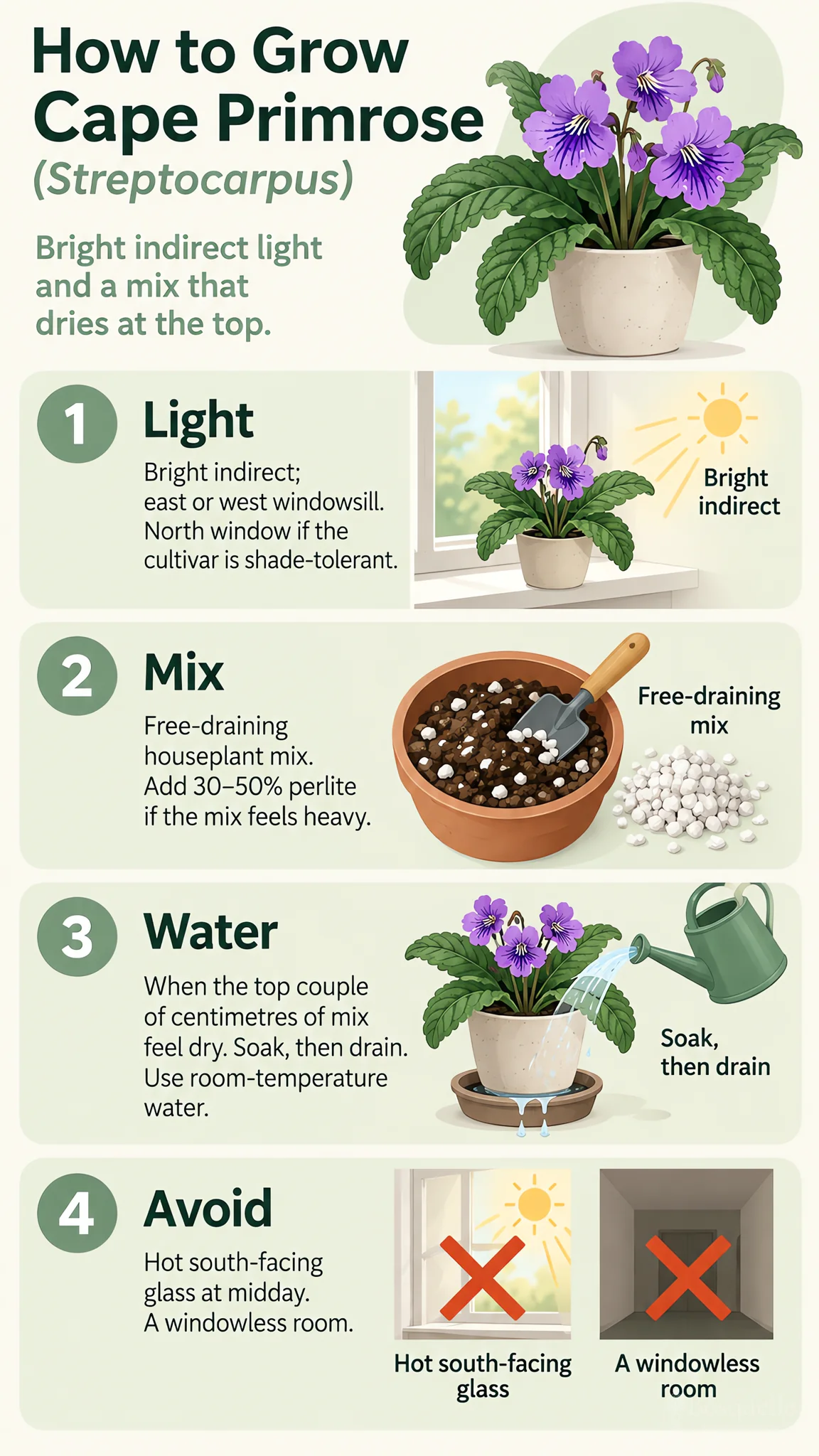
Bright indirect light, water when the top is dry, and a room between 60 and 78°F
| Factor | Recommended | Avoid |
|---|---|---|
| Light | Bright indirect; east or west windowsill; north window if the cultivar is shade-tolerant | Hot south-facing glass at midday; a windowless room |
| Water | When the top couple of centimetres of mix feel dry; soak, then drain; use room-temperature water | Cold water directly on the leaves; a pot left sitting in a full saucer |
| Temperature | 60 to 78°F; minimum about 45°F in winter | Rooms above 85°F in summer; frost; cold drafts |
| Mix | Free-draining houseplant mix; add 30–50% perlite if the mix feels heavy | Garden soil; standard African violet mix without extra perlite |
| Feed | Half-strength high-potash liquid feed every two weeks, spring through fall | Full-strength or high-nitrogen feed; any feed in winter |
| Pot | Wide, shallow pot one size up; slightly snug is fine | Deep pots that hold moisture at the root zone |
An east or west windowsill gives the steady bright, indirect light Cape primrose needs to bloom. Direct south-facing midday sun scorches the leaves. [1] Unlike African violet, Streptocarpus tolerates a slight drying between waterings and actually needs better drainage — mix in perlite if the potting mix drains slowly. [4]
- Set the pot on an east or west windowsill. Move it to a south window in winter for maximum light, but shift it away from the glass on cold nights.
- Check the mix with a fingertip. Water when the top centimetre or two feels dry. Pour until water runs out of the drainage holes, then empty the saucer. Use water at room temperature — cold water on warm leaves leaves brown spots. [2]
- Keep the room between 60 and 78°F. Summer heat above 85°F stresses the roots, and the plant wilts even in moist soil. Air conditioning through a heat wave helps. [2]
- Feed every two weeks with a half-strength, high-potash liquid fertilizer from spring through fall. Skip all feeding in winter, unless you are growing a year-round-flowering Crystal series cultivar, in which case use quarter-strength. [1]
- Remove spent flower stalks at their base to keep new blooms coming.
How much light does Cape primrose need?
Bright indirect light, such as an east or west windowsill. Too little light produces large, pale leaves and few flowers. Direct midday sun causes leaf scorch.
How often should I water Streptocarpus?
When the top centimetre or two of mix feels dry. Soak thoroughly and drain. Water less in winter. A slight wilt in a dry pot is recoverable; root rot from a permanently wet pot is not.
What temperature is too hot for Cape primrose?
Above about 85 to 90°F the plant wilts even in moist soil because roots cannot keep up with water loss through the leaves. Keep it out of unventilated rooms and direct summer sun.
Few flowers and large leaves — move to a brighter spot
The most common complaint is a plant that grows healthy-looking leaves but produces little bloom. The cause is almost always low light. [3]
- Large, deep-green leaves, few or no flowers — move to a brighter east or west window. The plant is photosynthesising enough to grow but not enough to flower.
- Leaves yellowing or yellowing at tips — check the mix. Wet and yellow means overwater or poor drainage. Dry and yellow means the room is too hot or the plant needs water.
- Brown patches on leaves — direct sun (scorch) or cold water on a warm leaf. Shade the window or switch to room-temperature water. [3]
- Grey fluff on leaves or crowns — grey mould (botrytis) from cold, damp, still air. Remove affected tissue and improve ventilation.
- Brown leaf tips in fall and winter — a natural seasonal response, not disease. Streptocarpus forms an abscission layer mid-leaf and sheds the tip to conserve nutrients. Trim the dead tip cleanly; the base will continue growing. [4]
Why is my Streptocarpus not flowering?
Usually too little light. Move to an east or west window. Also check that you are feeding with a high-potash fertilizer every two weeks during the growing season.
Why are the leaf tips turning brown?
Brown tips in fall and winter are often the plant's normal abscission response — the oldest leaf tissue is shed so the meristem at the base can survive. Trim the tip off cleanly. Brown spots elsewhere suggest cold water on the leaves or direct sun scorch.
How to take a leaf cutting
Cape primrose is one of the easier houseplants to propagate. A single healthy leaf can produce several new plants. Summer is the best time, when the plant is actively growing. [3]
- Choose a young, healthy leaf from the centre of the plant. Avoid very old outer leaves and very young inner ones.
- Cut the leaf into sections about 5 cm (2 inches) wide using a clean, sharp blade. You can also split a leaf lengthwise along the midrib to double the number of sections.
- Fill a small pot or seed tray with a 50/50 mix of perlite and peat-free multi-purpose compost, or use seed-and-cuttings compost.
- Insert each section basal end down — the end that was closest to the base of the plant — about 1 to 2 cm into the mix. Polarity matters: a section planted upside down will not root. [1]
- Water lightly and cover with a plastic bag or place inside a propagator to hold humidity. Keep in bright indirect light, not direct sun.
- Plantlets develop along the cut bottom edge in six to eight weeks. Once each plantlet has two or three leaves of its own, separate it carefully and pot it individually into a 8 cm pot.
Can I propagate Cape primrose from a leaf?
Yes — leaf sections are the standard method. Cut a healthy leaf into 5 cm sections, insert the basal end (closest to the crown) into moist, free-draining mix, and cover loosely. Plantlets appear in six to eight weeks.
Can I divide a Cape primrose?
Yes. Older, clumping plants can be pulled apart into sections when you repot in spring. Each section needs its own roots to survive.
Leaf-tip dieback, pot sizing, and winter watering
Should I repot Cape primrose every year?
Repot when roots appear at the base of the pot, usually every one to two years in spring. Choose a wide, shallow pot one size up — slightly snug is better than a large pot that holds extra moisture. After repotting, resume feeding only once roots have filled the new pot.
How do I water Cape primrose in winter?
Water only when the mix is dry, not on a fixed schedule. Cold, wet compost rots the roots. Keep the plant at a minimum of about 45°F (7°C) and move it to a south window for more light.
The leaf tips are dying back in fall — is the plant sick?
No. Streptocarpus forms an abscission layer partway along older leaves in fall, drops the leaf tip, and keeps the growing meristem at the base. Trim the dead tip off cleanly and the leaf continues. This is more noticeable in plants grown near cold windows.
Do I need to mist Cape primrose?
Not strictly. A bathroom or kitchen shelf, or a saucer of moist pebbles under the pot, provides enough humidity for most cultivars without daily misting.
Bright indirect light and a mix that dries at the top. Remove spent flower stalks and cut the plant back to a south window in winter.
FAQ
Is Cape primrose toxic to cats and dogs?
Streptocarpus is not listed as toxic by the ASPCA, but keeping pets from chewing houseplant leaves is always sensible.
Can I grow Streptocarpus outdoors?
Cape primrose is frost tender and only survives outside year-round in frost-free climates (roughly hardiness zones 10 to 11). Everywhere else it is a houseplant — bring it in before the first frost.
Why are my Streptocarpus leaves wilting?
Check the soil first. Dry and wilting means water the plant. Wet and wilting means the roots cannot take up water — often from overwatering, a blocked drain, or summer heat above 85°F. Let the mix dry and move the plant to a cooler spot.
Is Streptocarpus the same as African violet?
They are in the same family (Gesneriaceae) and African violet (Saintpaulia) is now classified within Streptocarpus by modern taxonomy. Care differs: Cape primrose needs slightly more light, cooler temperatures, and a freer-draining mix than classic African violet culture.
How long does Streptocarpus bloom?
Hybrids in good light can bloom from spring through fall. Crystal series cultivars may produce flowers almost all year if kept in a very well-lit spot.
Recommended plants


References
- [1] RHS -
https://www.rhs.org.uk/plants/streptocarpus/growing-guide - [2] Logee's Plants -
https://www.logees.com/growingandfloweringcapeprimroses/ - [3] Gardeners' World -
https://www.gardenersworld.com/how-to/grow-plants/how-to-grow-streptocarpus/ - [4] Garden Myths -
https://www.gardenmyths.com/streptocarpus-myths/
More first-season notes by plant are gathered in How to Grow Guides.
Updated: Reviewed by Bosquelle Editors