
Grow false aster in full sun, in soil that drains, and water it through the first season. Boltonia, white doll's daisy, and false chamomile are the same plant.
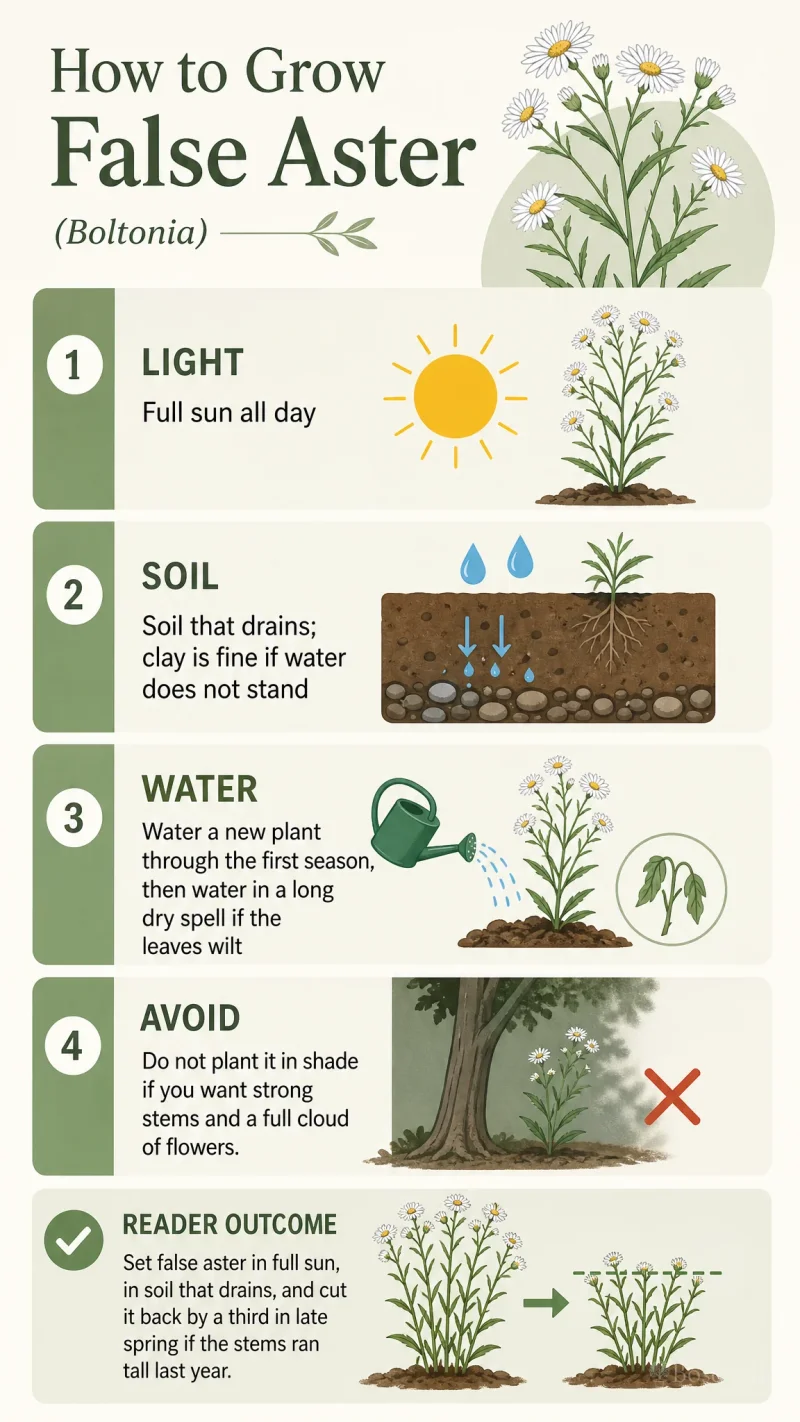
Give it full sun and soil that drains, and water it until the clump is set
| Factor | Recommended | Avoid |
|---|---|---|
| Light | Full sun all day | Do not plant it in shade if you want strong stems and a full cloud of flowers |
| Soil | Soil that drains; clay is fine if water does not stand | Do not leave the crown in a low wet pocket |
| Water | Water a new plant through the first season, then water in a long dry spell if the leaves wilt | Do not keep the soil soggy, and do not water on a weekly calendar once the clump is set |
| Feed | Little or no extra fertilizer | Do not dump extra nitrogen that pushes soft, floppy stems |
False aster wants full sun and a hole that drains. Shade and rich, wet ground are the usual reasons the stems fall over. Water a new plant through the first season, then stretch the watering so the soil can dry a little between waterings. Dry ground makes a shorter plant with fewer flowers, so water in a long dry spell if the leaves wilt. [1]
- Choose full sun. A south or west bed that drains is better than a dark north corner.
- Set it in soil that drains. Clay is fine if water does not stand around the crown.
- Water through the first season after planting. Then water in a long dry spell if the leaves wilt, and skip extra soakings in rich ground.
- Skip extra fertilizer unless the plant looks thin after a full season. Rich, wet ground is the usual cause of floppy stems.
Does false aster need full sun?
Yes. Full sun. Shade makes a taller, weaker plant with fewer flowers, and the stems fall over more easily.
How often should I water false aster?
Water a new plant through the first season. After that, water in a long dry spell if the leaves wilt, and do not keep the crown soggy.
Plant after frost, with the crown at soil level
Knock the plant from its pot and set the crown even with the surrounding soil. Dig a hole a little wider than the pot, and no deeper. Plant after the last spring frost, water after you plant, and leave room for the clump to fill.
- Plant after the last spring frost, so the new roots settle in warm ground. Do not set a transplant into frozen soil.
- Dig a hole a little wider than the root ball, and no deeper. Backfill with the same soil. Do not bury the crown.
- Set the crown even with the surrounding soil. Do not plant it in a low pocket that holds water.
- Leave about two to three feet between plants so the clumps can fill. Water to settle the soil, then keep watering through the first season. [2]
Split a crowded clump in spring
Lift a crowded clump in early spring, keep the vigorous outer pieces, and replant them at the same depth. Discard the woody center. Do this about every three or four years so the stand stays full and does not open in the middle.
- Dig around the clump in early spring, before the new stems run tall.
- Split off the outer pieces with roots attached. Throw out the old, woody center.
- Replant each piece at the same depth, two to three feet apart, and water to settle the soil.
When do I plant false aster?
Plant after the last spring frost, with the crown at soil level. Split a crowded clump in spring about every three or four years.
Cut it back by a third in late spring, then to the ground in late winter
Cut the stems back by about a third in late May or early June so the plant stays shorter and stands without staking. In late winter, cut last year's stems to the ground so new growth can come from the crown.
- In late May or early June, cut the stems back by about a third. The plant blooms a little later, but the stems stay upright. [3]
- In late winter, cut last year's stems down to the ground before new shoots run. Wait for that new growth before you decide a winter-killed top means a dead plant.
- Take out a broken stalk any time. Leave the gray-green leaves in place through the growing season.
- Stake only if you skipped the late-spring cut and the stems already lean. Do not wait until the cloud of flowers is open, when tying is harder.
When do I cut false aster back?
Cut it back by about a third in late May or early June. Cut last year's stems to the ground in late winter.
Not a fall aster — and not chamomile
False aster is Boltonia, a tall native daisy with gray-green leaves and a late cloud of tiny white heads. Fall asters are Symphyotrichum, usually later and in more colors — see How to Grow Asters.
Japanese aster is Kalimeris, a shorter summer daisy. Shops used to file it as Boltonia incisa — see How to Grow Japanese Aster. Tea chamomile is a different herb, not this tall border plant. Shasta daisy is Leucanthemum, with larger white heads — see How to Grow Shasta Daisy. If the tag is not Boltonia, you do not have this plant.
Is false aster the same as a fall aster?
No. False aster is Boltonia, a tall native with a late cloud of tiny white daisies. Fall asters are Symphyotrichum. Read the tag for Boltonia.
How to grow false aster from seed
Seed is a reliable start for the species. Sow extra, because sprouting can take many weeks. Barely cover the seed. Named selections do not come true, so start those from a division instead of saved seed.
- Sow after frost on weed-free ground, and cover the seed about an eighth of an inch. Keep the surface moist, not soggy, until seedlings show. [4]
- If you start indoors, sow in a mix that drains, keep it around 60°F, and wait seven or eight weeks for sprouts. Then plant the seedlings out after frost at the same depth they grew in the tray.
- Thin to about two to three feet once the seedlings have a few true leaves.
- Do not save seed from a named selection if you want the same height and color. Split the clump in spring instead.
Can I grow false aster from seed?
Yes. Sow after frost, barely cover the seed, and wait several weeks for sprouts. Named selections do not come true from saved seed.
Set false aster in full sun, in soil that drains, and cut it back by a third in late spring if the stems ran tall last year.
FAQ
Can I grow false aster in a pot?
You can hold a young plant in a large pot that drains, in full sun outdoors, if you water it more often than a plant in the ground. Empty the saucer so the crown does not sit wet. The plant is happier in the ground.
Is Snowbank a different plant?
Snowbank is a shorter white selection of the same Boltonia, not a second species. Pink Beauty is a pink selection of the same plant. Read the tag for Boltonia asteroides.
Is white doll's daisy the same as doll's-eyes?
No. White doll's daisy is this Boltonia. Doll's-eyes is Actaea, a woodland plant with white berries, not a late daisy cloud.
Recommended plants

References
- [1] NC State Extension -
https://plants.ces.ncsu.edu/plants/boltonia-asteroides/ - [2] Plant Native -
https://plantnative.org/native-plants/boltonia-boltonia-asteroides.htm - [3] Missouri Botanical Garden -
https://www.missouribotanicalgarden.org/PlantFinder/PlantFinderDetails.aspx?taxonid=277173 - [4] Harvest to Table -
https://harvesttotable.com/how-to-grow-boltonia/
More first-season notes by plant are gathered in How to Grow Guides.
Updated: Reviewed by Bosquelle Editors