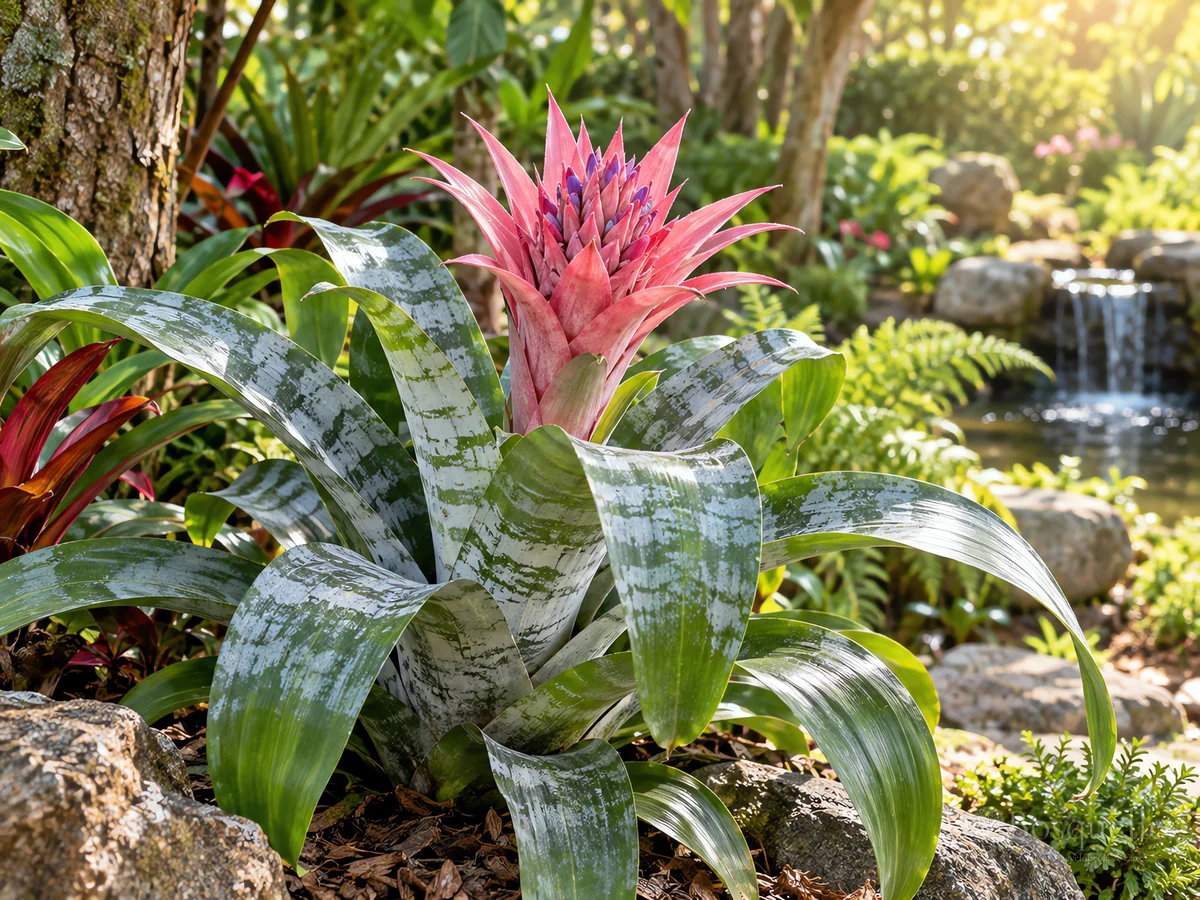
Grow urn plant in bright indirect light, with about an inch of water in the cup formed by the leaves. Urn plant here is Aechmea fasciata, also sold as silver vase plant — not a ceramic urn, and not an air plant.
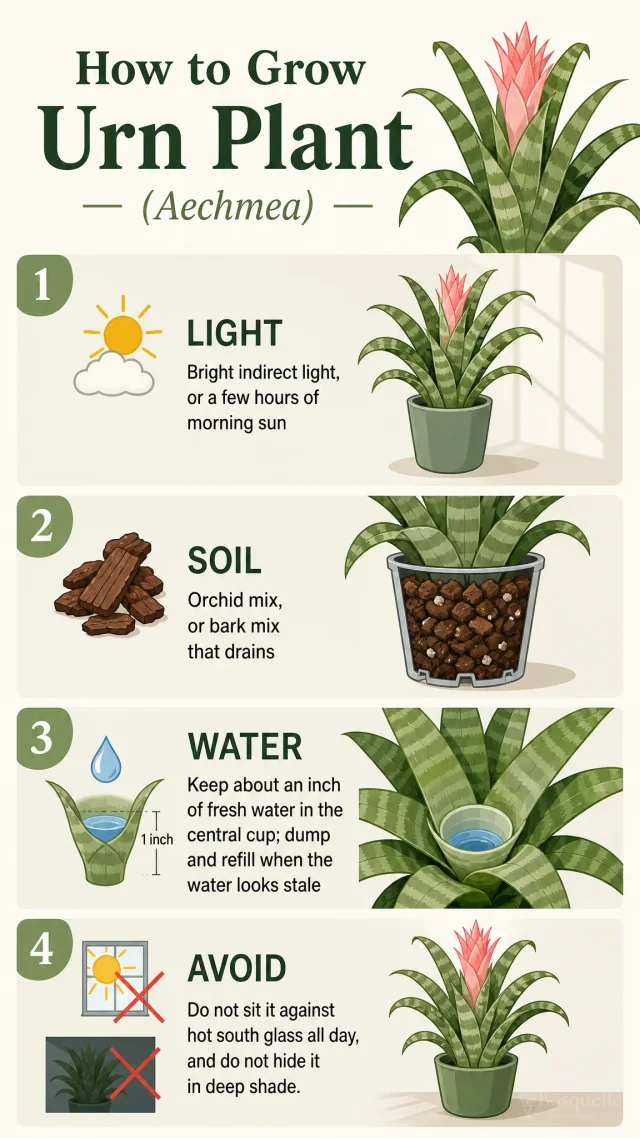
Keep about an inch of water in the cup, and give it bright indirect light
| Factor | Recommended | Avoid |
|---|---|---|
| Light | Bright indirect light, or a few hours of morning sun | Do not sit it against hot south glass all day, and do not hide it in deep shade |
| Water | Keep about an inch of fresh water in the central cup; dump and refill when the water looks stale, at least once a month | Do not leave the mix soggy, and do not let the cup sit stagnant |
| Soil | Orchid mix, or bark mix that drains | Do not keep it in heavy, wet houseplant soil |
| Pot | A pot with a drainage hole, only a little larger than the root mass | Do not grow it in a pot with no hole |
| Temperature | A warm room, about 65 to 75°F | Do not leave it in a cold draft or below about 45°F |
The plant takes most of its water from the cup, not from a wet root ball. Keep about an inch of water in that cup, then dump it and refill so salts and insects do not build up. [1] When you top up the cup, do not flood the mix. Soggy mix around the roots is the primary cause of root rot. [2] urn plant uses that same light and cup. The leaves are stiff, silver-banded, and toothed on the edge, so lift the pot instead of grabbing a leaf.
- Set it in bright indirect light. A pale, washed leaf often means too much hot sun; a dark, floppy leaf often means too little light.
- Keep about an inch of water in the cup. Dump and refill when the water looks cloudy or smells stale, and at least once a month.
- Let the mix dry a little between waterings. Empty the saucer after you water.
- Use less water on the mix in winter, but keep the cup from going bone-dry unless the room is cold.
How much light does urn plant need?
Bright indirect light, or a little morning sun. Hot south glass all day can bleach the silver bands, and deep shade makes the leaves dark and soft.
How do I water the cup?
Keep about an inch of fresh water in the central cup. Dump and refill when it looks stale, at least once a month, and do not soak the mix when you fill it.
Pot it in orchid mix, only up to the lowest leaves
Knock the plant from its nursery pot and set it no deeper than it was already growing. The lowest leaves sit on the mix so water does not pool against the crown. Fill around it with orchid mix, or with a bark mix that drains. Overflow from the cup can wet the mix a little; that is enough. [3]
- Choose a pot with a hole, only a little larger than the root mass.
- Fill it with orchid mix, or with bark mixed with a little houseplant mix so water still runs through.
- Set the lowest leaves on the mix. Do not bury the cup.
- Water once to settle the mix, empty the saucer, then keep the cup filled as usual.
How deep do I pot it?
No deeper than the nursery pot. The lowest leaves sit on the mix so water does not sit against the crown.
It flowers once — then cut a pup when it is about a third the size
The pink bract is showy for months, then the parent slowly fades. Before it dies, small offsets form at the base. Wait until a pup is about a third the size of the parent, or about six inches tall, then cut it free and pot it on its own. [4]
- Leave the faded pink spike until it browns, then cut it out at the base if it bothers you. The parent will not bloom again.
- Wait until the pup has a small rosette of its own, about a third the size of the parent.
- Cut it at the join with a clean knife. Roots on the pup are helpful, but they are not required.
- Pot it in a 3- or 4-inch pot of orchid mix, only up to the lowest leaves. Stake it loosely if it wobbles. Keep the new cup filled, and keep the mix barely moist until roots take.
Will it flower more than once?
No. The blooming plant flowers once, then fades. The next pink bract comes from a pup.
When do I cut a pup?
Wait until it is about a third the size of the parent, or about six inches tall, then cut it at the join and pot it in orchid mix.
Not an air plant — and not a pineapple or a ceramic urn
Air plants are tillandsias. They have no tank and they do not sit in orchid mix. Urn plant holds water in a cup of stiff, banded leaves. If you bought a soil-free clump, see How to Grow Air Plants.
Pineapple is Ananas. It wants full sun and it is grown for fruit, not for a silver vase of leaves. See How to Grow Pineapple.
A ceramic urn planter is not this plant. Guzmania and Neoregelia are other tank bromeliads with the same cup watering; Guzmania has smoother, spineless leaves. Banded “fasciata” on a small succulent tag is usually Haworthia — see How to Grow Haworthia. A snake plant with that word on the tag is Dracaena — see How to Grow Dracaena.
Is this an air plant?
No. Air plants have no water cup and no pot of mix. Urn plant sits in orchid mix and holds water in the cup.
Is this a pineapple?
No. Pineapple is a different bromeliad grown for fruit in full sun. This plant is the silver vase with a pink bract.
Is this a ceramic urn?
No. Urn plant is the bromeliad with a cup of leaves. A ceramic urn is a pot, not this plant.
Keep an inch of water in the cup, pot the next pup in orchid mix, and leave air plants on their own soak.
FAQ
Can I leave it outdoors all winter?
Only where frost never reaches the patio. Everywhere else, grow it as a houseplant, or bring the pot in before nights turn cold.
Do you hold other Aechmea kinds?
This catalog holds urn plant, Aechmea fasciata. Chantinii, Fendleri, Del Mar, and Primera are extra shop names, not cards here. They still want a cup of water and mix that drains.
Are the leaves toxic?
This plant is listed as non-toxic to cats, dogs, and horses. The leaf edges are toothed, so keep pets from chewing, and lift the pot by the pot, not by a leaf.
Do I need to feed it?
A half-strength houseplant feed in summer is enough. Do not pour a full-strength dose into the cup.
How do I get it to bloom?
Give it bright light for a few years. Some gardeners bag the plant with a ripe apple for a few days to trigger a bract. Keep the bagged plant out of hot sun.
Can I grow it from seed?
Seed is possible but slow. A pup from the base is the usual way to start a new plant.
Why are the leaf tips brown?
The cup went dry, or the plant sat in a cold draft. Refill the cup with fresh water and move it out of the chill. Trim only the dry tip if it bothers you.
What about scale on the leaves?
Wipe scale or mealybugs off with a damp cloth as soon as you see them. Dump and refill a stale cup so insects do not breed in the water.
Recommended plants
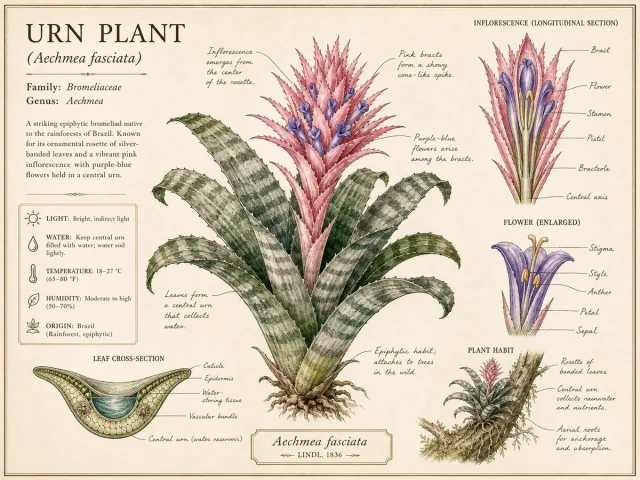
References
- [1] NC State Extension Gardener -
https://plants.ces.ncsu.edu/plants/aechmea-fasciata/ - [2] Clemson Home & Garden Information Center -
https://hgic.clemson.edu/factsheet/bromeliads/ - [3] NC State Extension Gardener -
https://plants.ces.ncsu.edu/plants/aechmea/ - [4] University of Georgia Extension -
https://site.extension.uga.edu/cobbanr/grow-bromeliads-from-pups/
More first-season notes by plant are gathered in How to Grow Guides.
Updated: Reviewed by Bosquelle Editors