
Give Dichelostemma full sun and soil that drains. After the grasslike leaves yellow, stop watering so the corm can rest dry through summer. Bluedicks is Dichelostemma capitatum, also sold as Dipterostemon capitatus.
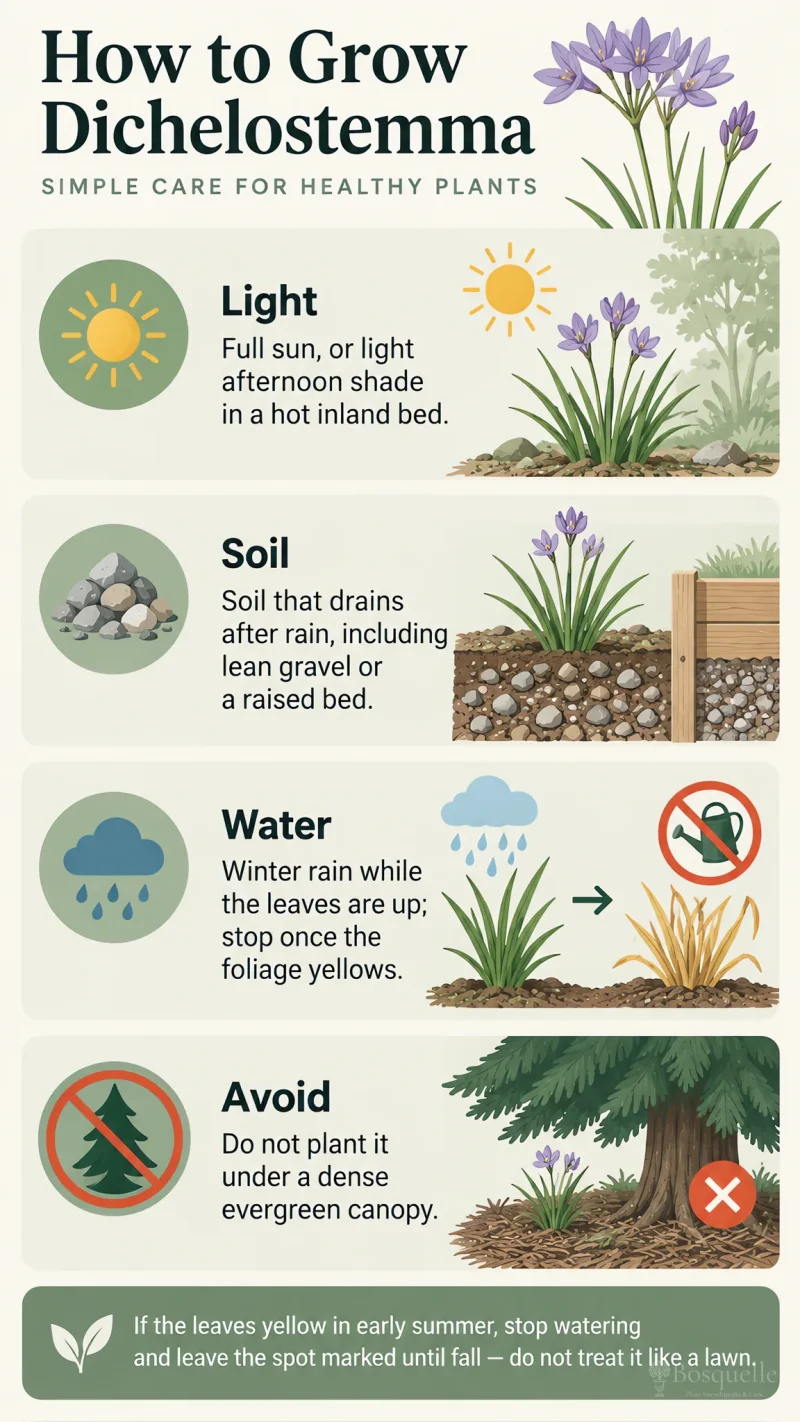
Give it full sun, soil that drains, and a dry summer rest
| Factor | Recommended | Avoid |
|---|---|---|
| Light | Full sun, or light afternoon shade in a hot inland bed | Do not plant it under a dense evergreen canopy |
| Water | Winter rain while the leaves are up; stop once the foliage yellows | Do not water it all summer as if it were a lawn |
| Soil | Soil that drains after rain, including lean gravel or a raised bed | Do not plant it next to a lawn or a bed that stays wet in summer |
| After bloom | Leave the grasslike leaves until they brown, then leave the spot marked | Do not cut the leaves while they are still green |
Dichelostemma is a cormous wildflower. It greens up with winter rain, blooms in spring, and then the leaves yellow so the corm can rest dry through summer. Give it full sun and soil that drains, and stop watering once those leaves fade, because summer wet is what rots the corm. [1] Do not site it beside a lawn that stays wet after bloom. [2] bluedicks wants that grassland light. firecracker flower wants the same dry rest even though the flowers look different — pick the kind on Types of Dichelostemma.
Does Dichelostemma need full sun?
Yes. Plant it in full sun, or with only light afternoon shade in a very hot inland bed. Do not tuck it under a dense evergreen canopy.
Should I water it in summer after the leaves yellow?
No. Once the leaves have yellowed, keep the bed dry. Summer water rots the corm.
Plant corms in fall, 3 to 4 inches deep
Start with a nursery corm in fall, after the first rains if you garden where winters are wet. Set large corms 3 to 4 inches deep, and set small ones 1 to 2 inches deep, pointed end up, in soil that drains. Buy nursery-propagated stock. Do not dig a wild colony.
- Buy nursery-grown corms. Do not lift plants from a hillside or a roadside bank.
- Plant in fall. Set large corms 3 to 4 inches deep and small ones 1 to 2 inches deep, pointed end up, in soil that drains.
- Backfill, firm, and water in once. Then wait for winter rain unless the winter stays unusually dry.
- Mark the spot so you do not dig or plant over the dormant corms after the leaves disappear.
How deep do I plant the corms?
Plant large corms in fall 3 to 4 inches deep, and small ones 1 to 2 inches deep. Mark the spot so you do not disturb them after the leaves disappear.
Can I dig bluedicks from a hillside?
No. Buy nursery-propagated plants. A wild colony is slow to rebuild once the corms are dug.
Split crowded corms every few years
If a clump has packed in and bloom has thinned, lift it in fall after the leaves have browned, pop the offsets off the parent corm, and replant them at the same depth. [3]
- Wait until the leaves have browned, then dig the clump while the soil is still workable.
- Pop the small corms off the parent. Replant large corms 3 to 4 inches deep and small ones 1 to 2 inches deep, in soil that drains.
- Water in once, then leave the bed to winter rain. Do not lift a wild hillside colony for this job.
When do I split the corms?
Every few years, after the leaves have browned in fall, if the clump is crowded and bloom has thinned. Replant at the same depth, and do not dig plants from the wild.
Not the tropical firecracker flower — and not a Brodiaea tag
A shop search for firecracker flower usually means Crossandra, a tropical shrub for warm shade, not this summer-dry corm. [4] Justicia sold as firecracker flower lives on How to Grow Shrimp Plant. Cuphea firecracker plant is a different summer annual — see How to Grow Cuphea. Older corm tags may still say Brodiaea. Queen Fabiola and Brodiaea laxa in old lists are usually Triteleia; see How to Grow Triteleia. Confirm Dichelostemma on the Latin.
Is this the same as Crossandra?
No. Crossandra is the tropical firecracker flower. Dichelostemma ida-maia is a California native corm with a dry summer rest.
Is this the same as Brodiaea?
No. Shop tags overlap. True Brodiaea and Triteleia are related corms, but they are not this genus. Confirm Dichelostemma on the Latin.
If the leaves yellow in early summer, stop watering and leave the spot marked until fall — do not treat it like a lawn.
FAQ
Can I grow it in a pot?
You can start corms in a deep pot that drains, then keep that pot bone-dry once the leaves brown. A ground bed that stays dry in summer is the simpler long-term home.
Can I eat the corms?
Native people gathered the corms as a starch. Digging enough for a meal wrecks a garden clump, and wild colonies should stay in the ground.
Is this the same as wild hyacinth?
Some tags say wild hyacinth. Eastern wild hyacinth is usually Camassia; see How to Grow Camassia. Fool's onion is an Allium; see How to Grow Alliums.
Is this toxic to dogs?
Dichelostemma is not listed on the ASPCA toxic-plant list. Still keep pets from digging up the corms, and call a vet if a dog or cat chews a plant and then acts sick.
Related guides

Recommended plants


References
- [1] Pollinator Patch Garden -
https://www.thepollinatorpatchgarden.com/plants/blue-dicks - [2] NRCS Plant Guide -
https://plants.sc.egov.usda.gov/documentlibrary/plantguide/pdf/cs_dica14.pdf - [3] Theodore Payne Foundation -
https://www.theodorepayne.org/nativeplantdatabase/index.php?title=Dichelostemma_capitatum_ssp._capitatum - [4] NC State Extension Gardener -
https://plants.ces.ncsu.edu/plants/dichelostemma-ida-maia/
This note is part of Dichelostemma Guides.
More first-season notes by plant are gathered in How to Grow Guides.
Updated: Reviewed by Bosquelle Editors