
Grow diascia in full sun, in moist soil that drains. Twinspur is the common name. Stiff twinspur is Diascia rigescens, an 8 to 10 inch plant with two spurs on the back of each flower.
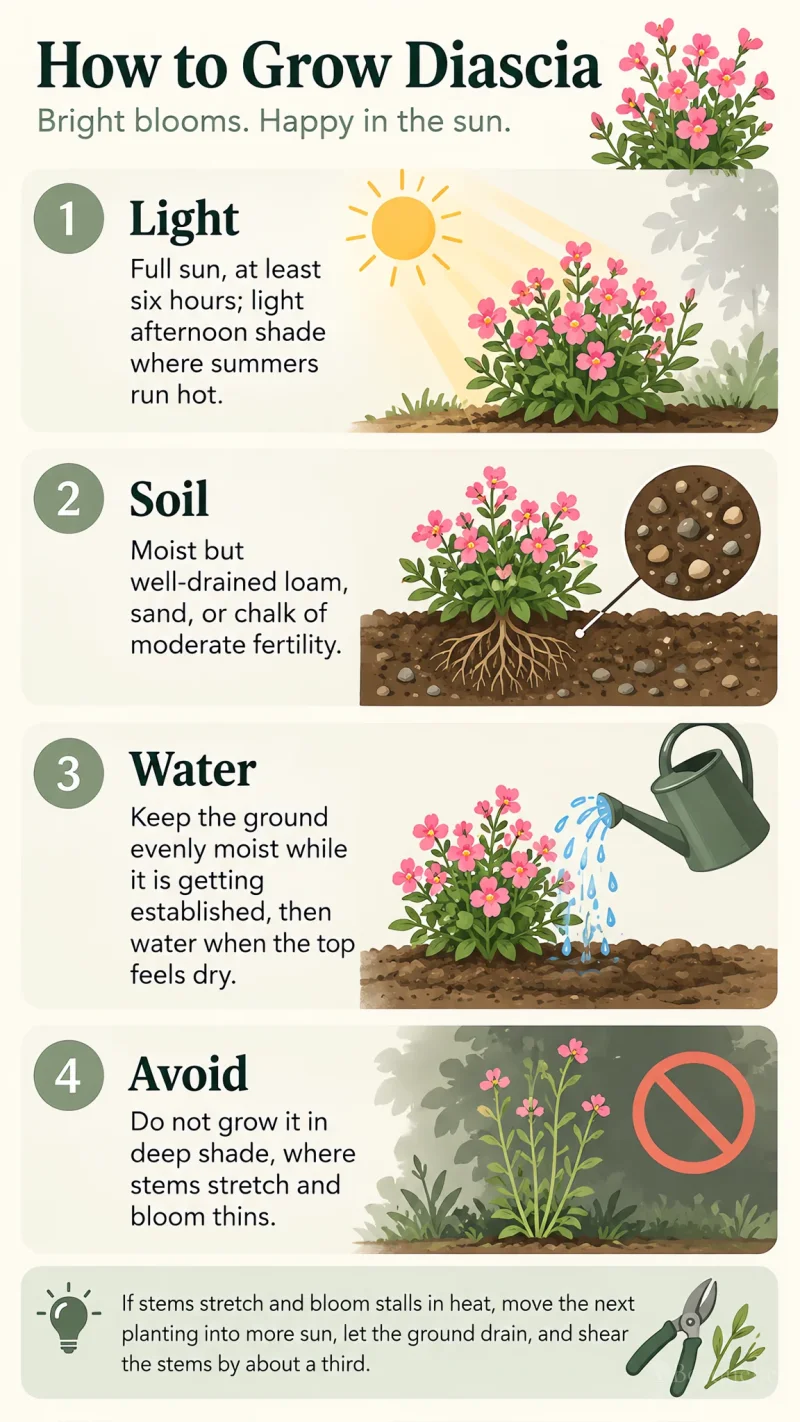
Give it full sun and soil that drains
| Factor | Recommended | Avoid |
|---|---|---|
| Light | Full sun, at least six hours; light afternoon shade where summers run hot | Do not grow it in deep shade, where stems stretch and bloom thins |
| Water | Keep the ground evenly moist while it is getting established, then water when the top feels dry | Do not leave the roots in soggy soil |
| Soil | Moist but well-drained loam, sand, or chalk of moderate fertility | Do not plant in heavy clay that stays wet after rain |
| Feed | Little extra fertilizer in open ground once it is growing | Do not keep feeding a plant that is already lush and thin |
diascia is Diascia rigescens, a South African perennial that most U.S. gardeners grow as a cool-season annual. Give it an open, sunny bed and ground that stays moist but does not sit wet. [1] It will take light afternoon shade when summer heat builds. Flowers stall in a hot, humid stretch, then return when nights cool if you shear the stems. [2] Water enough for the first weeks, then let the top of the soil dry slightly between waterings. A soggy crown rots faster than a missed watering. [3] Set plants out on Planting Diascia. Take cuttings on How to Propagate Diascia.
How much sun does diascia need?
Full sun, at least six hours. Light afternoon shade is fine where summers run hot. Deep shade makes weak stems and fewer flowers.
How often should I water diascia?
Keep the ground evenly moist while it is getting established, then water when the top feels dry. Do not leave the roots in standing water.
Does diascia come back every year?
Treat it as a one-season plant where frost is hard. In a mild winter the crown can return. A fresh plant, or a cutting you rooted, is the reliable start.
Grow it in a pot that drains
A pot works when it has a hole in the bottom and a mix that sheds water. This plant is a stiff edging twinspur, not a trailing basket filler, so choose a squat pot you can water, not a hanging basket built for a spiller. A pot dries faster than open ground, so water when the top of the mix is dry. Empty the saucer. Keep the mix moist, not soggy.
- Choose a pot with a drainage hole. Empty the saucer after you water.
- Use a potting mix that drains, not packed garden soil.
- Water when the top of the mix is dry. Skip heavy feed, which makes long, thin stems.
Can I grow diascia in a pot?
Yes. Use a pot with a hole, a mix that drains, and water when the top of the mix is dry. This stiff twinspur sits in a squat pot, not a trailing hanging basket.
Shear it when heat stops the flowers
Bloom is strongest in cool weather. When flowers stall in midsummer heat, or the stems look long and thin, cut them back. Fresh growth and a fall flush follow once nights cool. [4]
- Wait until flowers stall in heat, or the stems look long and thin with few buds.
- Cut the stems back by about a third. On a small plant that is about 3 inches.
- Water as usual. Do not soak the crown. Flowers return when nights cool.
When do I shear diascia?
When flowers stall in heat, or the stems look long and thin. Cut them back by about a third, then wait for cooler nights.
Not nemesia, and not a snapdragon
Diascia has two short spurs on the back of each flower. Nemesia looks similar at a glance, but the flower is more open and two-lipped, and some kinds are fragrant. If the tag says Nemesia, grow it as Nemesia, not as twinspur. A cool-season snapdragon is Antirrhinum, with a hinged mouth you can pinch — see How to Grow Snapdragons. Summer snapdragon is Angelonia, a heat plant with different timing — see How to Grow Angelonia. Penstemon is a related border plant with tubular flowers and no twin spurs — see How to Grow Penstemons. Confirm the Latin on the tag before you count on it trailing, standing stiff, or taking summer heat.
Is diascia the same as nemesia?
No. Diascia has two spurs on the back of each flower. Nemesia is a related plant with a more open, two-lipped bloom. Read the Latin on the tag.
If stems stretch and bloom stalls in heat, move the next planting into more sun, let the ground drain, and shear the stems by about a third.
FAQ
Do you list Flying Colors or Coral Canyon?
Those names are extra shop strains of twinspur. This guide covers stiff twinspur, Diascia rigescens. Give every packet the same sun and moist soil that drains. Coral Canyon is a hardier species some shops sell; it is not this plant.
Can I cut diascia for a vase?
The flowers can stand in a vase for a short time, then they pale if they open indoors. Grow it as a bed or edging plant, not as a cutting crop.
What should I plant with diascia?
Give it the same full sun and moist soil that drains. Pair it with other cool-season front-of-border plants. Do not crowd it into a wet pocket.
Can I grow diascia on a windowsill?
A bright, cool window can hold a cutting or a small pot through a mild spell. Most gardeners grow it outdoors after frost, where the stems get sun and air.
Is diascia poisonous?
Grow it as an ornamental. Do not eat the leaves or flowers. Keep pets from chewing the plant.
Related guides


Recommended plants

References
- [1] University of Arkansas Extension -
https://www.uaex.uada.edu/yard-garden/resource-library/plant-week/twinspur-diascia-7-27-12.aspx - [2] PlantZAfrica -
https://pza.sanbi.org/diascia-rigescens - [3] Royal Horticultural Society -
https://www.rhs.org.uk/plants/5763/diascia-rigescens/details - [4] NC State Extension -
https://plants.ces.ncsu.edu/plants/diascia-barberae/
This note is part of Diascia Guides.
More first-season notes by plant are gathered in How to Grow Guides.
Updated: Reviewed by Bosquelle Editors