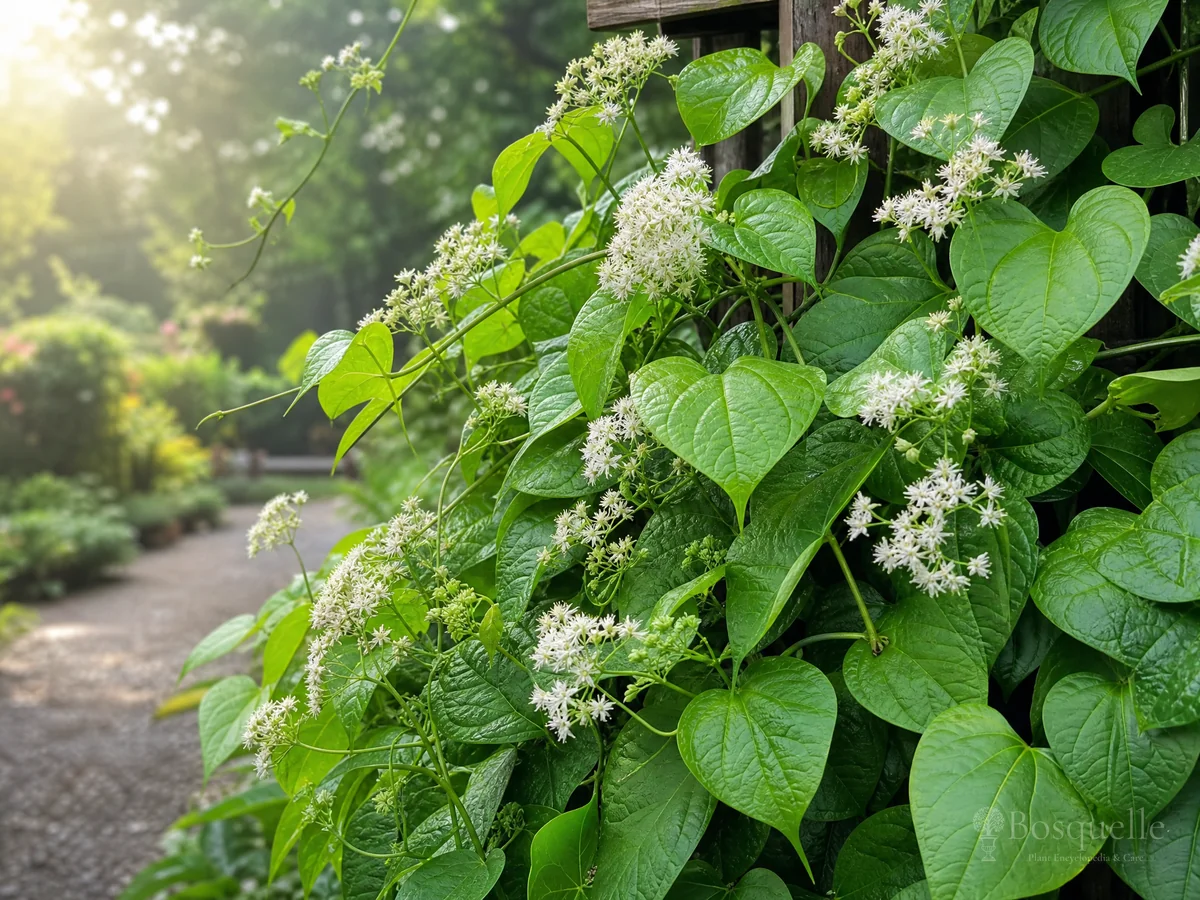
Grow climbing hempvine in moist to wet ground, in sun or part shade, with a fence or thicket to twine on. Climbing hempvine is Mikania scandens, also sold as climbing hempweed — a native wetland vine, not hemp.
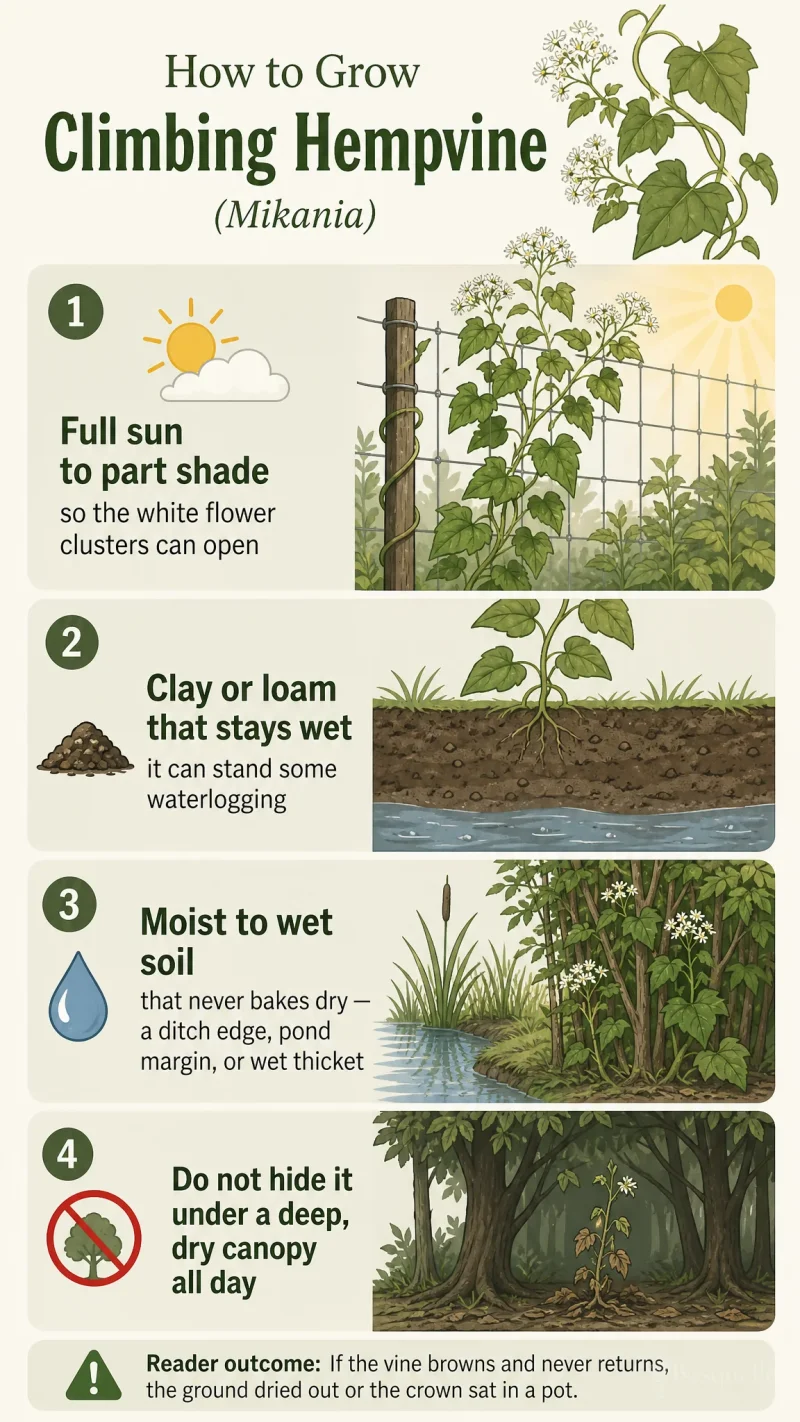
Keep it in moist to wet ground, in sun or part shade
| Factor | Recommended | Avoid |
|---|---|---|
| Light | Full sun to part shade, so the white flower clusters can open | Do not hide it under a deep, dry canopy all day |
| Water | Moist to wet soil that never bakes dry — a ditch edge, pond margin, or wet thicket | Do not plant it in a dry border that you water once a week |
| Soil | Clay or loam that stays wet; it can stand some waterlogging | Do not keep it in ordinary potting mix in a houseplant pot |
| Winter | Leave the roots in the wet ground; the top dies back and new stems return in spring | Do not lift the crown into a dry pot for the winter |
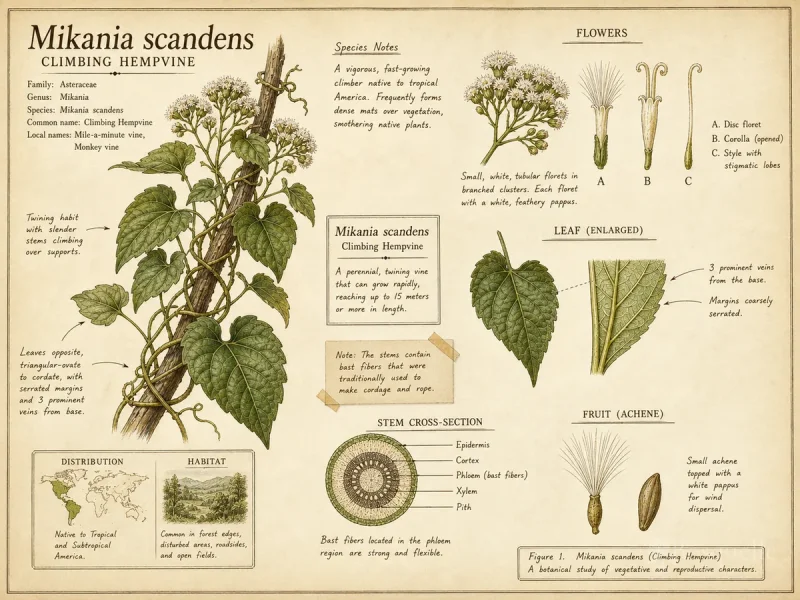
Climbing hempvine is Mikania scandens, a twining perennial in the sunflower family. Give it sun or light shade and soil that stays moist to wet, the same stream bank, swamp edge, or wet thicket it uses in the wild. [1] Opposite heart-shaped to triangular leaves sit on long stalks. From summer into fall, flat-topped clusters of small white or pinkish flowers open from the leaf axils and draw bees and butterflies. [2] Stems typically run about 8 to 10 feet in a garden and scramble over a fence or low shrubs. Pair it with other moisture-loving plants, not with a dry mixed bed. A dry slope, a windowsill pot, or a bed that dries in August will not keep this vine going.
How much sun does climbing hempvine need?
Full sun to part shade. It also climbs in shadier wet thickets, but flower clusters open more freely with some direct light.
Can it grow in dry garden soil?
No. The vine needs moist to wet ground. Ordinary garden soil that dries between waterings is the wrong site.
Plant it at a fence or in a wet thicket
Set a nursery plant after frost, in ground that already stays moist. Place the roots next to a fence, a trellis, or wet-edge shrubs it can twine around. It has no tendrils or aerial roots, so it needs something to wrap. Leave room for the scramble. Do not put it at a mailbox or in a small front-yard mix where it will smother neighbors.
- Plant after frost, in moist to wet ground, not in a dry border.
- Set the crown at the same soil line it had in the pot, next to a fence, trellis, or wet thicket.
- Leave space for the vine to run. Do not plant it in a tight mixed bed or at a mailbox.
- Water so the soil stays moist while the roots take, then keep that wet edge going.
When do I plant climbing hempvine?
Plant after frost, in moist to wet ground next to a fence or thicket. Keep the soil wet while the roots take.
Cut stems that smother other plants, and bag the pieces
When the site is wet and sunny, the vine covers what it can reach. Cut stems that bury small shrubs or swamp a neighbor. After frost the top dies back; cut the dead stems in late winter, or leave them until new growth starts. [3] Nodes root where stems lie on wet soil, and broken pieces can start new vines, so bag extras. Do not toss them into a ditch, a pond, or a storm drain.
- Give it a fence, trellis, or thicket to twine on, so it is not hunting through a mixed bed.
- During the growing season, cut stems that cover small plants you want to keep.
- After frost, cut dead stems in late winter, or leave them until spring shoots show.
- Bag the extras. Do not dump vine pieces in a ditch or pond, because nodes root on contact with wet soil.
Will it take over the fence?
It can cover a fence or a small shrub if the ground stays wet. Cut extra stems in summer, and bag the pieces so they do not root.
Not hemp — and not mile-a-minute
The name climbing hempvine is a common name, not a cannabis crop. If you want hops, that is a different vine — see How to Grow Hops. Indian hemp is Apocynum, a dry-ground milkweed relative, not this wetland scramble — see How to Grow Indian Hemp. Triangular leaves can look like a morning glory at a glance, but morning glory leaves are usually alternate and the flowers are trumpets. If you have those blooms, read How to Grow Morning Glory.
Shops also call this plant climbing boneset because the flower clusters look like upright boneset. That is still this vine. White perfoliate boneset is Eupatorium, an upright wet-meadow plant — see How to Grow Joe-Pye Weed. A shop comparison to autumn clematis is a habit note, not the same plant. If you have fragrant white clematis in fall, read How to Grow Clematis. Mile-a-minute in Florida news is usually Mikania micrantha, a noxious weed with paler leaves, green leaf stalks, and white flowers. Climbing hempvine usually has medium-green leaves, reddish stalks, and pinkish flowers. [4] Barbed mile-a-minute is another plant again (Persicaria): alternate triangular leaves, hooked prickles, and saucer-shaped cups on the stem. This vine has opposite leaves and no barbs.
Is this hemp?
No. Climbing hempvine is a native wetland vine in the sunflower family. It is not cannabis and not a hops crop.
Is this mile-a-minute?
Usually not. The noxious mile-a-minute Mikania in Florida has paler leaves and green leaf stalks. Barbed mile-a-minute has prickles and saucer-shaped cups on the stem. This vine has opposite leaves and no barbs.
If the vine browns and never returns, the ground dried out or the crown sat in a pot. Keep the roots wet in sun or part shade, cut extra stems before they cover small shrubs, and bag the pieces.
FAQ
Is there more than one kind of climbing hempvine?
Mikania scandens is the plant here. Climbing hempweed and climbing boneset are the same species. Florida Keys hempvine is a different Mikania. Purple pleasure, sold as Mikania ternata, is a fuzzy indoor trailer with divided purple leaves, not this wetland vine.
Can I grow it in a pot?
Only in a large, watertight tub that stays wet, set outdoors. Ordinary potting mix in a houseplant pot dries out and the vine dies. A hanging basket of purple foliage is usually purple pleasure, not this species.
Will it come back after frost?
Yes, from the roots, as long as they stay in wet ground. The top dies in winter; new stems climb again in spring. Do not lift the crown into a dry pot.
Can I start it from seed?
Seed can sprout after a long cold, moist wait, but a nursery plant is the usual start. Stem pieces also root, which is why you bag extras instead of tossing them.
Can I collect it from a wild swamp?
Buy nursery stock when you can. Wild plants belong in their own wetlands, and extras from a garden should be bagged, not dug from a preserve or tossed into a ditch.
Can I use it as medicine or like hemp?
Do not make tea, salve, or fiber from the vine. Grow it for the wet fence and the flowers. It is not a hemp crop and not a kitchen herb.
Recommended plants
References
- [1] University of North Florida Botanical Garden -
https://www.unf.edu/botanical-garden/plants/mikania-scandens.html - [2] Lady Bird Johnson Wildflower Center -
https://www.wildflower.org/plants/result.php?id_plant=MISC - [3] UF/IFAS Everglades Research and Education Center -
https://erec.ifas.ufl.edu/weed-id/climbing-hempweed/ - [4] UF/IFAS Extension -
https://ask.ifas.ufl.edu/publication/AG338
More first-season notes by plant are gathered in How to Grow Guides.
Updated: Reviewed by Bosquelle Editors