
Grow Chinese lantern lily in full sun, in soil that drains, water it through summer growth, and give the thin stems a stake. Chinese lantern lily is Sandersonia aurantiaca, also sold as Christmas bells — not a Physalis Chinese lantern, and not lily of the valley.

Give it full sun, soil that drains, and water while it grows
| Factor | Recommended | Avoid |
|---|---|---|
| Light | Full sun; morning sun with afternoon shade is fine in heat | Do not site it in deep shade that stays dim all day |
| Soil | Loam or sand that drains, with grit worked in if the bed is heavy | Do not plant it in a clay puddle that stays wet in winter |
| Water | Keep the ground moist through summer growth, then stop once the leaves yellow | Do not water a dormant tuber through winter rain |
| Size | Leave 2 to 3 feet of thin scramble and hanging orange lanterns | Do not expect a bushy hedge or a husk plant on a woody stem |
| Pests | Watch slugs and snails on new shoots | Do not leave wet leaves packed on a dormant tuber |
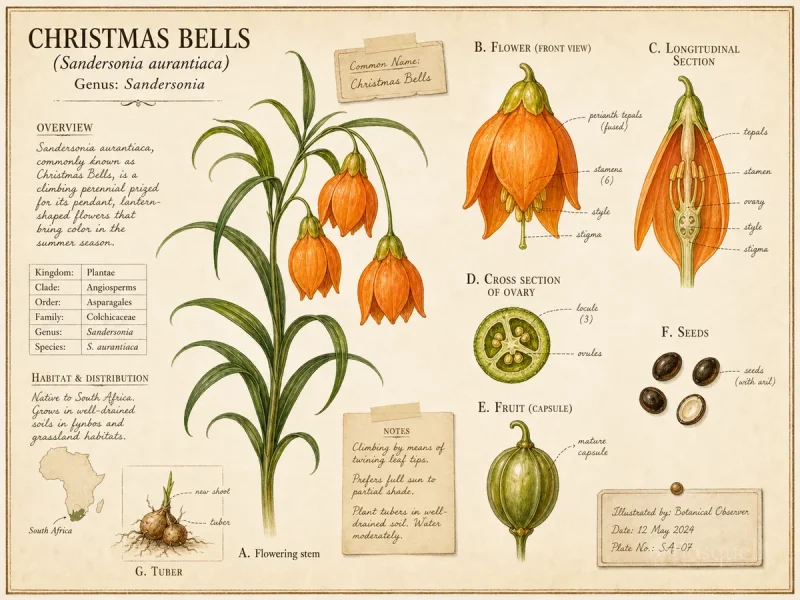
Chinese lantern lily is Sandersonia aurantiaca, a South African summer plant that grows from a forked tuber — two swollen lobes joined in the middle. Thin stems carry lance-shaped leaves and hanging orange lanterns. Give it full sun and ground that can wet in summer and then dry in winter, because winter wet around a dormant tuber is the usual cause of rot. [1] [2]
Water while the leaves are up so the new tuber can form for next year. After the leaves yellow, stop watering. To grow it in a pot you can carry under cover, continue on Chinese Lantern Lily in Pots.
How do I care for Chinese lantern lily?
Full sun, soil that drains, water while the leaves are up, a stake for the thin stems, and a dry rest after they yellow. Do not keep watering a dormant tuber.
Give the stems a stake as they run
The stems are thin and the lanterns hang, so they need a stake, a small trellis, or netting even when a leaf tip hooks. Set the support when you plant, so you do not spear the tuber later. [3]
- Push a narrow stake or a small trellis into the hole before you set the tuber, or just beside it if the tuber is already in.
- Tie the new shoot loosely as it lengthens, every couple of weeks, so the stem does not kink.
- Leave the green leaves in place until they yellow. You do not need a yearly cut-back.
Do I prune Chinese lantern lily?
No yearly cut-back. Tie the stems as they run, then wait until the leaves yellow before you tidy the top.
Lift the tubers after the leaves yellow
Where frost hits the bed, lift the forked tubers after the foliage dies, keep them in dry sand or peat — not bare on a shelf — and replant after the last hard frost. A frost-free bed that stays dry in winter can hold the tubers in place.
- Stop watering about two weeks after the leaves yellow, then cut the dead stems away.
- Lift the forked tubers, brush off wet soil, and pack them in dry sand or peat in a cool, dry place.
- Replant after the last hard frost, still horizontal, and water once to settle.
Plant the forked tubers in spring, after frost
Plant after the last hard frost, 2 to 4 inches deep and 6 to 8 inches apart, with the forked tuber lying flat. Handle it gently, because the lobes snap. Water once to settle, then wait for shoots before you water again. [4]
- Choose a sunny, sheltered pocket of ground that drains, and set a stake first.
- Lay the forked tuber flat, 2 to 4 inches deep and 6 to 8 inches from its neighbor.
- Cover, water once, then hold off until green shoots show, so the tuber does not sit wet and idle.
- Keep the ground moist while leaves are up. If winter rain sits on the bed, lift the tubers as above.
When should I plant Chinese lantern lily?
In spring, after the last hard frost. Set the forked tuber flat, 2 to 4 inches deep. Do not plant into cold, wet clay.
Not a Chinese lantern plant — and not lily of the valley
Shop bags that say Chinese lantern are often Physalis, a husk plant with papery orange calyxes around a berry. If the tag is Physalis, that job is How to Grow Chinese Lantern. Lily of the valley is Convallaria, a shade groundcover with white bells on a short stem — that job is How to Grow Lily of the Valley.
Australian Christmas bells are Blandfordia, a wet-heath plant, not this South African tuber. Climbing lily with reflexed red-and-yellow flowers is How to Grow Climbing Lily. A parrot lily sold as a New Zealand Christmas bell is How to Grow Alstroemeria. Flowering maple with hanging lanterns is How to Grow Flowering Maple.
Is Chinese lantern lily the same as Christmas bells?
Christmas bells is a common name for this tuber. Australian Christmas bells are Blandfordia, a different plant. Physalis Chinese lantern is a husk plant.
Site it in sun on ground that drains, water while the leaves are up, stake the stems, and let the tuber rest dry after they yellow.
FAQ
Is there more than one kind of Chinese lantern lily?
This catalog holds one species, Sandersonia aurantiaca. Shops sell orange and yellow bells, and cut-flower names such as Santonia show up, but they are not separate cards here. All of them still want sun, drain, summer water, a stake, and a dry winter rest.
Is Chinese lantern lily toxic?
It is not a food plant. All parts can make a person or a pet sick if eaten, so keep children and pets from chewing the tubers or the stems. Grow it for the lanterns, not for the kitchen.
Can I cut the flowers?
Yes. Cut a stem when the lowest lanterns have taken on color. The stems last about three weeks in a vase. Leave a couple of leaves on the plant if you want a larger tuber next year.
Related guides

Recommended plants
References
- [1] Royal Horticultural Society -
https://www.rhs.org.uk/plants/79277/sandersonia-aurantiaca/details - [2] SANBI PlantZAfrica -
https://pza.sanbi.org/sandersonia-aurantiaca - [3] NC State Extension -
https://plants.ces.ncsu.edu/plants/sandersonia-aurantiaca/ - [4] Van Zyverden -
https://www.vanzyverden.com/garden-guides/spring-planting/bulbs/sandersonia/
This note is part of Sandersonia Guides.
More first-season notes by plant are gathered in How to Grow Guides.
Updated: Reviewed by Bosquelle Editors