
Grow cereus cactus in full sun and cactus mix that dries. Cereus cactus is Cereus. Shops also say hedge cactus. It is not a flattened night-blooming cereus.

Give it full sun, mix that dries, and a dry winter
| Factor | Recommended | Avoid |
|---|---|---|
| Light | Full sun outdoors. A south or west window indoors | Do not leave it in a dim room that stretches the column |
| Mix | Cactus mix with grit or coarse sand | Do not use peat that stays wet around the roots |
| Water | Soak in spring through fall when the mix is dry | Do not water on a winter calendar. The roots rot if the mix stays wet |
| Winter | Cool and dry, about 45 to 55 F | Do not keep a warm, wet pot all winter |
| Drought | Dry spells once the mix drains | Do not keep the mix wet because the tag says drought-tolerant |
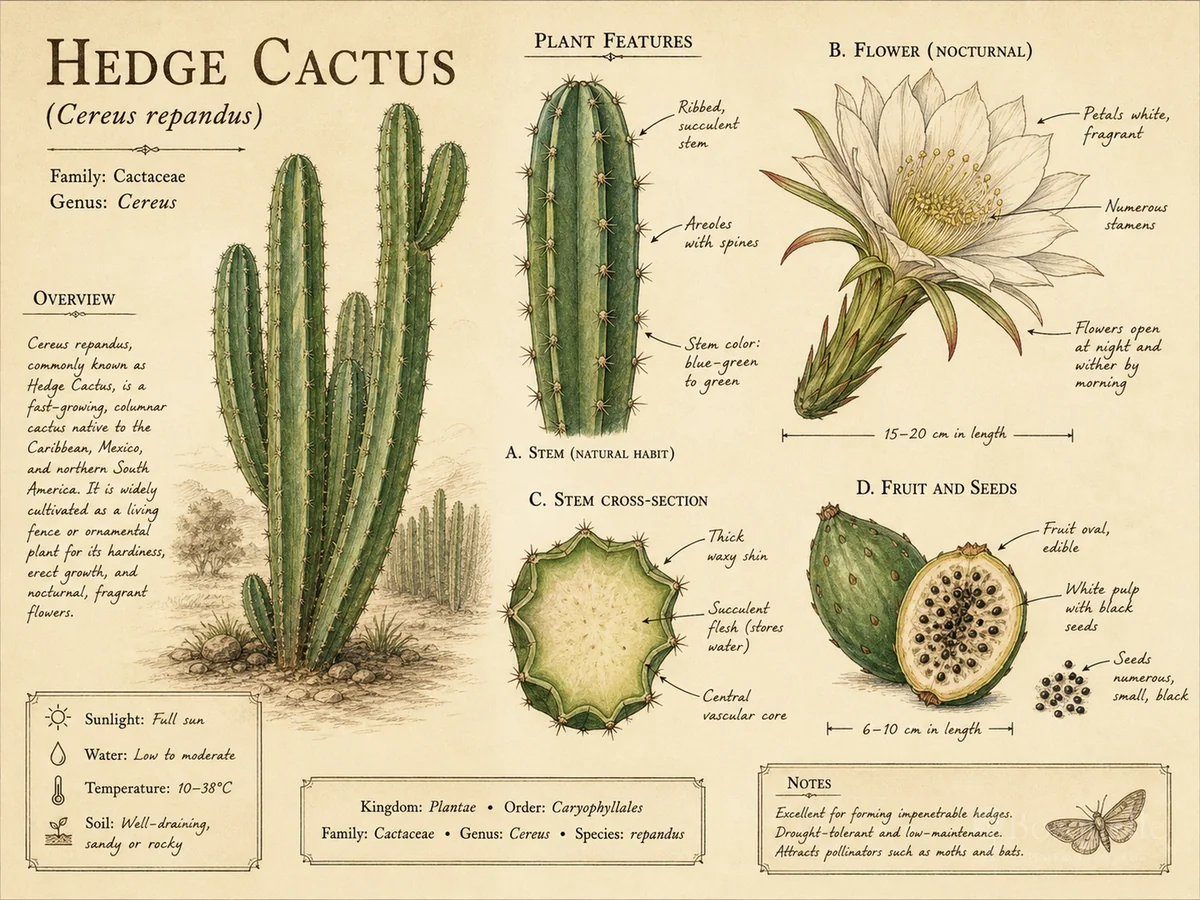
hedge cactus is a ribbed, bluish-green column. Give it full sun and mix that dries. Outdoors that means an open, bright spot. Indoors, set the pot at a bright south or west window. A plant that just left a shaded greenhouse will scorch if you set it against hot glass on the first day, so move it into strong sun over about two weeks. [1] [2] Water when the mix is dry in the growing season. In winter, keep it cool and almost dry.
- Site it in full sun outdoors, or at a south or west window indoors. A dim room stretches the column and washes out the blue-green color.
- Use cactus mix with grit. Ordinary potting soil holds water against the roots.
- Soak until water runs out, then wait until the mix is dry. Empty the saucer. Skip extra water in cool, low light.
- In winter, keep the pot cool and almost dry. That rest keeps the stem firm — not a warm, wet sill.
How much sun does cereus cactus need?
Give it full sun outdoors, or a south or west window indoors. A dim room stretches the column.
How often do I water it?
In spring through fall, soak when the mix is dry, then empty the saucer. In winter, keep it almost dry.
Plant it in a pot with a hole, or draining ground if frost stays off
In most of the US, grow it in an unglazed pot with a hole so you can bring it in before a freeze. Where frost stays off, you can plant it in a sunny bed that drains. [3]
- Wear gloves, or wrap the stem in several layers of newspaper, before you lift it. The ribs carry spines.
- Choose a snug pot about an inch or two wider than the root mass, with a hole. A pot that is much larger stays wet around the roots. As the column gets tall, use a heavy base so the pot does not tip.
- Set the plant at the same depth it grew in the nursery pot. Do not bury the green tissue.
- If you plant in the ground, use a bed that dries after rain. If the native soil holds water, mound it or backfill with cactus mix.
- Wait about a week after you plant or pot it before the first soak, so broken roots can dry. Then soak once, and wait until the mix is dry again.
- Bring a pot in before a freeze. If a brief cold night is coming and the plant is in the ground, slip paper bags over the growing tips.
Can I plant it in the ground?
Yes, in a sunny bed that dries, if frost stays off. Otherwise use a pot with a hole and bring it in before a freeze.
Cut a stem and let the wound dry before you set it
You do not prune this cactus to reshape it. A nursery plant is the usual start. If you want a second plant, or a row for a hedge, cut a firm stem in warm weather and let the wound dry so it does not rot in the mix. [4]
- Wear gloves. Cut a firm stem in late spring or summer, when the plant is growing. A cutting can be short, or several feet on a thick column.
- Set the cutting upright in a dry, shaded spot until the wound skins over. That can take a week or more on a thick column.
- Set it upright in cactus mix that drains, and bury only enough of the base to hold it. Stake a tall cutting so it does not fall. Do not water for about a week.
- Then soak once, and wait until the mix is dry. Keep it in bright light until you feel resistance on a gentle tug, then move it into full sun.
How do I start a cutting?
Cut a stem in warm weather, let the wound dry until it skins over, then set it in cactus mix. Skip water for about a week.
Not a night-blooming cereus — this one is a column
Night-blooming cereus on a tag is usually a climbing dragon fruit vine or a flattened orchid cactus. hedge cactus is a ribbed, upright column, also sold as Peruvian apple cactus. Confirm the Latin. Cereus is not Selenicereus. See How to Grow Dragon Fruit if the plant in the pot is a climbing, three-angled vine, or How to Grow Orchid Cactus if the stems are flat and leaf-like.
A saguaro has a thick trunk and later arms — see How to Grow Saguaro only if that is the plant you have. Christmas cactus is a flattened holiday stem — see How to Grow Christmas Cactus if that is the plant in the pot. It wants more water than this cactus. Ming Thing is a knobby monstrose form of a different Cereus, not the tall hedge cactus we hold.
Is this night-blooming cereus?
Usually not. Shops use that name for climbing dragon fruit or a flattened orchid cactus. Hedge cactus is a ribbed, upright column.
When the mix is dry and the column looks plump, soak once. If frost is coming, bring the pot in.
FAQ
Do I fertilize cereus cactus?
You do not have to. If you feed, use a weak cactus fertilizer in spring and summer only. Skip winter.
What is the white fluff near the spines?
That can be mealybug. Wipe it off when you see it. Wet, still air makes pests worse. Do not start with a spray.
Can I grow it from seed?
Seed works, but it is slow. A nursery plant or a stem cutting is the usual start.
Are the fruits edible?
Mature plants can make a smooth, thornless fruit shops call Peruvian apple. Eat the white flesh and small seeds fresh if you want. Do not cook the stems.
Is it safe around pets?
The spines catch skin. Keep pets from chewing the stems.
Is Ming Thing the same plant?
No. Ming Thing is a knobby monstrose form of a different Cereus. Hedge cactus is the tall ribbed column. Give both mix that dries, but do not expect Ming Thing to become a hedge.
Recommended plants
References
- [1] Gardening Know How -
https://www.gardeningknowhow.com/ornamental/cacti-succulents/scgen/peruvian-apple-cactus.htm - [2] Clemson Cooperative Extension HGIC -
https://hgic.clemson.edu/factsheet/indoor-cacti/ - [3] University of Arizona Cooperative Extension -
https://www.extension.arizona.edu/publication/how-transplant-cactus - [4] University of Arizona Cooperative Extension -
https://extension.arizona.edu/sites/default/files/2025-03/How-to-Propagate-Agaves-and-Cacti-From-Cuttings-and-Seed.pdf
More first-season notes by plant are gathered in How to Grow Guides.
Updated: Reviewed by Bosquelle Editors