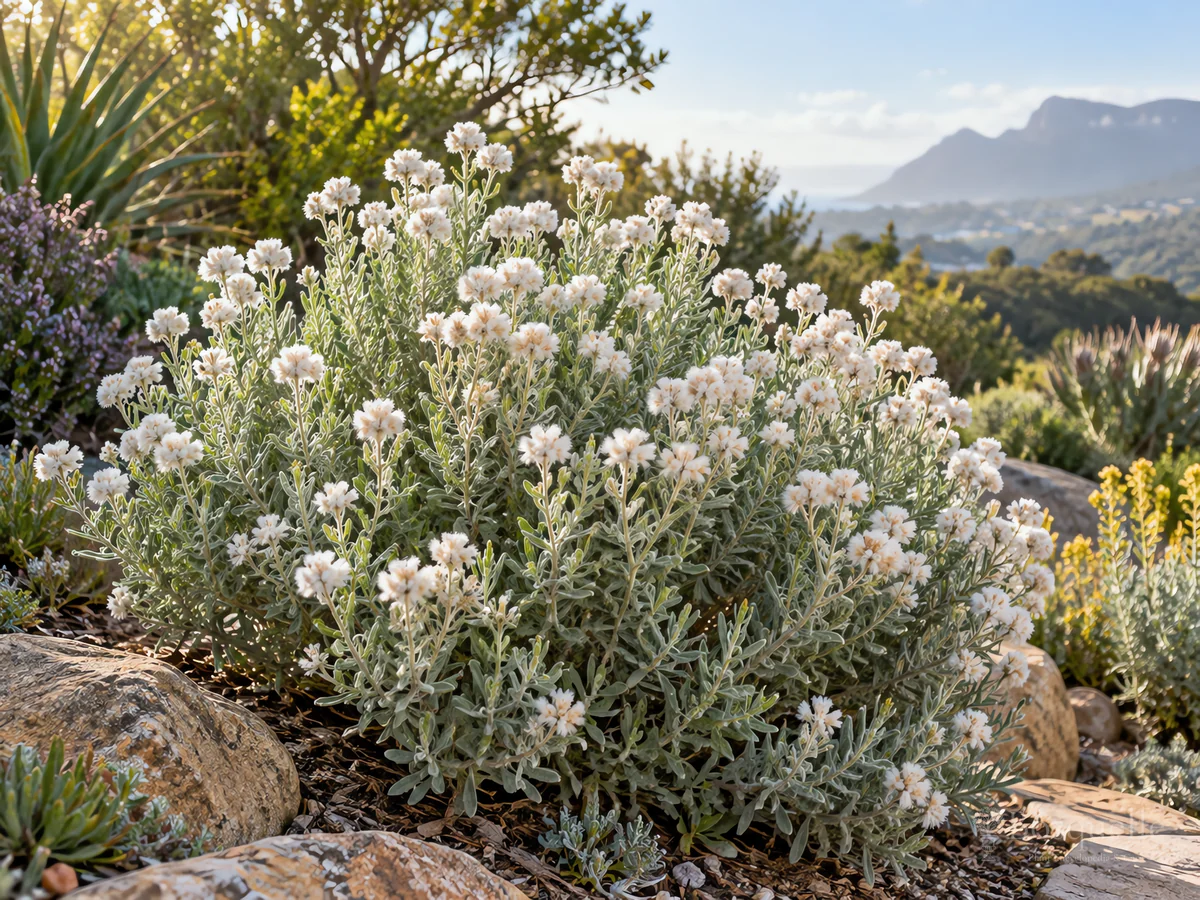
Grow cape snowbush in full sun on soil that drains. Cape snowbush is Eriocephalus africanus, also sold as kapok bush. It is not kitchen rosemary, and it is not the tropical snowbush sold for pink leaves.

Give it full sun and soil that drains
| Factor | Recommended | Avoid |
|---|---|---|
| Light | Full sun | Do not plant it in shade |
| Water | Water a new shrub until the roots take, then skip extra water | Do not keep the roots wet |
| Soil | Soil that drains after rain; chalk, loam, sand, or clay that sheds water | Do not plant it in a winter bog |
| Size | 2 to 3 feet tall and wide | Do not crowd the mound |
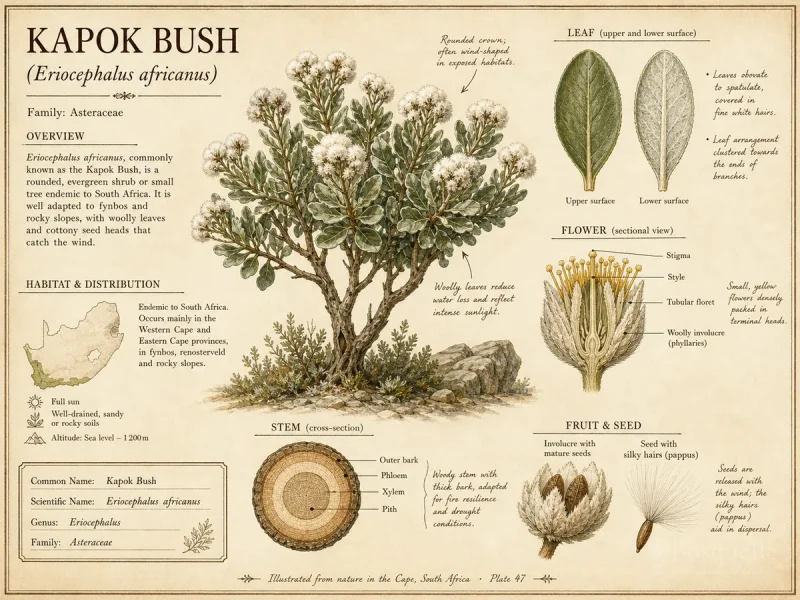
Cape snowbush wants full sun and a hole that dries after rain. Water a new shrub through the first dry weeks, then ease off; an established plant takes missed water better than soggy ground. [1] Kapok Bush is a bushy evergreen mound about 2 to 3 feet tall and wide, with needle-like gray-green leaves that smell like Vicks when you crush them. White daisy flowers with a purple center cover the shrub in winter, then fluffy white seedheads follow. [2] Bees work the flowers on a warm day. Once the roots are in, skip extra water and skip rich fertilizer that stays wet. Wet soil around the roots is the primary cause of root rot.
How much sun does Cape snowbush need?
Give it full sun. Shade after it is planted opens the mound and keeps the soil wet longer than the roots can take.
How often do I water Cape snowbush?
Water a new shrub until the roots take. Then skip extra water. Wet soil around the roots is the primary cause of root rot.
How big does Cape snowbush grow?
A mature mound is about 2 to 3 feet tall and about 2 to 3 feet wide. Leave that room so the shrub can fill in.
When does Cape snowbush bloom?
The best show is in winter, when white daisy flowers with a purple center cover the shrub. Fluffy seedheads follow, and bloom can run into spring and early summer.
What does Cape snowbush look like?
It is a silver-gray evergreen mound with thin, aromatic leaves. In winter it looks dusted with snow from the white flowers, then from the woolly seedheads.
Plant a nursery shrub in winter or spring
Set a nursery plant while you can still water it through the first weeks. In a winter-rain climate, plant in the wet months so the roots take before the dry summer. Elsewhere, plant in spring after frost. Slide the root ball out and set the crown at the same depth it sat in the pot, in soil that drains.
- Plant in the wet winter months if that is when your rain falls, or in spring after frost, when you can water the first weeks.
- Dig a hole twice as wide as the root ball. Set the crown at the same depth it sat in the pot. Do not bury it.
- Mix a little compost into soil that already drains. Do not drop the shrub into a wet, rich hole. [3]
- Water it in. Water again when the soil under a thin mulch is almost dry, until new growth shows, then ease off.
- Keep mulch off the crown.
How do I plant Cape snowbush?
Use a nursery shrub. Plant in winter rain or in spring after frost, set the crown at pot depth, and water until new growth shows.
Grow it in a pot that drains
A pot with a drainage hole can hold this shrub on a sunny patio. Use a gritty potting mix, not garden soil, and empty the saucer after you water. Keep the pot outdoors in full sun. In a cold winter, move it under glass or onto a bright, frost-free porch. This is not a windowsill houseplant. [4]
- Choose a pot with a drainage hole, and fill it with gritty potting mix.
- Set the crown at mix level, water it in, and do not leave the pot in a saucer of water.
- Keep it outdoors in sun. Move it under glass only if a hard frost is coming; do not grow it as a houseplant.
Can I grow Cape snowbush in a pot?
Yes, in a pot that drains. Use a gritty mix, keep it outdoors, and move it under glass if a hard frost is coming. Do not grow it as a houseplant.
Tip-prune after the seedheads drop
The woolly seedheads are part of the show, so wait until they have dropped before you cut. Then tip-prune so the shrub stays bushy, or clip it into a low hedge or a rounded mound. Do not shear it like kitchen rosemary into a tight box if you still want the winter daisies.
- Wait until the fluffy seedheads have dropped.
- Tip-prune to keep the shrub bushy, or clip it into a low hedge or a ball.
- Cut dead wood at any time. Do not shear the whole plant into a tight kitchen-rosemary hedge if you want the winter flowers.
How do I prune Cape snowbush?
Wait until the seedheads drop, then tip-prune for a bushy mound or a low hedge. Cut dead wood at any time.
Start a new plant from a cutting or from seed
A tip or heel cutting taken in spring or autumn roots readily in a mix that drains. Seed sown on gritty mix in autumn or spring can sprout in about ten days. Keep either method out of standing water.
- Take a tip or heel cutting in spring or autumn. Strip the lower leaves and stick the cut end in a mix that drains.
- Keep the mix barely moist until roots form, then pot it on and grow it in sun.
- To sow, scatter seed on gritty mix in autumn or spring. Seedlings can show in about ten days. Move them to a small pot once they handle, and do not let the mix stay soggy.
Can I grow Cape snowbush from a cutting?
Yes. Take a tip or heel cutting in spring or autumn, stick it in a mix that drains, and keep the mix barely moist until roots form. Seed on gritty mix is the slower home method.
Not kitchen rosemary — and not tropical snowbush
Kitchen rosemary is a Mediterranean herb grown for cooking. If the tag says rosemary, Tuscan Blue, or a potted Christmas-tree rosemary, read How to Grow Sage. Cape snowbush is in the daisy family. The flowers are small white daisies with a purple center, not two-lipped mint flowers, and the leaves are softer and gray, not glossy needles.
US wild rosemary on a Gulf Coast tag is usually false rosemary, Conradina — see How to Grow False Rosemary. Florida rosemary is Ceratiola — see How to Grow Florida Rosemary. Coastal rosemary is Westringia — see How to Grow Coastal Rosemary. Tropical snowbush is Breynia, a shrub grown for pink and white mottled leaves and regular water, not this dry silver mound. A kapok tree is Ceiba, a large tropical tree; the fluffy seedheads on this 2 to 3 foot shrub are not kapok pods. Confirm the Latin on the tag is Eriocephalus africanus.
Is Cape snowbush the same as kitchen rosemary?
No. Cape snowbush is a South African daisy-family shrub. Kitchen rosemary is a cooking herb in the sage group.
Is Cape snowbush the same as tropical snowbush?
No. Tropical snowbush is Breynia, grown for pink and white mottled leaves. Cape snowbush is Eriocephalus africanus, a dry silver mound with winter daisies.
Is Cape snowbush the same as false rosemary?
No. False rosemary is Conradina, a native mint-family shrub. Cape snowbush is Eriocephalus africanus. Both may be sold as wild rosemary, so read the Latin.
If the hole stays wet after rain, move the shrub to a mound that drains, and skip extra water once the roots are in.
FAQ
Is there more than one kind of Cape snowbush?
Eriocephalus africanus is the plant here. Extra shop names such as kapok bush, wild rosemary, and African rosemary are the same shrub, not a second type. Other African Eriocephalus species are not in this catalog.
What should I plant with Cape snowbush?
Pair it with other sun shrubs that like soil that drains, such as breath of heaven — see How to Grow Breath of Heaven. Do not crowd it against a wet, shady hedge.
Is Cape snowbush endangered?
No. Eriocephalus africanus is a common shrub in its home range. Confirm the Latin on the tag. Shop listings sometimes reuse Cape snowbush for another Eriocephalus.
Will Cape snowbush come back after a hard frost?
Top growth can die when a freeze drops much below about 23°F. In a cold winter, a draining pot you can move under glass is safer than an open bed. Do not count on a stump sprout after a hard freeze.
Recommended plants
References
- [1] SANBI PlantZAfrica -
https://pza.sanbi.org/eriocephalus-africanus - [2] Plant Lust -
https://plantlust.com/plants/11607/eriocephalus-africanus/ - [3] Kumbula Indigenous Nursery -
https://kumbulanursery.co.za/plants/eriocephalus-africanus - [4] Royal Horticultural Society -
https://www.rhs.org.uk/plants/59970/eriocephalus-africanus/details
More first-season notes by plant are gathered in How to Grow Guides.
Updated: Reviewed by Bosquelle Editors