
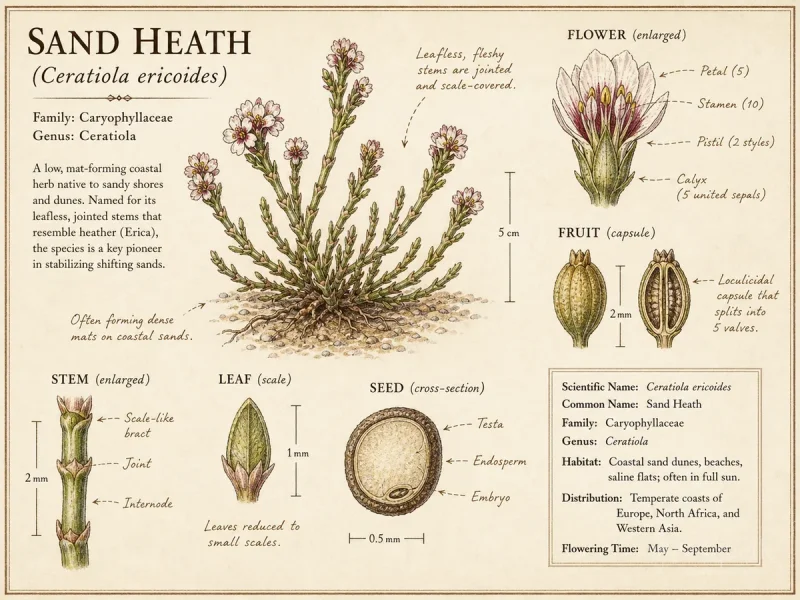
Grow Florida rosemary in full sun, on deep sand that drains, and skip extra water once the roots are in. Florida rosemary is Ceratiola ericoides, also sold as sand heath.

Give it full sun, dry sand, and room to stand 4 to 8 feet
| Factor | Recommended | Avoid |
|---|---|---|
| Light | Full sun | Do not plant it in shade |
| Water | Water a new shrub until the roots take, then skip extra water | Do not keep the sand wet |
| Soil | Deep sand that drains | Do not plant it in damp loam or a wet hole |
| Size | 4 to 8 feet tall and wide | Do not crowd the mound |
Florida rosemary wants full sun and a hole of deep sand that stays dry after rain. Water a new shrub through the first dry weeks, then ease off; an established plant takes missed water better than soggy sand. [1] Sand Heath is a dense evergreen mound about 4 to 8 feet tall and wide, with needle-like dark-green leaves that can smell faintly of rosemary when you crush them. [2] Once the roots are in, skip extra water and skip rich compost that stays wet. This is a dry sandhill shrub, not a border plant for moist loam.
How much sun does Florida rosemary need?
Give it full sun. Shade makes a thin, open mound and weakens the shrub.
How often do I water Florida rosemary?
Water a new shrub until the roots take. Then skip extra water. Wet sand around the roots is the primary cause of rot.
How big does Florida rosemary grow?
A mature mound is about 4 to 8 feet tall and about as wide. Leave that room so the shrub can fill in.
Is Florida rosemary a shrub?
Yes. It is an evergreen shrub with a rounded, densely branched mound, not a tree and not a kitchen herb.
What does Florida rosemary look like?
It is a dark-green, rounded mound with needle-like leaves. Tiny yellow-brown flowers sit in the leaf axils. Male and female flowers grow on separate plants.
Plant a nursery shrub, and do not break the thin roots
Buy a nursery plant at least a year old, in a gallon pot if you can find one. The roots are thin and break easily, so slide the root ball out and set it at the same depth it sat in the pot.
- Plant a nursery shrub that is at least one year old. Do not use a seedling younger than that. [3]
- Slide the root ball out. Do not tease or chop the thin roots.
- Set it at the same depth it sat in the pot, in deep sand that drains. Leave 4 to 8 feet so the mound can fill in.
- Water it in, then skip extra water once new growth shows. Keep it off the first dune line, where salt spray and wind hit the foliage.
How do I plant Florida rosemary without killing it?
Use a nursery shrub at least a year old. Slide the root ball out, keep the thin roots intact, and set it at the same depth it sat in the pot.
Root a softwood cutting in a coarse mix
The usual way to start a new shrub is a softwood cutting. Seed is slower. Do not root this plant in a glass of water the way kitchen rosemary is often started.
- Take a tip cutting about 3.5 inches long and strip the leaves from the bottom half inch.
- Stick it in a coarse mix that drains, such as perlite and vermiculite, or pine bark and sand.
- Keep the mix barely moist under a mist, or in a bright spot out of standing water, for 8 to 12 weeks until roots form.
- Leave the rooted cutting in the cell for several months before you move it to a larger pot, because the new roots break off easily.
Can I grow Florida rosemary from a cutting?
Yes. Take a 3.5-inch tip cutting, stick it in a coarse mix that drains, and wait 8 to 12 weeks for roots. Leave it in the cell for several months before you pot it on.
Sow seed after you nick the coat
Seed works, but it is slow. Collect the small yellow-green fruits from December through March, dry them for at least a week, then nick the seed with sandpaper so it can sprout in about six months instead of eight to twelve.
- Collect fruit from a female plant from December through March and air-dry it for at least a week.
- Nick the seed with sandpaper.
- Sow it in a pot at least 6 inches deep, in a mix that drains, and water only as needed.
- Wait. Seedlings stay tiny for a long time. Do not plant a seedling younger than one year.
Can I grow Florida rosemary from seed?
Yes, but it is slow. Collect fruit in winter, nick the seed with sandpaper, and sow it in a deep pot that drains. Wait six months or more for sprouts, then keep the seedling for at least a year before you plant it out.
Not kitchen rosemary — and not coastal rosemary
Kitchen rosemary is a Mediterranean herb grown for cooking. If the tag says rosemary, Tuscan Blue, or a potted Christmas-tree rosemary, read How to Grow Sage.
Coastal rosemary is Westringia, an Australian hedge. If the tag says coastal rosemary or Mundi, read How to Grow Coastal Rosemary. A European heath sold as sand heath is Erica; that keep-alive is How to Grow Heath.
False rosemary is Conradina, a mint-family scrub shrub with showy lavender flowers. Florida rosemary has tiny yellow-brown flowers and a dark-green mound. In Georgia scrub, a shorter gray-green shrub with pink flowers is calamint, not this plant. [4] Do not eat Florida rosemary as an herb substitute.
Is Florida rosemary the same as kitchen rosemary?
No. Florida rosemary is a native sandhill shrub. Kitchen rosemary is a cooking herb in the sage group.
Are rosemary trees native to Florida?
Kitchen rosemary is not a native Florida tree. Florida rosemary is the native sandhill shrub Ceratiola ericoides.
Is Florida rosemary edible?
No. It is an ornamental native shrub. Grow kitchen rosemary if you want leaves for cooking.
If the sand stays wet, move the shrub to a hole that drains, and skip extra water once the roots are in.
FAQ
Can I grow Florida rosemary in a pot?
A nursery gallon is how the shrub is sold, not a houseplant. Keep it outdoors in full sun, in sand that drains. Indoor rosemary in a pot is the kitchen herb.
Do I need to prune Florida rosemary?
Leave the rounded mound. Cut only dead wood. Do not shear it like kitchen rosemary.
Is there more than one kind of Florida rosemary?
Ceratiola ericoides is the plant here. Extra shop names such as sand heath and sandhill rosemary are the same shrub, not a second type.
Will Florida rosemary come back after fire?
A hot fire kills the shrub. New plants come from seed in the sand, not from the old stump.
Recommended plants
References
More first-season notes by plant are gathered in How to Grow Guides.
Updated: Reviewed by Bosquelle Editors