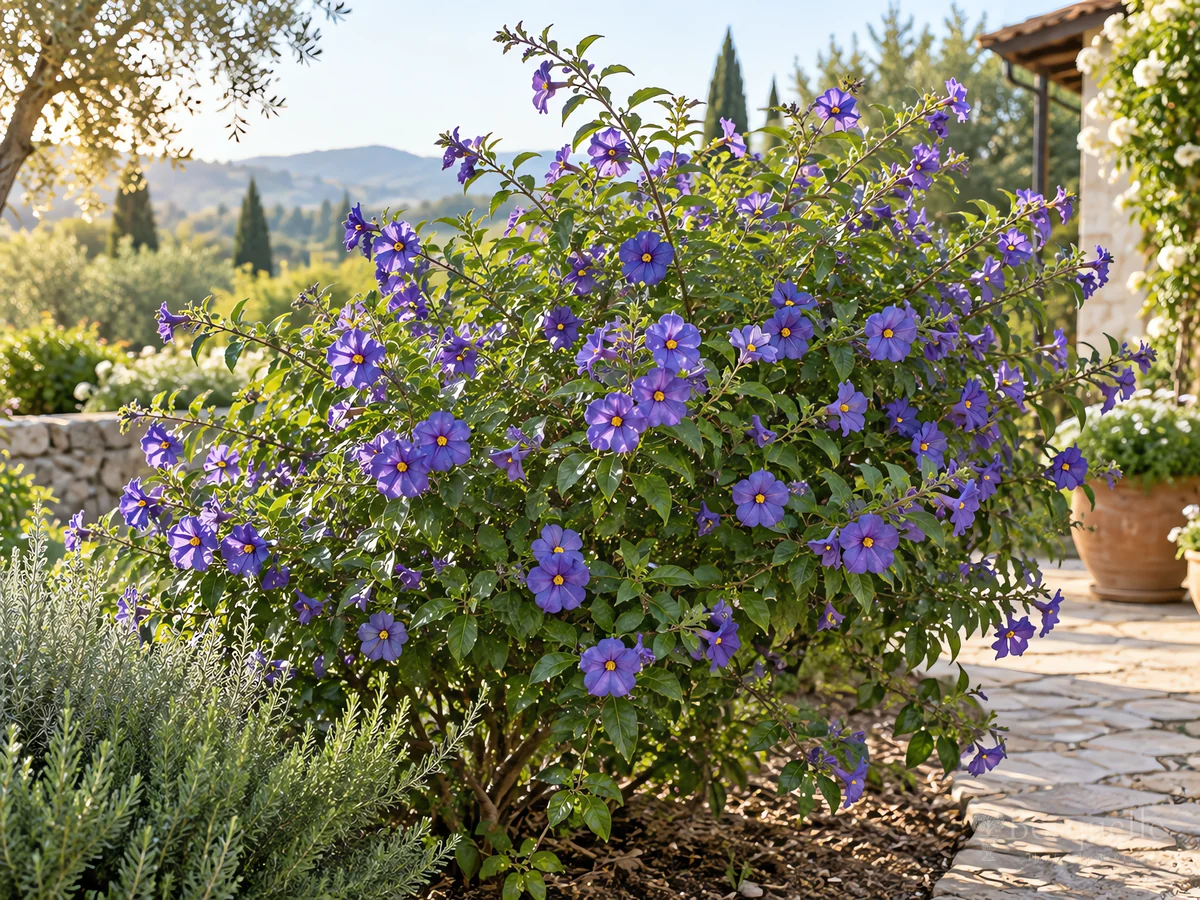
Grow blue potato bush in full sun and soil that drains, and water when the top two inches are dry. Paraguay nightshade is the same shrub. Lycianthes is the Latin. This is not a potato vine.
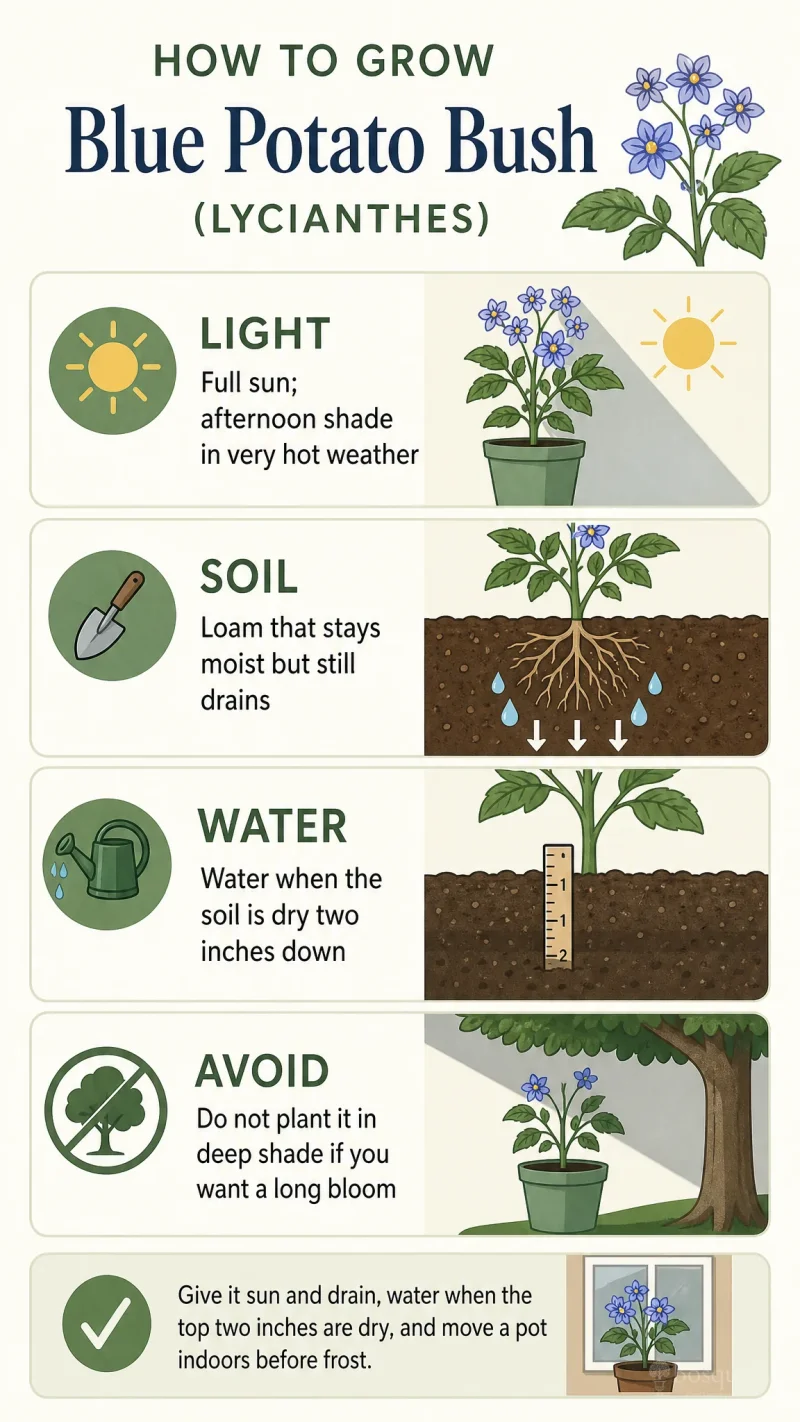
Give it full sun, soil that drains, and water when the top two inches are dry
| Factor | Recommended | Avoid |
|---|---|---|
| Light | Full sun; afternoon shade in very hot weather | Do not plant it in deep shade if you want a long bloom |
| Soil | Loam that stays moist but still drains | Do not leave the roots in a wet pocket |
| Water | Water when the soil is dry two inches down | Do not keep the soil soaked; extra water makes leaves instead of flowers |
| Feed | A complete, balanced slow-release fertilizer in the growing season | Do not pour on extra nitrogen if you want flowers, not a leafy hedge |
| Deer | Usually left alone | Do not plant it as a guaranteed deer-proof screen and walk away |
blue potato bush is a fast evergreen nightshade shrub with purple-blue funnel flowers and a yellow eye. The flowers open on new wood from spring into fall, then small red-orange berries follow. Give it full sun and loam that drains. Water when the top two inches of soil are dry. Too much irrigation, or a heavy nitrogen feed, pushes leaves at the expense of bloom. [1] A sheltered south or west wall with moist but well-drained loam is the usual outdoor site. [2]
- Choose full sun. Afternoon shade is fine where summers run very hot. Deep shade is the usual reason the bloom stays thin.
- Set it in loam that stays moist but still drains. A wet pocket around the roots is the usual cause of rot.
- Water when the soil is dry two inches below the surface. Let extra water run off. Do not keep the bed soaked.
- Feed with a complete, balanced fertilizer in spring and summer, following the label. Skip extra nitrogen if the plant is leafy and shy to flower.
Set a shrub in the ground on Planting Blue Potato Bush. Cut it back after bloom on How to Prune Blue Potato Bush. Start another plant from a cutting on How to Propagate Blue Potato Bush.
Does blue potato bush need full sun?
Full sun. Afternoon shade helps in very hot weather. Deep shade is the usual reason the bloom stays thin.
How often should I water blue potato bush?
Water when the soil is dry two inches down. Do not keep the soil soaked. Extra water makes leaves instead of flowers.
Grow it in a pot and bring it in before frost
Where frost hits, grow blue potato bush in a large pot so you can move it. A standard in a pot, or a shrub in a tub with a drainage hole, can spend summer in full sun and come indoors before a freeze. Keep the mix barely moist while it rests, and stop feeding until new growth starts. [3] Tip-prune through the season if you need a smaller plant that still fits the door. [4]
- Choose a large pot with a drainage hole. A pot on wheels is easier to move once the shrub fills out.
- Fill it with a potting mix that drains. Water when the top two inches are dry, and empty the saucer so the roots do not sit wet.
- Set the pot in full sun outdoors through the warm months. Afternoon shade helps if the leaves scorch in very hot weather.
- Bring the pot indoors before frost. Give it a bright, cool room. Keep the mix barely moist. Do not feed it until new growth starts in spring. If the room is dim, expect some leaf drop; keep watering so the root ball does not dry out completely.
Can I grow blue potato bush in a pot?
Yes. Use a large pot with a drainage hole, and bring it indoors before frost. Water when the top two inches are dry in summer, and keep the mix barely moist while it rests.
Not a potato vine — and not a sweetpotato vine
Blue potato bush is Lycianthes, a shrub you can also train as a small standard. Potato vine is Solanum laxum, a twining climber with starry white or pale flowers — that is a different plant, and it is not this guide. Sweetpotato vine is Ipomoea, grown for colored leaves in a basket — see How to Grow Sweetpotato Vine.
The name does not mean you can eat the berries. All parts can cause severe discomfort if eaten, so wear gloves when you prune and keep pets and children from chewing leaves or fruit. Yesterday-today-and-tomorrow is Brunfelsia, a different nightshade shrub — see How to Grow Yesterday-Today-and-Tomorrow. Hanging trumpets are Brugmansia — see How to Grow Angel's Trumpet. Up-facing trumpets are Datura — see How to Grow Devil's Trumpet. If the tag is not Lycianthes or Solanum rantonnetii, you do not have this plant.
Is blue potato bush the same as potato vine?
No. Blue potato bush is a shrub. Potato vine is a twining climber. Sweetpotato vine is Ipomoea, grown for its leaves.
Are the berries edible?
No. All parts can cause severe discomfort if eaten. Wear gloves when you handle it, and keep pets and children from chewing the berries.
Give it sun and drain, water when the top two inches are dry, and move a pot indoors before frost.
FAQ
Is Royal Robe a different plant?
No. Royal Robe is a shop name for this same shrub. Lynn's Variegated and Alba are also this species, not a second kind to site differently.
Why isn't it blooming?
The flowers open on new wood. If you get leaves and few flowers, the plant is usually too wet, too heavy on nitrogen, or still in too much shade. Let the top two inches dry, then water, and give it more sun.
Is it sold as Solanum rantonnetii?
Yes. That is the older name. Paraguay nightshade is the same shrub. Check that the tag is not potato vine or a sweetpotato vine.
Will deer eat it?
Deer usually leave it alone. That is not a promise they will never browse a tender shoot.
Related guides
Recommended plants

References
- [1] UC Master Gardeners of San Luis Obispo County -
https://ucanr.edu/blog/uc-master-gardeners-diggin-it-slo/article/blue-potato-bush - [2] Royal Horticultural Society -
https://www.rhs.org.uk/plants/57749/lycianthes-rantonnetii/details - [3] UC Master Gardeners of Solano County -
https://ucanr.edu/blog/under-solano-sun/article/blue-potato-bush - [4] San Marcos Growers -
https://www.smgrowers.com/products/plants/plantdisplay.asp?plant_id=1023
This note is part of Lycianthes Guides.
More first-season notes by plant are gathered in How to Grow Guides.
Updated: Reviewed by Bosquelle Editors