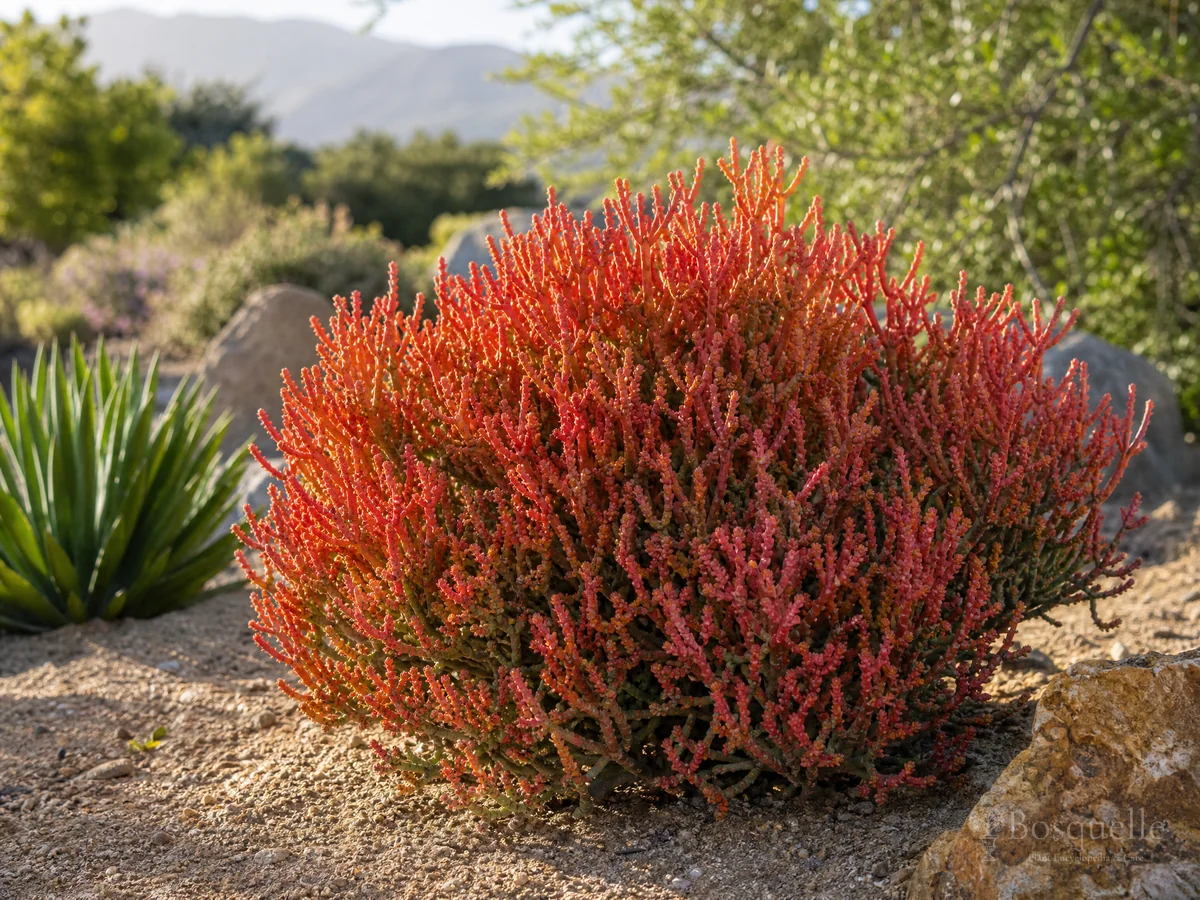
Grow Berberidopsis in part shade, in moist soil that drains, on a sheltered wall. Shops also call it coral plant or coral barberry. It is not compact coral barberry, not the Mexican coral vine, and not Jatropha coral plant.

Give it part shade, moist acidic soil, and a sheltered wall
| Factor | Recommended | Avoid |
|---|---|---|
| Light | Part shade, or a north or west wall; a little morning sun is fine | Do not bake it in hot afternoon sun |
| Soil | Moist, humus-rich soil that is acid to neutral | Do not plant it in dry chalk |
| Water | Keep the soil moist through the growing season | Do not let the roots dry out, and do not leave them in standing water |
| Support | A wall, trellis, or wires; tie the weak stems as they grow | Do not expect it to cling like ivy |
| Wind | A sheltered corner | Do not plant it on a windy, drying wall |
| Winter | Mulch the roots. If frost cuts the tops, it can resprout from the rootstock | Do not treat winter dieback as a dead plant |
Berberidopsis is Berberidopsis corallina, a Chilean evergreen climber with heart-shaped leaves and hanging coral-red flowers in late summer. Site it in part shade, in moist acidic soil that drains, on a wall out of drying wind. A north or west face is the usual home. [1] Lime-free soil holds the leaves better than dry chalk. Water so the soil stays moist the first seasons. [2]
How much sun does Berberidopsis need?
Part shade, or a north or west wall. A little morning sun is fine. Hot afternoon sun and wind dry the leaves.
Does it come back after a freeze?
Mulch the roots. If frost cuts the tops, wait for new shoots from the rootstock before you dig it out.
Plant it at the same depth, on a north or west wall
Plant a container plant after the last frost, against a north or west wall you can reach. Set the crown at the old soil line, and have the support in place before you plant. The stems twine weakly, so tie them as they grow. [3]
- Wait until after the last frost.
- Choose a north or west wall out of drying wind.
- Dig a hole as deep as the pot and a little wider.
- Set the crown at the old soil line. Do not bury the stems.
- Water so the soil stays moist, then mulch the roots.
- Tie the new stems to the wall, trellis, or wires as they lengthen.
When do I plant Berberidopsis?
After the last frost, at the old soil line, on a sheltered north or west wall.
Prune after frost, and do not cut it hard
This climber needs little pruning. After frost has passed in spring, cut out dead or weak stems at the base and tie in what remains. Do not cut the plant hard. Old wood does not sprout well after a heavy cut.
- Wait until frost has passed in spring.
- Cut dead or weak stems at the base.
- Tie the remaining stems back to the support.
- Do not cut the plant hard to the ground as routine care.
When do I prune Berberidopsis?
After frost in spring, cut only dead or weak stems. Do not cut it hard.
Root a cutting, or pin a stem so it roots
Start another plant from a half-ripe stem in mid to late summer, or pin a low stem so it roots. Seed is slow and often fails, so a cutting or a layered stem is the usual way.
- In mid to late summer, take a half-ripe stem about three to four inches long.
- Leave two leaves at the tip, and cut those leaves in half.
- Push the cutting into moist mix that drains, in a shady pot or frame.
- Keep the mix moist until roots form.
- Or pin a low stem to the soil so it roots, then cut it free.
Can I grow it from seed?
You can, but germination is slow and often poor. A summer cutting or a pinned stem is the usual start.
Not barberry — and not Mexican coral vine
Compact coral barberry is a dwarf Berberis shrub about eighteen inches tall. It wants sun, has yellow-orange spring flowers, and carries spines. See How to Grow Barberry if that is the plant on the tag. [4] This plant is a Chilean evergreen climber with hanging coral-red flowers, not a hedge barberry.
Mexican coral vine is Antigonon, a fast full-sun tendril vine. See How to Grow Coral Vine if the tag says queen's wreath or Mexican creeper. Coral bells are Heuchera. See How to Grow Coral Bells. Coral tree is Erythrina. See How to Grow Coral Tree.
Jatropha coral plant is a tropical shrub with deeply lobed leaves and poisonous sap. Coral cactus is a succulent. If the tag says coralberry or snowberry, see How to Grow Snowberry.
Is this the same as barberry?
No. Compact coral barberry is a small sun shrub with spines. This plant is a shade climber from Chile.
Is this the Mexican coral vine?
No. Mexican coral vine is Antigonon, a full-sun tendril vine. This plant wants part shade and a cool, moist wall.
Set it on a sheltered north or west wall, keep the soil moist, and prune only the dead wood after frost.
FAQ
Can I grow it in a pot?
A large pot with a drainage hole and a trellis can hold a young plant. It is not a houseplant. Most gardeners plant it in the ground against a sheltered wall.
What about Berberidopsis beckleri?
That is an Australian evergreen climber with the same shade, moist soil, and sheltered wall. The Chilean coral plant is Berberidopsis corallina.
Can I harvest the stems?
People in Chile use the flexible stems for baskets. This is an ornamental climber, not a harvest crop.
Is it poisonous?
There is no reliable U.S. poison listing for this climber. Compact coral barberry is a different, spiny shrub. Keep pets from chewing any ornamental they are not known to eat.
Recommended plants

References
- [1] Royal Horticultural Society -
https://www.rhs.org.uk/plants/2075/berberidopsis-corallina/details - [2] Gardenia.net -
https://www.gardenia.net/plant/berberidopsis-corallina - [3] Useful Temperate Plants -
https://temperate.theferns.info/plant/Berberidopsis+corallina - [4] NC State Extension -
https://plants.ces.ncsu.edu/plants/berberis-x-stenophylla-corallina-compacta/
More first-season notes by plant are gathered in How to Grow Guides.
Updated: Reviewed by Bosquelle Editors