
Grow bellwort in part shade to full shade and moist, humus-rich woodland soil that still drains. Bellwort is Uvularia grandiflora, also called merrybells — an eastern woodland wildflower, not the annual cornflower.

Give it part shade, moist woodland soil, and a leaf mulch
| Factor | Recommended | Avoid |
|---|---|---|
| Light | Part shade to full shade under deciduous trees, with spring light before the canopy closes | Do not plant it in hot midday sun, which scorches the leaves |
| Soil | Moist, humus-rich woodland soil that still drains, with leaf mold worked in | Do not plant it in a soggy low spot, which rots the rhizome |
| Water | Keep the soil evenly moist through spring, and water in a dry spell while the leaves are up | Do not let the bed bake dry in the first summers, and do not leave it standing in water |
| Mulch | A loose layer of shredded leaves, or pine needles, to keep the roots cool | Do not strip the leaf litter, and do not feed it richly |
Bellwort is a woodland perennial from a short rhizome. Sit it under deciduous trees so it gets light in early spring and shade once the canopy closes. It will take occasional dry spells once it is established, but it is still a moist-woods plant, not a gravel-bed drought shrub. [1] Keep the soil evenly moist while the leaves are up. Dry ground in heat is the usual reason the clump wilts early; a soggy low spot is what rots the rhizome. A thin layer of shredded leaves or pine needles holds that moisture and keeps the roots cool, which is the same litter the plant grows in on the forest floor. [2] Water it in a dry spell the first spring, then leave the mulch in place. Established clumps tolerate a missed watering better than a week in standing water.
How much shade does bellwort need?
Part shade to full shade, ideally under deciduous trees. It uses the spring light before the leaves come out, then needs shade through summer heat.
Plant in spring or fall, at the same depth it grew
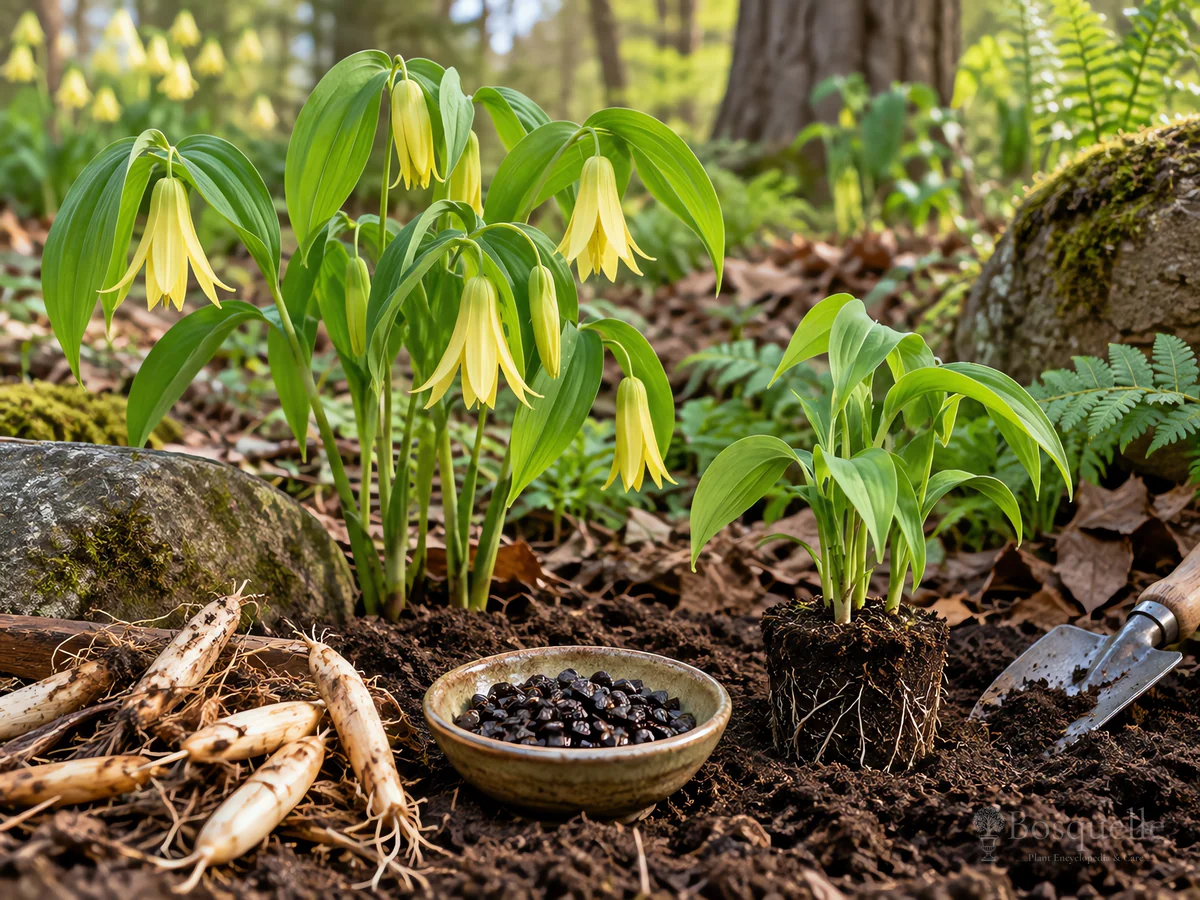
Set a nursery clump in early spring or in fall, in a shady, moist bed you will not need to move later. Slide it out of the pot and plant it at the same depth it grew, with the crown just at the soil. Space clumps about 12 to 18 inches apart so the arching stems can fill without crowding. [3] Firm the backfill so there are no air pockets, water it in the same day, and keep the soil evenly moist while it settles. A moved clump may sit still for a year or two before it blooms well. Do not dig plants from the woods.
- Pick a shady, moist woodland bed you will not need to move later.
- Plant in early spring or in fall, at the same depth the clump grew in the pot, with the crown just at the soil.
- Space plants about 12 to 18 inches apart, then firm the soil so there are no air pockets around the rhizome.
- Water thoroughly the same day, mulch with leaves, and keep the soil evenly moist while the clump settles.
How do I plant a nursery bellwort?
Plant it in early spring or in fall, at the same depth it grew in the pot. Space clumps about 12 to 18 inches apart, water the same day, and keep the soil moist while it settles.
The yellow bells last a couple of weeks; the leaves stay through summer
Bellwort opens nodding yellow bells in April or May, about an inch and a half long, with six twisted tepals. Each stem usually carries one flower on a fork, and the show lasts about two weeks. The plant looks droopy at bloom, as if the leaves had wilted; after the flowers fade, the stems straighten and the perfoliate leaves — the blade wraps the stem — hold through summer. [4] Do not cut those leaves while they are green. The plant is storing food in the rhizome for next spring. When the flowers fade, a three-lobed capsule takes their place. To raise plants from that seed, see Growing Bellwort From Seed.
Plant it with other woodland neighbors that share shade and moist humus, such as How to Grow Trillium, How to Grow Wild Ginger, and How to Grow Hostas, and keep aggressive spreaders off the clump.
When does bellwort bloom?
In mid-spring, from April into May. The yellow bells last about two weeks, then the leaves stay up through summer.
Not Solomon's seal — and not fairy bells or annual cornflower
After bloom, bellwort can look like Solomon's seal until you check the flowers and the leaf base. Solomon's seal hangs several greenish-white bells from the leaf axils along an unbranched arching stem. Bellwort forks, carries a yellow bell at the end of a branch, and the leaf wraps the stem. If the tag is Solomon's seal, see How to Grow Solomon's Seal.
Fairy bells are Disporum, usually sold as an Asian woodland plant with bells along or at the end of the stem — see How to Grow Fairy Bells if that is the shop name. False Solomon's seal holds a terminal plume of small white flowers, not a single yellow bell — see How to Grow False Lily of the Valley. Yellow mandarin is Prosartes, a more branched woodland plant we do not list here.
Catalog tags that say cornflower are this same bellwort as an old folk name, not the sun annual with fringed blue heads — see How to Grow Cornflower if the plant wants full sun and looks like a daisy. Wood daffodil is another old nickname, not a trumpet bulb — see How to Grow Daffodils. Morton and some tags also say large bellflower; those upright cups are Campanula — see How to Grow Bellflowers.
Is bellwort the same as Solomon's seal?
No. Solomon's seal hangs several pale bells along an unbranched stem. Bellwort forks, opens a yellow bell, and the leaf wraps the stem.
If the leaves wilt in June, the soil probably dried out or the sun was too hot. Put the next plants in shade with a leaf mulch, and keep the soil evenly moist while the leaves are up.
FAQ
Is there more than one kind of bellwort?
Uvularia grandiflora is the plant here, the shop species. Woods also hold perfoliate bellwort and sessile bellwort, which want the same moist shade; we do not list those as separate kinds.
Can I grow it in a pot?
A deep pot of moist, humus-rich mix in shade can hold a clump, but this is a woodland plant, not a houseplant. Keep the mix evenly moist while the leaves are up, and do not let the pot sit in a saucer of water.
Will it come back after winter?
Yes, from the rhizome, as long as the soil stays moist and drained in spring. A thin leaf mulch through winter is enough; you do not lift it. The top dies back in fall after a full summer of leaves, and that is normal.
Is bellwort deer-resistant?
We do not list it as deer-resistant. Site the clump where you can see the spring growth, and keep a mulch on the bed.
Related guides
Recommended plants

References
- [1] NC State Extension -
https://plants.ces.ncsu.edu/plants/uvularia-grandiflora/ - [2] Lady Bird Johnson Wildflower Center -
https://www.wildflower.org/plants/result.php?id_plant=UVGR - [3] Wisconsin Horticulture -
https://hort.extension.wisc.edu/articles/bellwort-uvularia-grandiflora/ - [4] The Morton Arboretum -
https://mortonarb.org/plant-and-protect/trees-and-plants/bellwort/
This note is part of Uvularia Guides.
More first-season notes by plant are gathered in How to Grow Guides.
Updated: Reviewed by Bosquelle Editors