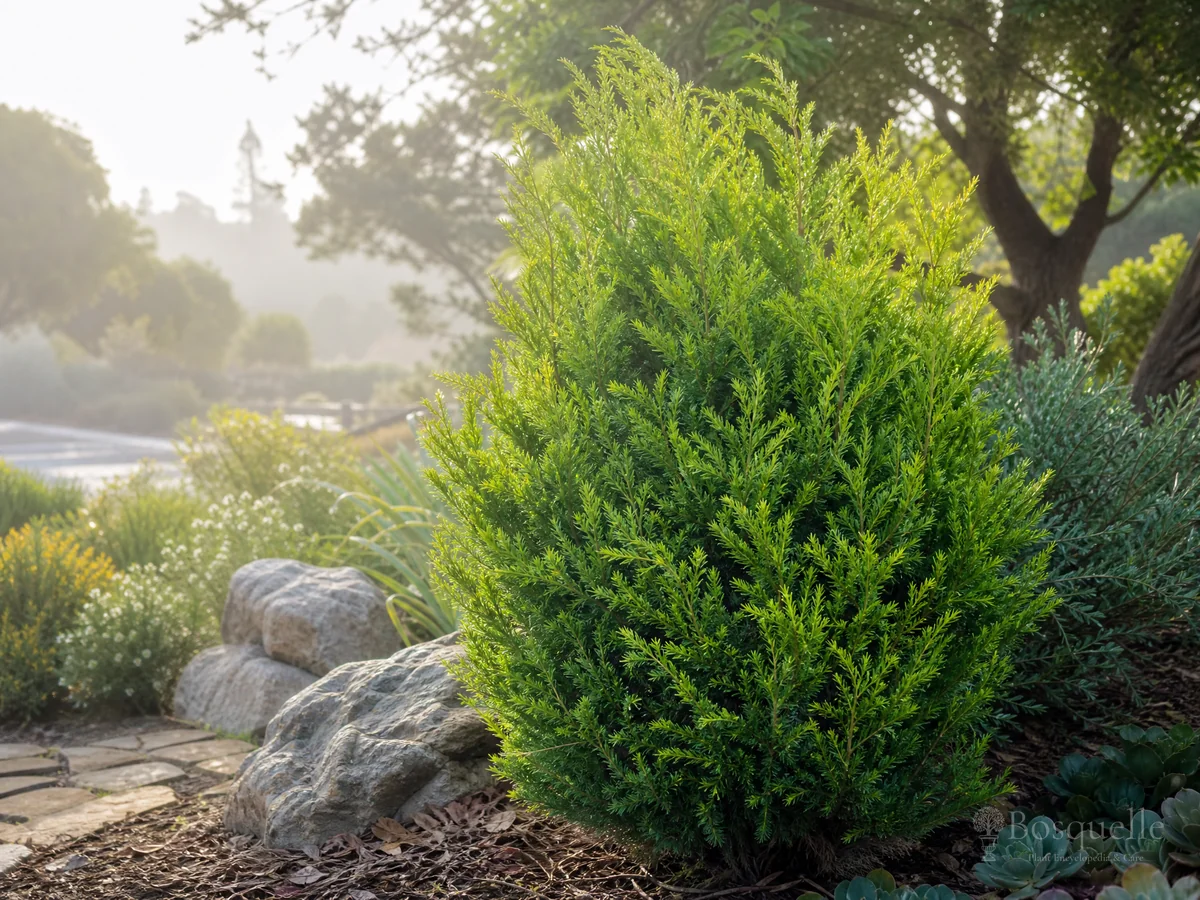
Grow bay cedar in full sun, in sand that drains, with salt spray just back of the tide. Bay cedar is Suriana. It is not a cooking bay, and it is not a true cedar.
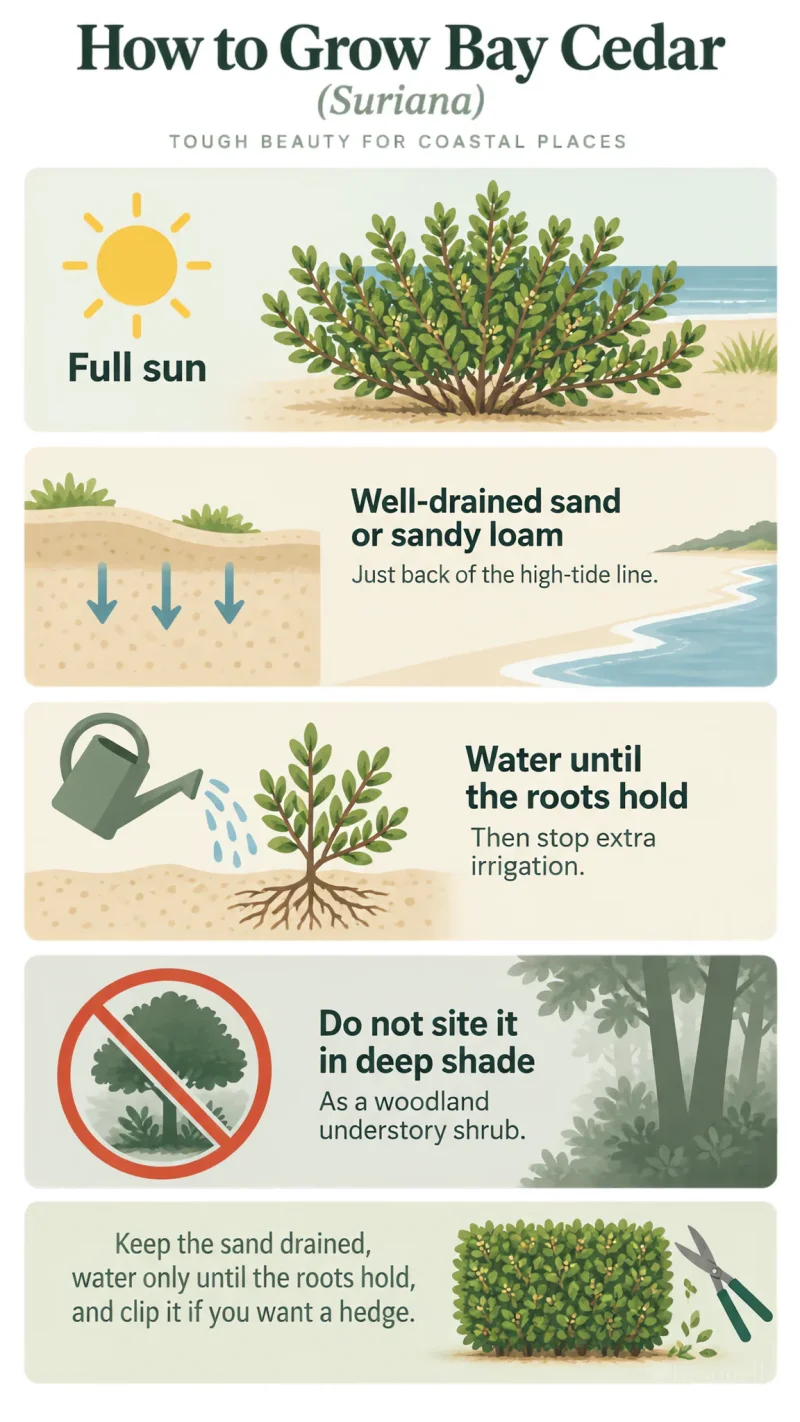
Give it full sun, sand that drains, and salt spray
| Factor | Recommended | Avoid |
|---|---|---|
| Light | Full sun | Do not site it in deep shade as a woodland understory shrub |
| Soil | Well-drained sand or sandy loam, just back of the high-tide line | Do not plant it in a bog, or in standing salt water like a mangrove |
| Water | Water until the roots hold, then stop extra irrigation | Do not keep the root zone wet after it is established |
| Salt | Salt spray and salty soil | Do not flood it with standing brackish water |
| Kind | Bay cedar for a coastal hedge, screen, or specimen | Do not buy a bay laurel for cooking leaves, or a true cedar for inland timber |
bay cedar is an evergreen coastal shrub with tiny gray-green fleshy leaves on short upturned twigs, and small yellow flowers through the year. Site it in full sun on sand that drains, where salt spray and wind hit a dune or a rocky shore just back of the high-tide line. [1] A new plant needs water until the roots hold. After that, stop extra irrigation, because this shrub is built for long dry spells in that sand. Salt in the air and the soil is fine. Standing brackish water is the wrong site, so keep it on the dry side of the tide line. [2] It usually stands about 6 to 10 feet, and old plants can reach about 20 feet, so give it room as a hedge or a small specimen, not a windowsill bowl. [3]
How much sun does bay cedar need?
Give it full sun. Deep shade as a woodland understory shrub is the wrong site.
How often do I water bay cedar?
Water until the roots hold, then stop extra irrigation. Keeping the root zone wet after it is established is how the plant rots.
Will it take salt spray?
Yes. Salt spray and salty soil are fine. Standing brackish water like a mangrove fringe is not.
Clip it as a hedge, or train it as a small tree
Bay cedar takes clipping, so it works as a coastal hedge. If you want a small tree instead, leave a few trunks and lift the lower twigs as they lengthen.
- Decide hedge or small tree before you cut, because the first cuts set the shape.
- For a hedge, clip new growth as the row fills so the screen stays dense.
- For a small tree, keep a few sturdy trunks and cut the lowest twigs as they lengthen.
- Do not strip the plant of all its leaves in one pass.
Do I clip bay cedar?
Clip it if you bought it for a hedge. Leave a few trunks and lift the lower twigs if you want a small tree.
Plant it in well-drained sand, 5 to 6 feet apart for a screen
Set a nursery plant in well-drained sand, at the same depth it grew in the pot. Space a screen 5 to 6 feet apart so the row can close without crowding.
- Buy a nursery plant with a solid root mass when you can. Native-plant nurseries along the coast are the usual source.
- Plant any month on frost-free coastal ground. If your winter still freezes, wait until after the last frost.
- Dig in sand that drains. Skip a low wet pocket and skip a hole that holds water after rain.
- Set the plant at the same depth it grew in the pot, and backfill with the sand you removed.
- Space a screen 5 to 6 feet apart. A tighter mass planting can sit about 3 to 5 feet apart.
- Water until new growth stiffens, then stop extra irrigation.
When do I plant bay cedar?
Plant any month on frost-free coastal ground. If your winter still freezes, wait until after the last frost.
How far apart do I plant it?
Space a screen 5 to 6 feet apart. A tighter mass planting can sit about 3 to 5 feet apart.
Take the seed from a dry five-pointed calyx and scarify it
Shops start bay cedar from seed. Collect the small brown five-pointed calyx when it is dry, pick out the seeds, and nick or sand the coat. Soaking the seed, or chilling it in a refrigerator, cuts germination. [4]
- Collect dry brown calyxes from the plant. Skip green or moldy fruit.
- Pick the seeds out by hand.
- Scarify the coat with sandpaper or a light nick. Do not soak the seed, and do not put it in the refrigerator.
- Sow in a mix that drains, barely covered, and keep that mix moist and warm until sprouts show.
- Move seedlings to their own pots when they have a few true leaves, then water less so they harden before they go in the ground.
How do I start bay cedar from seed?
Take the seed from a dry five-pointed calyx, scarify the coat, and sow it in mix that drains. Keep the mix moist until it sprouts. Do not soak the seed.
Not a bay laurel — and not a true cedar
Bay laurel is Laurus, the cooking-bay shrub with leathery aromatic leaves — see How to Grow Bay Laurel. True cedar is Cedrus, an inland conifer — see How to Grow Cedar. Eastern red cedar is a juniper, not this dune shrub — see How to Grow Juniper. Buttonwood is Conocarpus, a larger coastal hedge with button-like fruit — see How to Grow Buttonwood. Seagrape is Coccoloba, with round leaves the size of a hand — see How to Grow Seagrape. Suriana is one species.
Is this bay laurel?
No. Bay cedar has tiny fleshy gray-green leaves and small yellow flowers. Bay laurel is the cooking-bay shrub with leathery aromatic leaves.
Is this a true cedar?
No. Bay cedar is a flowering coastal shrub. True cedar is an inland conifer, and eastern red cedar is a juniper.
Keep the sand drained, water only until the roots hold, and clip it if you want a hedge.
FAQ
Can I keep it as a houseplant all year?
No. A patio pot in full sun with mix that drains can hold a small specimen, but a dim indoor room is the wrong site for this coastal shrub.
Does it come back after a freeze?
A freeze can kill the top. Do not treat it as a plant you lift and store for a cold winter. Site it where frost is rare.
Can I start it from a stem cutting?
Start it from seed. There is no home cutting method worth following for this shrub.
Is Suriana more than one plant?
No. Bay cedar is one species. Extra shop names are the same plant, not a second kind to choose.
Does it feed butterflies?
Yes. It is a host plant for martial scrub-hairstreak and mallow scrub-hairstreak, and the flowers give nectar.
Recommended plants

References
- [1] UF/IFAS Extension -
https://ask.ifas.ufl.edu/publication/FP565 - [2] Florida Native Plant Society -
https://www.fnps.org/plant/suriana-maritima - [3] Institute for Regional Conservation -
https://www.regionalconservation.org/beta/nfyn/plantdetail.asp?tx=Surimari - [4] Naples Botanical Garden -
https://www.naplesgarden.org/writing-an-instruction-manual-for-coastal-plants/
More first-season notes by plant are gathered in How to Grow Guides.
Updated: Reviewed by Bosquelle Editors